Yan Qiufan, Li Xiaoyang, Ma Baohua, Zou Yongde, Wang Yan, Liao Xindi, Liang Junboo, Mi Jiandui, Wu Yinbao
College of Animal Science, National Engineering Research Center for Breeding Swine Industry, South China Agricultural University, Guangzhou, China.
Nanhai Entry-Exit Inspection and Quarantine Bureau, Foshan, China.
Front Microbiol. 2018 Dec 19;9:3129. doi: 10.3389/fmicb.2018.03129. eCollection 2018.
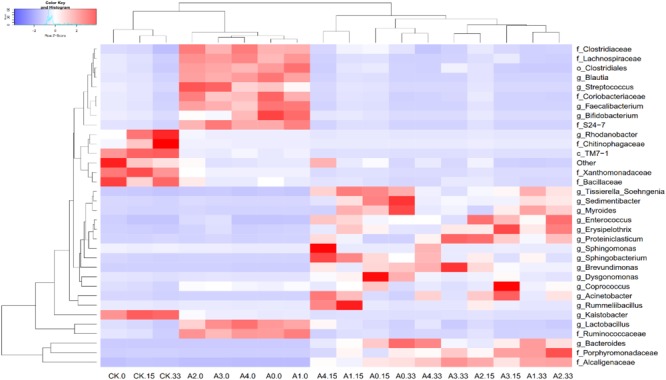
Antibiotic residues that enter the soil through swine manure could disturb the number, community structure and functions of microbiota which could also degrade antibiotics in soil. Five different concentrations of doxycycline (DOX) incorporated into swine manure were added to soil to explore the effects of DOX on microbiota in soil and degradation itself. The results showed that the soil microbiome evolved an adaptation to the soil containing DOX by generating resistance genes. Moreover, some of the organisms within the soil microbiome played crucial roles in the degradation of DOX. The average degradation half-life of DOX in non-sterile groups was 13.85 ± 0.45 days, which was significantly shorter than the 29.26 ± 0.98 days in the group with sterilized soil ( < 0.01), indicating that the soil microbiome promoted DOX degradation. DOX addition affected the number of tetracycline resistance genes, depending on the type of gene and the DOX concentration. Among these genes, A, M, W, and X had significantly higher copy numbers when the concentration of DOX was higher. In contrast, a lower concentration of DOX had an inhibitory effect on G. At the same time, the microbial compositions were affected by the initial concentration of DOX and the different experimental periods. The soil chemical indicators also affected the microbial diversity changes, mainly because some microorganisms could survive in adversity and become dominant bacterial groups, such as the genera and (which were associated with electrical conductivity) and spp. (which were positively correlated with pH). Our study mainly revealed soil microbiota and DOX degradation answered differently under variable concentrations of DOX mixed with swine manure in soil.
通过猪粪进入土壤的抗生素残留可能会干扰微生物群的数量、群落结构和功能,而微生物群也能降解土壤中的抗生素。将五种不同浓度的强力霉素(DOX)掺入猪粪后添加到土壤中,以探究DOX对土壤微生物群及其自身降解的影响。结果表明,土壤微生物群通过产生抗性基因进化出对含DOX土壤的适应性。此外,土壤微生物群中的一些生物体在DOX降解中起关键作用。非无菌组中DOX的平均降解半衰期为13.85±0.45天,显著短于无菌土壤组的29.26±0.98天(P<0.01),表明土壤微生物群促进了DOX的降解。添加DOX会影响四环素抗性基因的数量,这取决于基因类型和DOX浓度。在这些基因中,当DOX浓度较高时,A、M、W和X的拷贝数显著更高。相比之下,较低浓度的DOX对G有抑制作用。同时,微生物组成受DOX初始浓度和不同实验时期的影响。土壤化学指标也影响微生物多样性变化,主要是因为一些微生物能够在逆境中生存并成为优势细菌类群,如与电导率相关的属和与pH呈正相关的 spp。我们的研究主要揭示了在土壤中不同浓度的DOX与猪粪混合的情况下,土壤微生物群和DOX降解的反应不同。