Department of Pathology, Microbiology and Immunology, School of Medicine, University of South Carolina, Columbia, SC, United States.
Environmental Health and Disease Laboratory, Department of Environmental Health Sciences, Arnold School of Public Health, University of South Carolina, Columbia, SC, United States.
Front Immunol. 2018 Dec 20;9:2992. doi: 10.3389/fimmu.2018.02992. eCollection 2018.
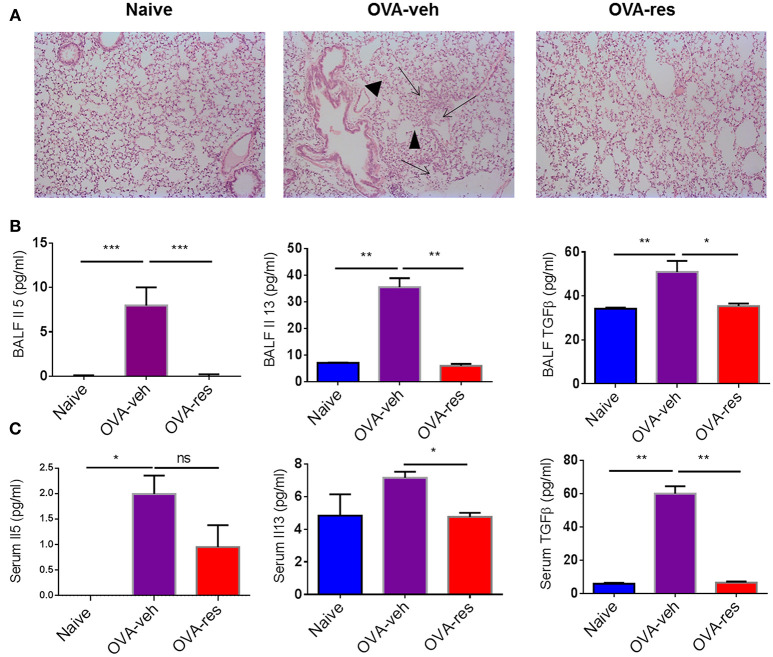
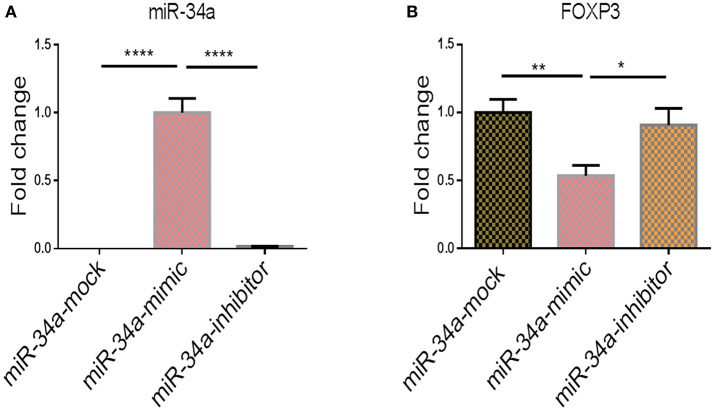
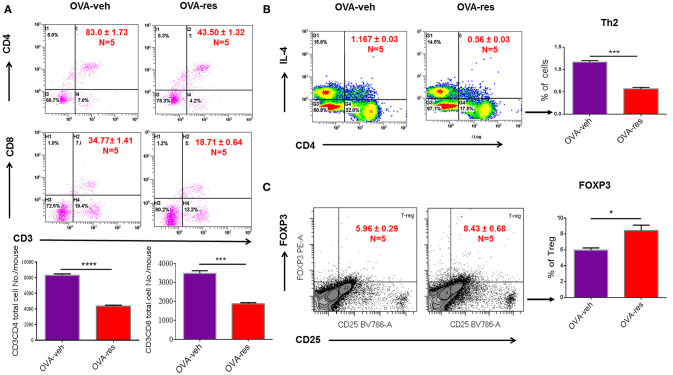
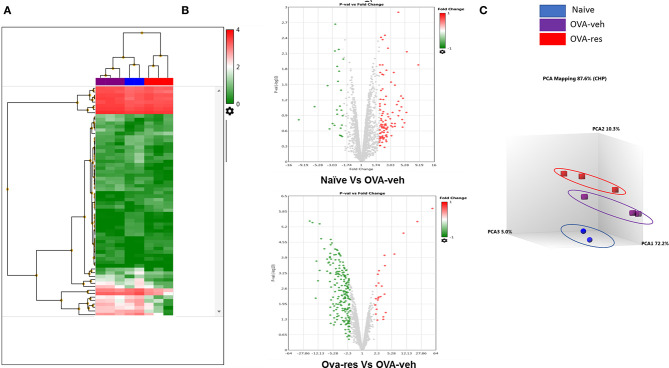
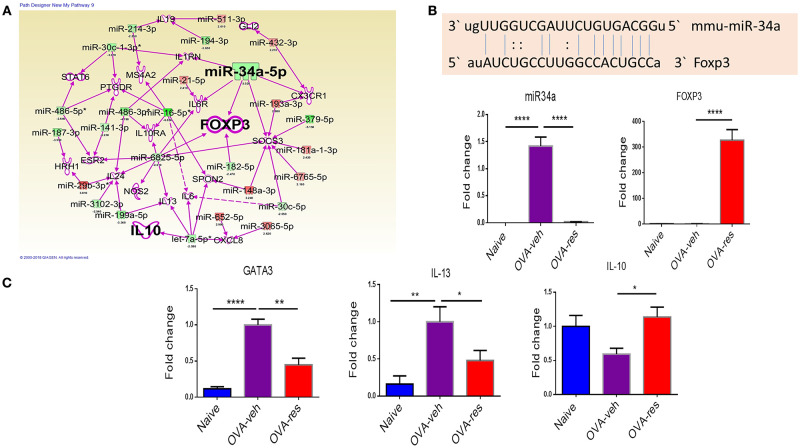
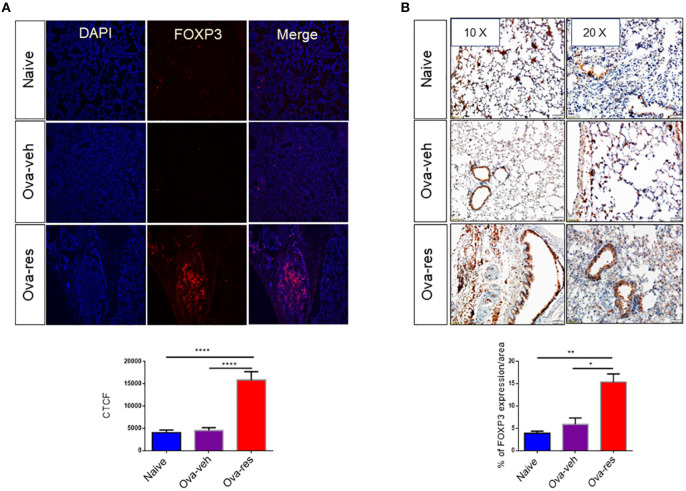
Asthma is a chronic inflammatory disease of airways mediated by T-helper 2 (Th2) cells involving complex signaling pathways. Although resveratrol has previously been shown to attenuate allergic asthma, the role of miRNA in this process has not been studied. We investigated the effect of resveratrol on ovalbumin-induced experimental allergic asthma in mice. To that end, BALB/c mice were immunized with ovalbumin (OVA) intraperitoneally followed by oral gavage of vehicle (OVA-veh) or resveratrol (100 mg/kg body) (OVA-res). On day 7, the experimental groups received intranasal challenge of OVA followed by 7 days of additional oral gavage of vehicle or resveratrol. At day 15, all mice were euthanized and bronchioalveolar fluid (BALF), serum and lung infiltrating cells were collected and analyzed. The data showed that resveratrol significantly reduced IL-5, IL-13, and TGF-β in the serum and BALF in mice with OVA-induced asthma. Also, we saw a decrease in CD3+CD4+, CD3+CD8+, and CD4+IL-4+ cells with increase in CD4+CD25+FOXP3+ cells in pulmonary inflammatory cell infiltrate in OVA-res group when compared to OVA-veh. miRNA expression arrays using lung infiltrating cells showed that resveratrol caused significant alterations in miRNA expression, specifically downregulating the expression of miR-34a. Additionally, miR-34a was found to target , as evidenced by enhanced expression of in the lung tissue. Also, transfection studies showed that miR-34a inhibitor upregulated expression while miR-34a-mimic downregulated expression. The current study suggests that resveratrol attenuates allergic asthma by downregulating miR-34a that induces increased expression of , a master regulator of Treg development and functions.
哮喘是一种由 Th2 细胞介导的气道慢性炎症性疾病,涉及复杂的信号通路。尽管白藜芦醇先前已被证明可减轻过敏性哮喘,但 miRNA 在这一过程中的作用尚未得到研究。我们研究了白藜芦醇对卵清蛋白(OVA)诱导的实验性过敏性哮喘小鼠的影响。为此,BALB/c 小鼠经腹腔注射 OVA 免疫,然后口服给予载体(OVA-veh)或白藜芦醇(100mg/kg 体重)(OVA-res)。在第 7 天,实验组接受 OVA 鼻腔挑战,然后再接受 7 天的载体或白藜芦醇口服灌胃。在第 15 天,所有小鼠被安乐死,收集支气管肺泡灌洗液(BALF)、血清和肺浸润细胞并进行分析。数据显示,白藜芦醇显著降低了 OVA 诱导哮喘小鼠血清和 BALF 中的 IL-5、IL-13 和 TGF-β。此外,与 OVA-veh 相比,OVA-res 组肺炎症细胞浸润中 CD3+CD4+、CD3+CD8+和 CD4+IL-4+细胞减少,CD4+CD25+FOXP3+细胞增加。用肺浸润细胞进行 miRNA 表达谱分析显示,白藜芦醇导致 miRNA 表达显著改变,特别是 miR-34a 的表达下调。此外,miR-34a 被发现靶向 ,因为肺组织中 的表达增强。此外,转染研究表明,miR-34a 抑制剂上调 表达,而 miR-34a 模拟物下调 表达。本研究表明,白藜芦醇通过下调 miR-34a 减轻过敏性哮喘,miR-34a 诱导 Treg 发育和功能的主调节因子 的表达增加。