El Shahawy Mohamed S, Hemida Mahmoud H, El Metwaly Ibrahim, Shady Zakarya M
Department of Internal Medicine, Gastroenterology Unit, Faculty of Medicine AL-Azhar University Cairo Egypt.
Department of Internal Medicine, Immunology Unit, Faculty of Medicine AL-Azhar University Cairo Egypt.
JGH Open. 2018 Aug 2;2(6):270-275. doi: 10.1002/jgh3.12081. eCollection 2018 Dec.
BACKGROUND/AIM: Many studies have investigated risk factors other than antibiotic resistance linked to () eradication failure. The aim of this study was to study the effect of serum levels of 25-hydroxy-vitamin D (25[OH]D) on eradication rates of infection.
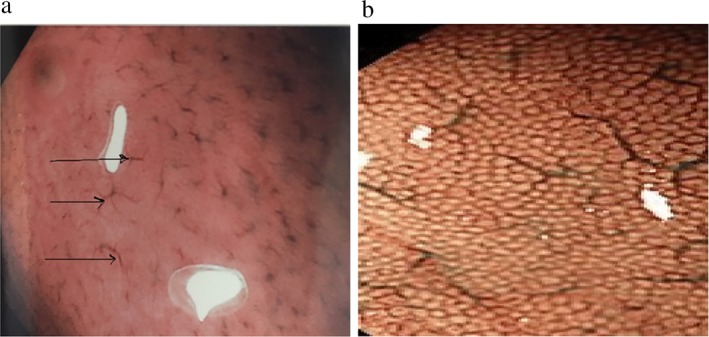
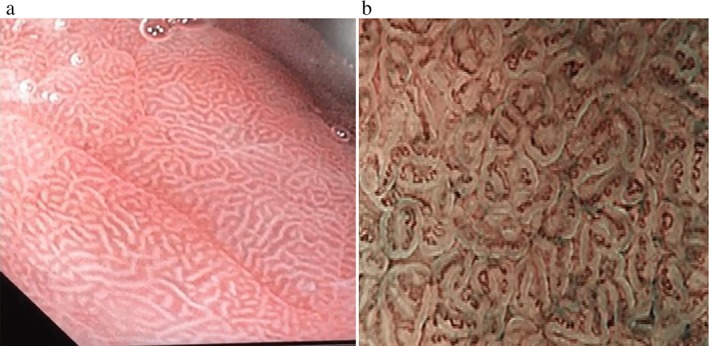
This study included 150 patients diagnosed with gastritis using magnifying narrow-band imaging endoscopy supported by stool antigen test. Serum 25-OH vitamin D levels were measured via the Enzyme-Linked Immune Sorbent assay (ELISA) method before starting eradication therapy of infection. All patients were treated with clarithromycin-based triple therapy for 14 days. eradication was determined via a stool antigen test performed 4 weeks after the end of therapy. According to the serum level of 25-OH vitamin D levels, the patients were divided into two groups: group I (sufficient) had a vitamin D level of ≥20 ng/mL, while group II (deficient) had a vitamin D level of <20 ng/mL.
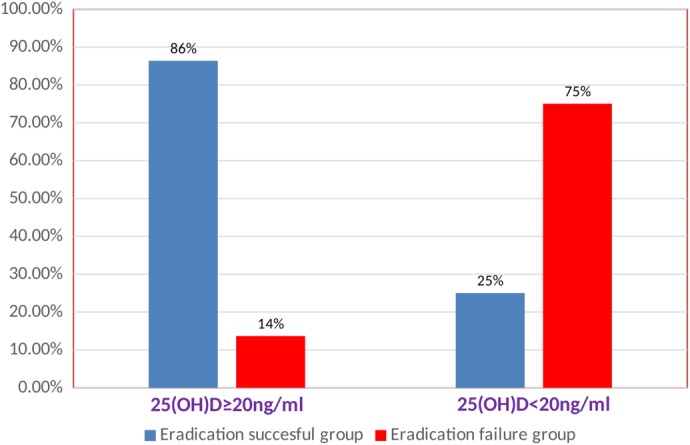
Our results revealed that eradication was successful in 105 (70%) patients and failed in 45 (30%) patients. The mean 25[OH]D level was significantly lower in the eradication failure group compared to the successful treatment group (14.7 ± 4.5 27.41 ± 7.1; < 0.001). Furthermore, there were significantly more patients with deficient 25[OH]D levels in the failed treatment group, 30 (66.6%), compared to the successful group, 10 (9.5%) ( < 0.001).
Our results demonstrated that 25-OH vitamin D deficiency may be considered a risk factor related to eradication failure of infection. In addition, a further randomized trial to evaluate the effect of vitamin D supplementation in H. pylori eradication is mandatory.
背景/目的:许多研究调查了与(幽门螺杆菌)根除失败相关的抗生素耐药性以外的危险因素。本研究的目的是探讨血清25-羟基维生素D(25[OH]D)水平对幽门螺杆菌感染根除率的影响。
本研究纳入了150例经粪便抗原检测支持的放大窄带成像内镜诊断为幽门螺杆菌胃炎的患者。在开始幽门螺杆菌感染根除治疗前,通过酶联免疫吸附测定(ELISA)法测定血清25-OH维生素D水平。所有患者接受以克拉霉素为基础的三联疗法治疗14天。在治疗结束4周后通过粪便抗原检测确定幽门螺杆菌根除情况。根据血清25-OH维生素D水平,将患者分为两组:I组(充足)维生素D水平≥20 ng/mL,而II组(缺乏)维生素D水平<20 ng/mL。
我们的结果显示,105例(70%)患者根除成功,45例(30%)患者根除失败。根除失败组的平均25[OH]D水平显著低于成功治疗组(14.7±4.5对27.41±7.1;P<0.001)。此外,与成功组的10例(9.5%)相比,失败治疗组中25[OH]D水平缺乏的患者明显更多,为30例(66.6%)(P<0.001)。
我们的结果表明,25-OH维生素D缺乏可能被视为与幽门螺杆菌感染根除失败相关的危险因素。此外,必须进行进一步的随机试验来评估补充维生素D对幽门螺杆菌根除的影响。