Departamento de Microbiologia, Universidade Federal de Viçosa, Viçosa, Minas Gerais, Brazil.
Colegiado de Engenharia Agronômica, Universidade Federal do Vale do São Francisco, Petrolina, Pernambuco, Brazil.
PLoS One. 2019 Jan 8;14(1):e0209093. doi: 10.1371/journal.pone.0209093. eCollection 2019.
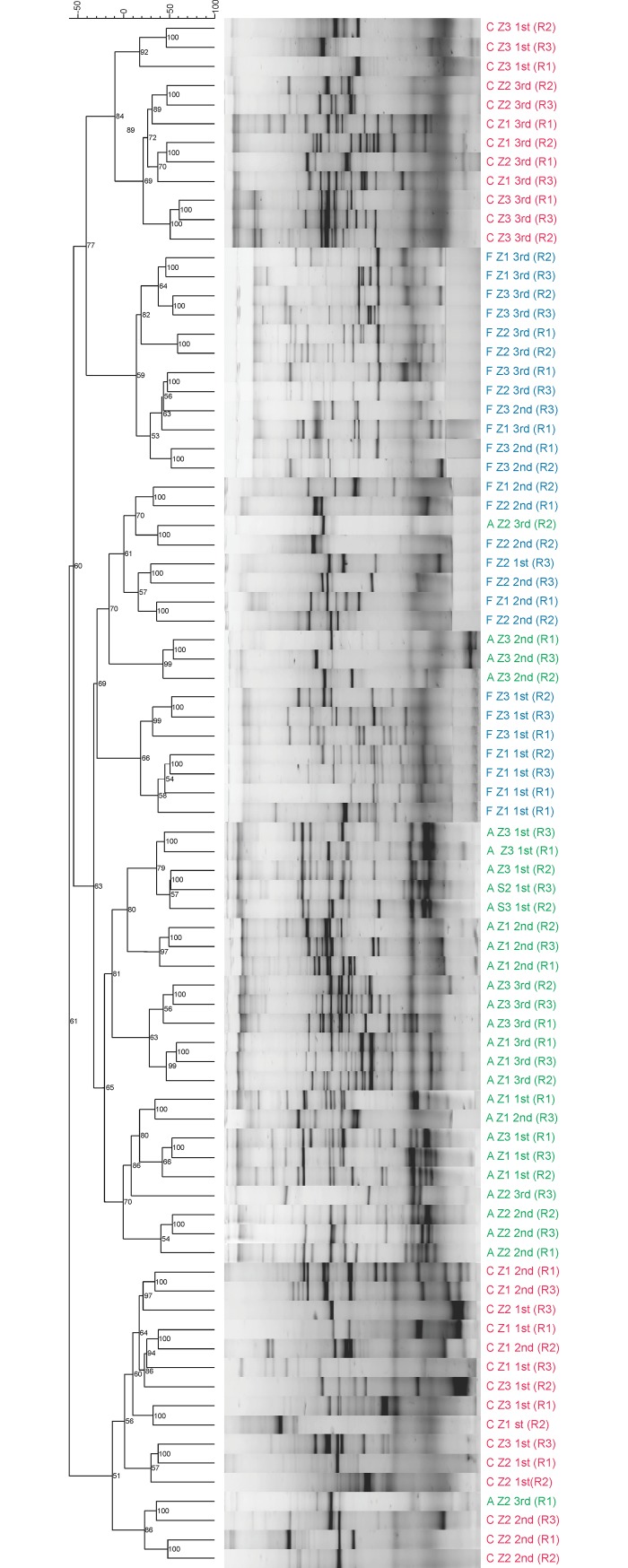
Agroecology aims to maintain ecosystem services by minimizing the impact of agriculture and promoting the use of biological potential. Arbuscular mycorrhizal fungi (AMF) are elements which are key to improving crop productivity and soil quality. It is pertinent to understand how agricultural management in the tropics affects the AMF spatio-temporal community composition, especially in crops of global importance, such as coffee (Coffea arabica L.). Soil and root samples were collected from three localities under three management systems (agroecological, conventional and forest fragment), during the phenological stages of coffee (flowering, grain filling, harvesting). Spores were extracted for morphological identification and molecular community analysis by PCR-DGGE. Dendrograms were prepared and the bands were sequenced and analyzed by bioinformatics. No differences were observed in the richness of morphospecies between management systems, localities and period, but little is known about tropical species. Molecular analysis showed that the agroecological management system was similar to natural forest and with a higher diversity indices than conventional management. Locality and period of sample affect AMF community composition. It is necessary to associate classical taxonomic evaluations with molecular biological techniques because different approaches can lead to different outcomes. This study contributes to the understanding of the impact of agriculture management systems on AMF and provides evidence that agroecology is a management system applicable to sustainable coffee production.
农业生态学旨在通过最小化农业的影响和促进生物潜力的利用来维持生态系统服务。丛枝菌根真菌(AMF)是提高作物生产力和土壤质量的关键因素。了解热带农业管理如何影响 AMF 的时空群落组成至关重要,特别是在全球重要作物如咖啡(Coffea arabica L.)中。在咖啡的物候阶段(开花、灌浆、收获),从三个管理系统(农业生态、常规和森林片段)的三个地点采集了土壤和根样本。通过 PCR-DGGE 提取孢子进行形态鉴定和分子群落分析。准备了聚类树图,并对条带进行测序和生物信息学分析。管理系统、地点和时期之间的形态种丰富度没有差异,但对热带物种知之甚少。分子分析表明,农业生态管理系统与天然林相似,多样性指数高于常规管理。采样的地点和时期会影响 AMF 群落组成。有必要将经典的分类评估与分子生物学技术结合起来,因为不同的方法可能会得出不同的结果。本研究有助于了解农业管理系统对 AMF 的影响,并提供了证据表明农业生态学是一种适用于可持续咖啡生产的管理系统。