School of Materials Science and Engineering, Beijing Institute of Technology, No. 5 South Zhongguancun Street, Beijing, 100081, China.
Collaborative Innovation Center of Electric Vehicles in Beijing, No. 5 South Zhongguancun Street, Beijing, 100081, China.
Nat Commun. 2019 Jan 8;10(1):73. doi: 10.1038/s41467-018-07980-7.
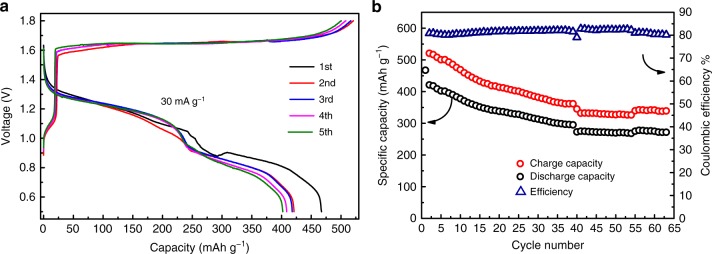
Aluminum is a naturally abundant, trivalent charge carrier with high theoretical specific capacity and volumetric energy density, rendering aluminum-ion batteries a technology of choice for future large-scale energy storage. However, the frequent collapse of the host structure of the cathode materials and sluggish kinetics of aluminum ion diffusion have thus far hampered the realization of practical battery devices. Here, we synthesize AlMnO·nHO by an in-situ electrochemical transformation reaction to be used as a cathode material for an aluminum-ion battery with a configuration of Al/Al(OTF)-HO/AlMnO·nHO. This cell is not only based on aqueous electrolyte chemistry but also delivers a high specific capacity of 467 mAh g and a record high energy density of 481 Wh kg. The high safety of aqueous electrolyte, facile cell assembly and the low cost of materials suggest that this aqueous aluminum-ion battery holds promise for large-scale energy applications.
铝是一种天然丰富的三价电荷载流子,具有高的理论比容量和体积能量密度,使铝离子电池成为未来大规模储能的首选技术。然而,频繁的阴极材料主体结构坍塌和铝离子扩散的动力学迟缓,迄今为止阻碍了实用电池器件的实现。在这里,我们通过原位电化学转化反应合成了 AlMnO·nHO,用作 Al/Al(OTF)-HO/AlMnO·nHO 构型的铝离子电池的阴极材料。这种电池不仅基于水系电解液化学,而且还提供了 467 mAh g 的高比容量和创纪录的 481 Wh kg 的高能量密度。水系电解液的高安全性、简便的电池组装和材料的低成本表明,这种水系铝离子电池有望在大规模能源应用中得到应用。