Department of Obstetrics, Perinatology and Gynecology, Polish Mother's Memorial Hospital-Research Institute, Lodz 93-338, Poland.
Scientific Laboratory of the Center of Medical Laboratory Diagnostics and Screening, Polish Mother's Memorial Hospital-Research Institute, Lodz 93-338, Poland.
Oxid Med Cell Longev. 2018 Dec 2;2018:3919106. doi: 10.1155/2018/3919106. eCollection 2018.
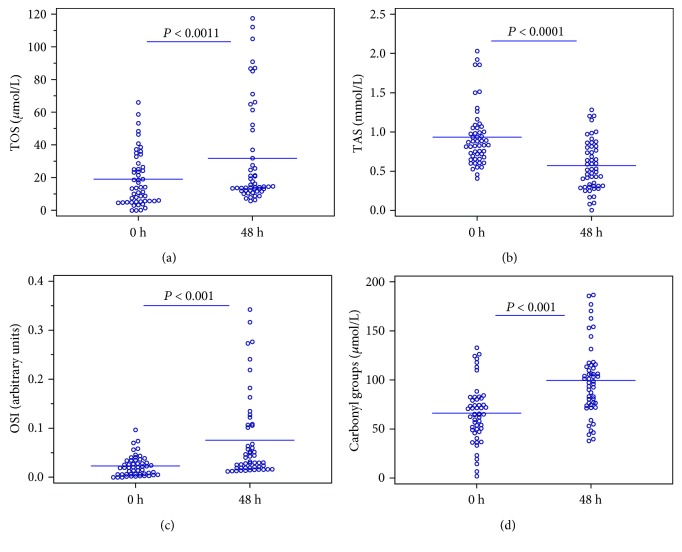
Preterm birth is defined as delivery before 37 completed weeks of pregnancy, and it is the leading cause of neonatal morbidity and mortality. Oxidative stress is recognized as an important factor in the pathogenesis of premature labor. We conducted this analysis to investigate the safety of administration of the tocolytic drug Atosiban-a reversible, competitive antagonist of the oxytocin receptor in the treatment of preterm birth and its impact on the level of oxidative stress in pregnant women after 48 hours of tocolytic treatment. This prospective study was conducted between March 2016 and August 2017 at the Obstetric Clinic of the Polish Mother's Memorial Hospital Research Institute. Total oxidant status (TOS), total antioxidant status (TAS), and oxidative stress index (OSI) values as well as 3-nitrotyrosine, carbonyl, and thiol group levels were measured using an ELISA test in serum and plasma of 56 pregnant women before and after 48 hours of continuous administration of Atosiban. We found that TAS levels decreased almost twice after the 48-hour drug administration (0.936 ± 0.360 mmol/L vs. 0.582 ± 0.305 mmol/L, < 0.001) while TOS increased from 18.217 ± 16.093 mol/L to 30.442 ± 30.578 mol/L ( < 0.001). We also found a significant increase in OSI index-almost a threefold increase from 0.022 ± 0.022 to 0.075 ± 0.085, < 0.001. In addition, statistically significant differences in the level of carbonyl groups were found. It increased from 65.358 ± 31.332 mol/L to 97.982 ± 38.047 mol/L ( < 0.001), which indicates increased oxidation of plasma proteins. Furthermore, patients who gave birth prematurely had higher levels of TOS after a 48-hour drug administration than the second group with labor after 37 weeks of pregnancy (42.803 ± 34.683 mol/L vs. 25.792 ± 27.821 mol/L, < 0.031). The obtained results clearly indicate that pregnant women during tocolytic treatment with Atosiban are in a state of increased oxidative stress and occurrence of preterm birth can be associated with this phenomenon. This trial is registered with NCT03570294.
早产是指妊娠 37 周前分娩,是新生儿发病率和死亡率的主要原因。氧化应激被认为是早产发病机制中的一个重要因素。我们进行这项分析是为了研究阿托西班(一种催产素受体的可逆、竞争性拮抗剂)在治疗早产中的安全性及其对接受 48 小时保胎治疗的孕妇氧化应激水平的影响。这项前瞻性研究于 2016 年 3 月至 2017 年 8 月在波兰母亲纪念医院研究所产科诊所进行。在连续使用阿托西班 48 小时前后,使用 ELISA 试验测量了 56 名孕妇血清和血浆中的总氧化剂状态(TOS)、总抗氧化状态(TAS)和氧化应激指数(OSI)值,以及 3-硝基酪氨酸、羰基和硫醇水平。我们发现,药物治疗 48 小时后,TAS 水平几乎下降了两倍(0.936±0.360mmol/L 比 0.582±0.305mmol/L,<0.001),而 TOS 从 18.217±16.093mol/L 增加到 30.442±30.578mol/L(<0.001)。我们还发现 OSI 指数显著增加-几乎增加了三倍,从 0.022±0.022 增加到 0.075±0.085,<0.001。此外,还发现了羰基水平的统计学显著差异。它从 65.358±31.332mol/L 增加到 97.982±38.047mol/L(<0.001),表明血浆蛋白氧化增加。此外,与妊娠 37 周后分娩的第二组相比,接受阿托西班保胎治疗 48 小时后的早产患者的 TOS 水平更高(42.803±34.683mol/L 比 25.792±27.821mol/L,<0.031)。研究结果清楚地表明,阿托西班保胎治疗的孕妇处于氧化应激增加的状态,早产的发生可能与此现象有关。本试验在 NCT03570294 注册。