Mohebbi Sohameh, Tohidi Moghadam Tahereh, Nikkhah Maryam, Behmanesh Mehrdad
Department of Nanobiotechnology, Faculty of Biological Sciences, Tarbiat Modares University, P.O. Box: 14115-154, Tehran, Iran.
Department of Genetics and Nanobiotechnology, Faculty of Biological Sciences, Tarbiat Modares University, P.O. Box: 14115-154, Tehran, Iran.
Nanoscale Res Lett. 2019 Jan 8;14(1):13. doi: 10.1186/s11671-018-2828-3.
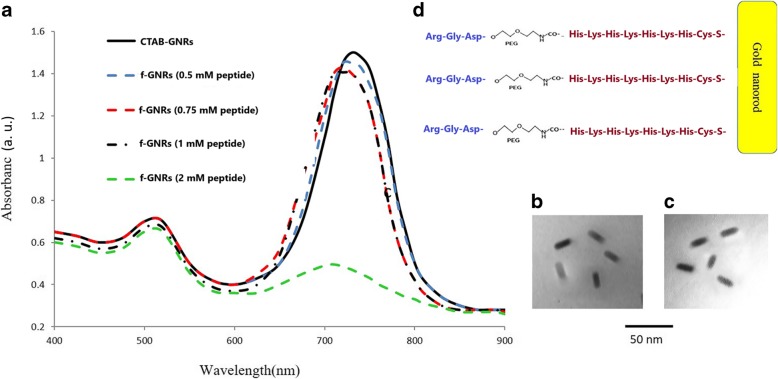
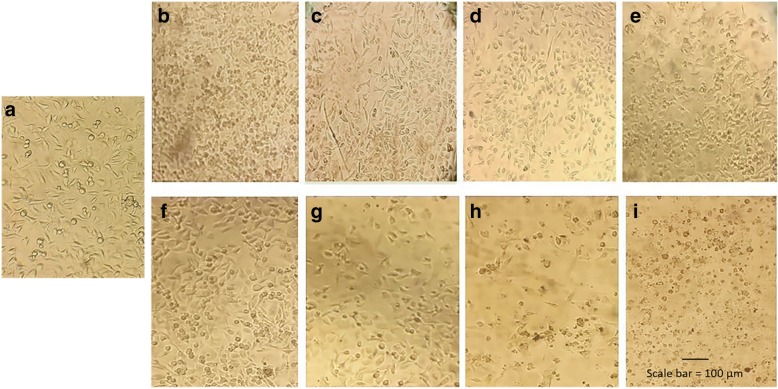
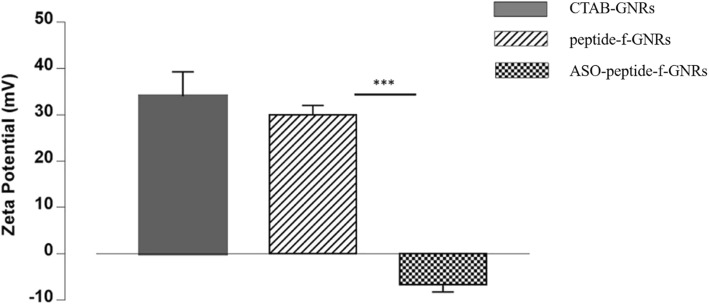
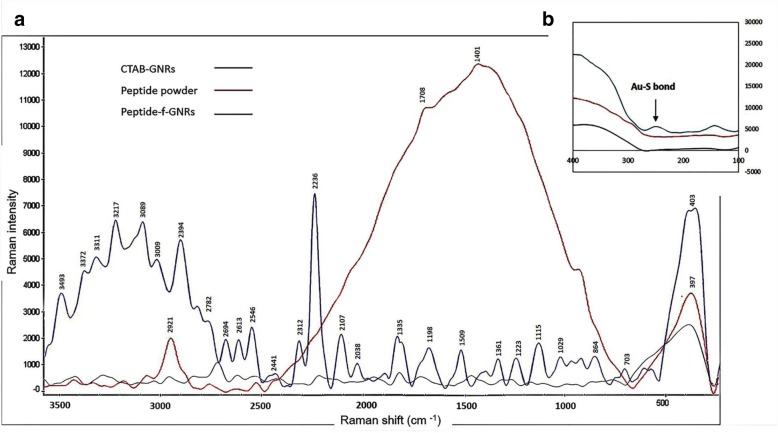
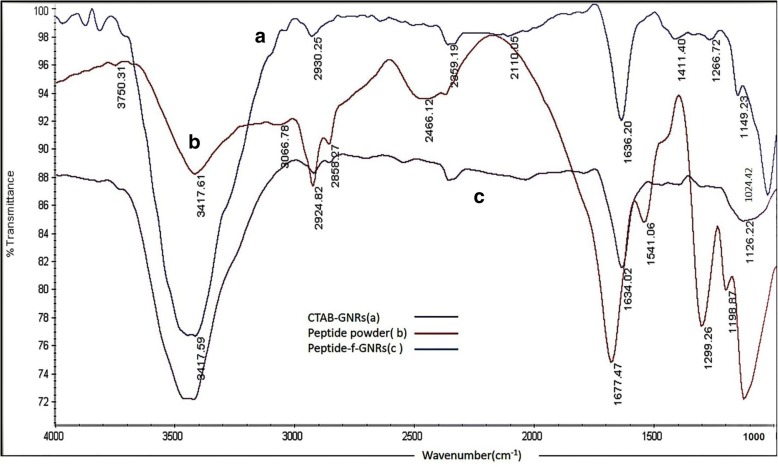
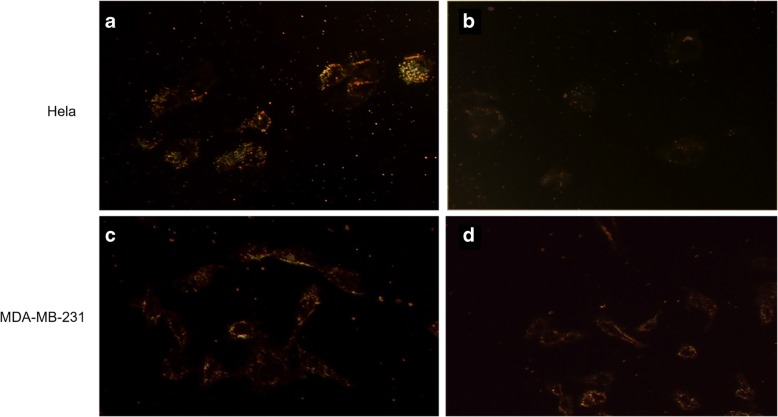
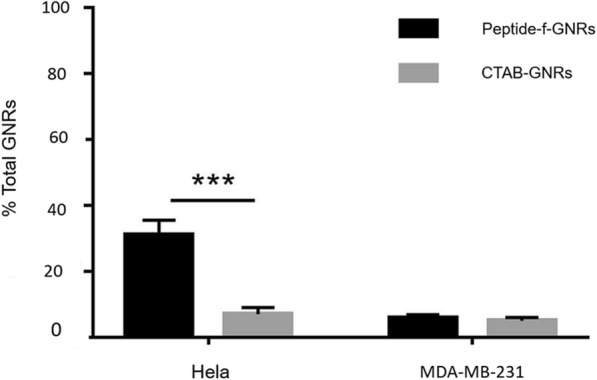
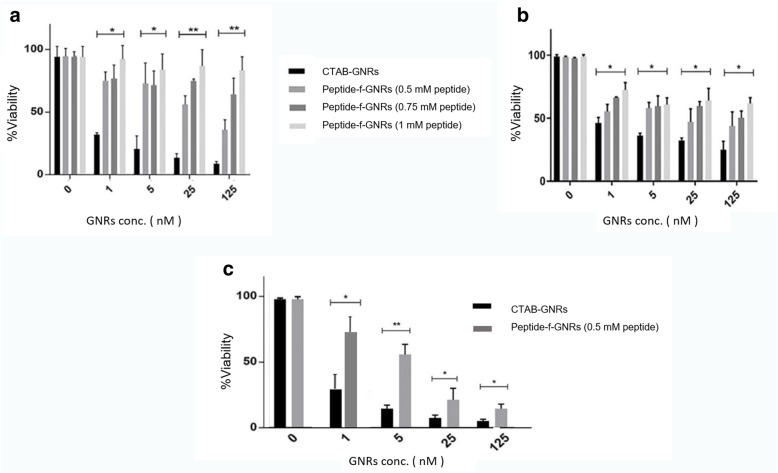
Gold nanorods (GNRs) have been nominated as a promising candidate for a variety of biological applications; however, the cationic surfactant layer that surrounds a nanostructure places limits on its biological applicability. Herein, CTAB-GNRs were functionalized via a ligand exchange method using a (C(HK)4-mini PEG-RGD)-peptide to target the overexpressed αvβ3 integrin in cancerous cells, increase the biocompatibility, and gain the ability of gene/drug delivery, simultaneously. To confirm an acceptable functionalization, UV-Visible, FTIR, and Raman spectroscopy, zeta potential, and transmission electron microscopy of nanostructures were done. MTT assay was applied to study the cytotoxicity of nanostructures on two cell lines, HeLa and MDA-MB-231, as positive and negative αvβ3 integrin receptors, respectively. The cytotoxic effect of peptide-functionalized GNRs (peptide-f-GNRs) was less than that of CTAB-coated GNRs (CTAB-GNRs) for both cell lines. Uptake of peptide-f-GNRs and CTAB-GNRs was evaluated in two cell lines, using dark-field imaging and atomic absorption spectroscopy. Peptide-f-GNRs showed a proper cell uptake on the HeLa rather than MDA-MB-231 cell line according to the RGD (Arg-Gly-Asp) sequence in the peptide. The ability of peptide-f-GNRs to conjugate to antisense oligonucleotides (ASO) was also confirmed using zeta potential, which was due to the repeated HK (His-Lys) sequence inside the peptide. The result of these tests highlights the functionalization method as a convenient and cost-effective strategy for promising applications of targeted GNRs in the biological gene/drug delivery systems, and the repeated histidine-lysine pattern could be a useful carrier for negatively charged drug/gene delivery, too.
金纳米棒(GNRs)已被视为多种生物应用的有前景候选物;然而,围绕纳米结构的阳离子表面活性剂层限制了其生物适用性。在此,通过配体交换法,使用(C(HK)4 - mini PEG - RGD)肽对CTAB - GNRs进行功能化,以靶向癌细胞中过表达的αvβ3整合素,同时提高生物相容性并获得基因/药物递送能力。为确认可接受的功能化,对纳米结构进行了紫外 - 可见光谱、傅里叶变换红外光谱和拉曼光谱、zeta电位及透射电子显微镜检测。采用MTT法研究纳米结构对两种细胞系(分别作为αvβ3整合素受体阳性和阴性的HeLa细胞系和MDA - MB - 231细胞系)的细胞毒性。对于这两种细胞系,肽功能化的GNRs(肽 - f - GNRs)的细胞毒性均小于CTAB包被的GNRs(CTAB - GNRs)。使用暗场成像和原子吸收光谱在两种细胞系中评估了肽 - f - GNRs和CTAB - GNRs的摄取情况。根据肽中的RGD(精氨酸 - 甘氨酸 - 天冬氨酸)序列,肽 - f - GNRs在HeLa细胞系上显示出良好的细胞摄取,而在MDA - MB - 231细胞系上则不然。还使用zeta电位证实了肽 - f - GNRs与反义寡核苷酸(ASO)结合的能力,这归因于肽内部重复的HK(组氨酸 - 赖氨酸)序列。这些测试结果突出了功能化方法作为一种便捷且经济高效的策略,用于靶向GNRs在生物基因/药物递送系统中的有前景应用,并且重复的组氨酸 - 赖氨酸模式也可能是用于带负电荷药物/基因递送的有用载体。