Department of Pediatrics, College of Medicine and Health Sciences, UAE University, Alain, United Arab Emirates.
Department of Medicine, College of Medicine and Health Sciences, UAE University, Alain, United Arab Emirates.
PLoS One. 2019 Jan 9;14(1):e0210316. doi: 10.1371/journal.pone.0210316. eCollection 2019.
The impact of obesity on cardiovascular health of young children is still to be fully illustrated. This study measured biomarkers for glycemic control, lipid metabolism, systemic inflammation, endothelial dysfunction, and hepatic cholestasis in schoolchildren. Its main purpose was to determine whether metabolic derangements could be detected in young children with excess fat.
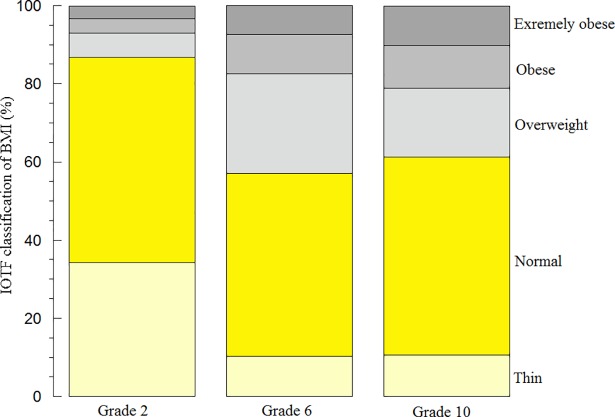
This cross-sectional study involved 967 children in the second, sixth, and tenth grades (median age, 7.3, 11.3, and 15.4 years, respectively). Using the International Obesity Task Force interpretation (IOTF) of body-mass-index (BMI), children were stratified as thin (<5th centiles), normal (5th to <85th centiles), overweight (85th to <95th centiles), obese (95th to <98th centiles), or extremely-obese (≥98th centiles). Waist circumference was also measured. Several metabolic determinations were then used as surrogate biomarkers for cardiovascular risks.
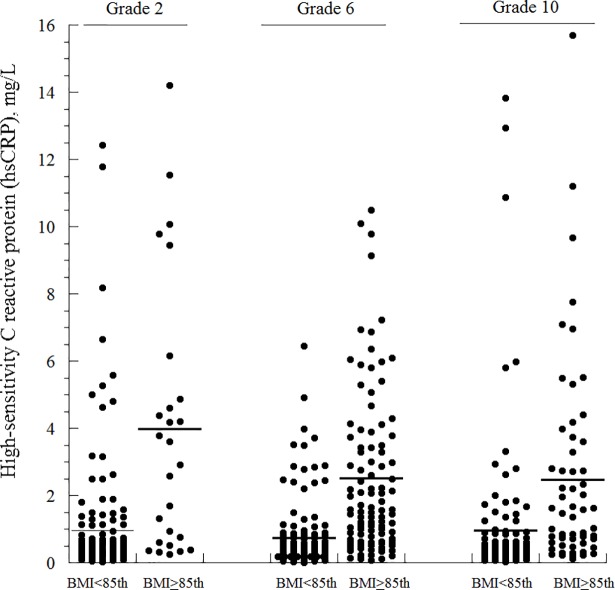
Prevalence of BMI≥85th centile among the second graders was 13.1%, sixth graders 42.2%, and tenth graders 33.8%. BMI≥85th centile was associated with a tendency for higher hemoglobin A1c (p≥0.160) and higher blood glucose (p≥0.197). For the second graders, BMI≥85th centile was associated with higher high-sensitivity C-reactive protein (hs-CRP, p<0.001), higher tumor necrosis factor-α (TNF-alpha, p<0.001), higher interleukin-6 (IL-6, p<0.001), higher soluble intercellular cytoadhesive molecule-1 (sICAM-1), higher triglycerides (p≤0.024), and lower high-density lipoprotein (HDL, p<0.001). Additionally, for the sixth and tenth graders, BMI≥85th centile was associated with higher gamma-glutamyl transferase (GGT, p<0.001). In the sixth graders, BMI≥85th centile was insignificantly changed with sICAM-1 or the soluble vascular cytoadhesive molecule-1 (sVCAM-1).
The studied children with excess fat had increased risks for developing systemic inflammation, dyslipidemia, endothelial dysfunction, cholestasis, and diabetes. These results suggest that metabolic biomarkers should be included in the routine assessment of children with an overweight problem.
肥胖对幼儿心血管健康的影响仍有待充分说明。本研究测量了血糖控制、脂质代谢、全身炎症、内皮功能障碍和胆汁淤积的生物标志物,以评估超重的儿童是否存在代谢紊乱。
本横断面研究纳入了 967 名二、六、十年级的儿童(中位数年龄分别为 7.3、11.3 和 15.4 岁)。使用国际肥胖工作组(IOTF)对体重指数(BMI)的解释,将儿童分为消瘦(<第 5 百分位数)、正常(第 5 至<第 85 百分位数)、超重(第 85 至<第 95 百分位数)、肥胖(第 95 至<第 98 百分位数)和极度肥胖(≥第 98 百分位数)。同时还测量了腰围。然后,使用几种代谢测定作为心血管风险的替代生物标志物。
二年级儿童 BMI≥第 85 百分位数的患病率为 13.1%,六年级为 42.2%,十年级为 33.8%。BMI≥第 85 百分位数与血红蛋白 A1c 升高的趋势相关(p≥0.160)和高血糖(p≥0.197)。对于二年级儿童,BMI≥第 85 百分位数与较高的高敏 C 反应蛋白(hs-CRP,p<0.001)、较高的肿瘤坏死因子-α(TNF-α,p<0.001)、较高的白细胞介素-6(IL-6,p<0.001)、较高的可溶性细胞间黏附分子-1(sICAM-1)、较高的三酰甘油(p≤0.024)和较低的高密度脂蛋白(HDL,p<0.001)相关。此外,对于六年级和十年级儿童,BMI≥第 85 百分位数与γ-谷氨酰转移酶(GGT,p<0.001)升高相关。在六年级儿童中,sICAM-1 或可溶性血管细胞黏附分子-1(sVCAM-1)与 BMI≥第 85 百分位数无显著变化。
本研究中,超重的儿童患全身炎症、血脂异常、内皮功能障碍、胆汁淤积和糖尿病的风险增加。这些结果表明,代谢生物标志物应纳入超重儿童的常规评估中。