NIHR CLAHRC Wessex, University of Southampton, Southampton, UK.
Health Sciences, University of Southampton, Southampton, UK.
Health Expect. 2019 Jun;22(3):435-443. doi: 10.1111/hex.12866. Epub 2019 Jan 10.
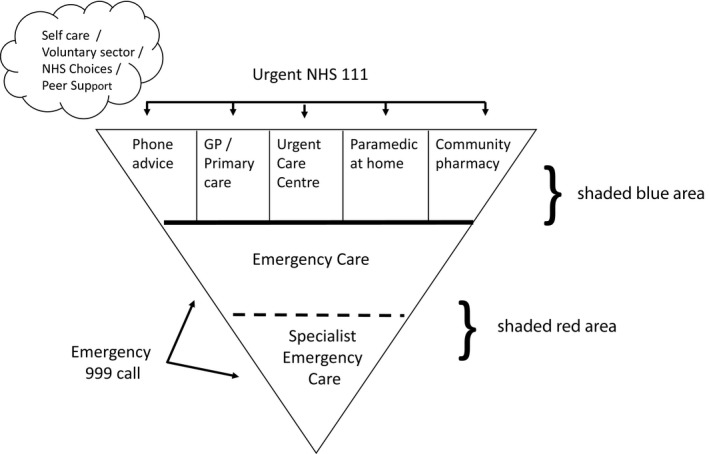
Whilst many health systems offer a range of urgent and emergency care services to deal with the need for unscheduled care, these can be problematic to navigate.
To explore how lay people make sense of urgent care provision and processes.
Qualitative study, incorporating citizen panels and longitudinal semi-structured qualitative interviews.
Two citizens' panels, comprising purposively selected public populations-a group of regular users and a group of potentially marginalized users of urgent and emergency care. Semi-structured interviews were conducted with 100 people, purposively sampled to include those over 75, aged 18-26 years, and from East/Central Europe. A sub-sample of 41 people received a second interview at +6-12 months. Framework analysis was thematic and comparative, moving through coding to narrative and interpretive summaries.
Participants narratives illuminated considerable uncertainty and confusion regarding urgent and emergency care provision which in part could be traced to the contingent nature of urgent and emergency care need. Accounts of emergency care provision were underpinned by strong moral positioning of appropriate help-seeking, demarcating legitimate service use that echoed policy rhetoric, but did not necessarily translate into individual behaviour. People struggled to make sense of urgent care provision making navigating "appropriate" use problematic.
The focus on help-seeking behaviour, rather than sense-making, makes it difficult to move beyond the polarization of "appropriate" and "inappropriate" service use. A deeper analysis of sense-making might shift the focus of attention and allow us to intervene to reshape understandings before this point.
尽管许多卫生系统提供了一系列紧急和急救服务来应对非计划性医疗需求,但这些服务可能难以应对。
探索非专业人士如何理解紧急医疗服务的提供和流程。
定性研究,包括公民小组和纵向半结构化定性访谈。
两个公民小组,由有目的选择的公众群体组成——一组是紧急和急救服务的常规使用者,另一组是潜在的边缘化使用者。对 100 人进行了半结构化访谈,这些人是有目的抽样的,包括 75 岁以上的人、18-26 岁的人以及来自东欧/中欧的人。41 人接受了第二次访谈,时间在+6-12 个月。框架分析是主题性和比较性的,从编码到叙事和解释性摘要。
参与者的叙述阐明了对紧急和急救服务提供的相当大的不确定性和困惑,部分原因可以追溯到紧急和急救需求的偶然性。对紧急护理服务提供的描述是基于对适当寻求帮助的强烈道德定位,划定了合法的服务使用范围,呼应了政策言论,但不一定转化为个人行为。人们难以理解紧急护理服务的提供,使得“适当”使用的导航变得困难。
关注寻求帮助的行为,而不是理解,使得我们难以超越“适当”和“不适当”服务使用的两极分化。对理解的更深入分析可能会转移注意力焦点,并允许我们在这一点之前进行干预,重塑理解。