Health Services Management Centre, School of Social Policy, University of Birmingham, Birmingham, B15 2RT, UK.
NIHR CLAHRC Wessex, University of Southampton, Southampton, SO17 1BJ, UK.
BMC Health Serv Res. 2020 Sep 21;20(1):887. doi: 10.1186/s12913-020-05705-5.
Use of emergency department (ED) care globally seems to be increasing at a faster rate than population growth (Baker, House of Commons Library. Accident and Emergency Statistics, Demand, Performance, 2017). In the UK there has been a reported 16% rise in emergency admissions over the past 5 years. Estimates that between 11 and 40% of ED attendances are non-urgent, with 11% of patients being discharged from the ED without treatment (NHS Digital 2017), and a further 44% require no follow-up treatment (NHS Digital, Hospital Accident and Emergency Activity 2016-17, 2019) is cited as evidence that these patients did not require this level of care. The solution to not using the most appropriate point in the system has traditionally been seen as a knowledge problem, requiring, improved sign-posting and information to enable people to self-manage or use health care management for minor ailments. However research about help-seeking behaviour suggests that the problem may not be an informational one. A considerable literature points to help seeking as a social process influenced by a range of contingencies and contextual factors including the way in which lay people influence health care utilisation (Giebel et al. BMJ Open 9:1, 2019). Personal communities comprise a variety of active and significant social ties which have potential to influence individual capacity to seek help. Here we extend and unpack further influencing decisions about seeking formal health care with reference to how they are shaped and informed by and within personal social networks.
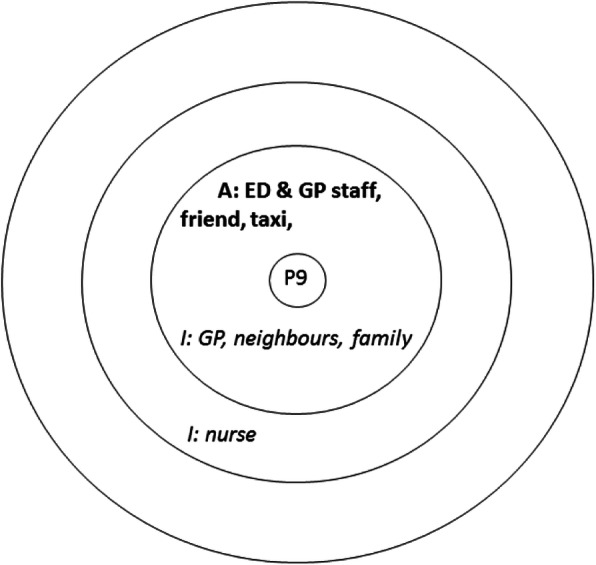
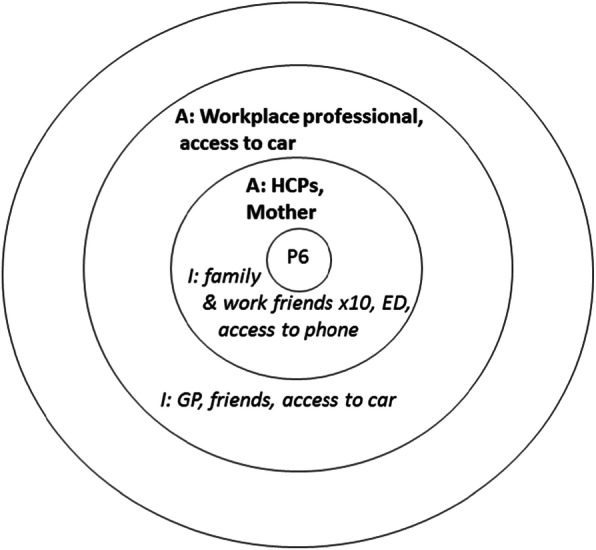
We undertook a personal network mapping and qualitative interview-based study to look at, problematize and understand attendance for non-urgent problems. We used network analysis and methods to map and characterise the personal communities of people seeking help from ED for minor ailments and semi-structured interviews with 40 people attending a single ED and associated GP hub providing equivalent care. Interviews were built around an ego network mapping activity and a topic guide structured to explore attender's narratives about why they had visited the ED. This ego network activity uses a diagram consisting of three concentric circles (Fiori et al. J Gerontol B-Psychol 62: 322-30, 2007), representing closest social network members (in the centre) and those at further distance. Participants were initially presented with one of these diagrams and asked to write names of people or resources that had played a role in their attendance and the interviewer probed the interviewee to discuss the actions, input and value of the people and services that supported the visit to the ED.
We analysed number and type of network connections and undertook a thematic analysis to identify how imagined and actual network members and influences were implicated in ED attendance. The network maps created during the interviews were examined and a typology of networks was developed and used to distinguish different types of networks informed by our reading of the data, and a Network Typology Scoring Tool, a measure of frequency of contact and relationship type in networks.
Our study suggests that faced with acute minor illness or injury people's networks narrow: they do not (and perhaps cannot) mobilise their imagined care network because the resources or connections may not be there or are difficult to engage. In addition we identified important system drivers of behaviour, notably that these patients are often directed to the ED by 'professional influencers' including health services staff.
全球范围内,急诊科(ED)的使用似乎正以前所未有的速度增长,其增速快于人口增长速度(Baker,下议院图书馆。急诊统计,需求,绩效,2017 年)。在英国,过去 5 年来,急诊入院人数增加了 16%。有报道称,11%至 40%的急诊科就诊是非紧急的,11%的患者在没有接受治疗的情况下从急诊科出院(NHS Digital 2017),另有 44%的患者不需要后续治疗(NHS Digital,医院急诊活动 2016-17 年,2019 年),这表明这些患者不需要这种级别的治疗。传统上,解决未在系统中使用最合适的治疗点的方法被视为知识问题,需要改进指示牌和信息,以实现人们的自我管理或使用医疗保健管理治疗小病。然而,有关寻求帮助行为的研究表明,问题可能不是信息问题。大量文献指出,寻求帮助是一种社会过程,受到一系列偶然因素和背景因素的影响,包括外行如何影响医疗保健的使用(Giebel 等人,BMJ Open 9:1, 2019)。个人社区由各种活跃和重要的社会关系组成,这些关系有可能影响个人寻求帮助的能力。在这里,我们进一步扩展和扩展了参考个人社交网络中如何塑造、通知和形成的内容,以进一步了解他们对寻求正式医疗保健的决策。
我们进行了个人网络映射和基于定性访谈的研究,以了解、探讨和理解因非紧急问题而寻求急诊治疗的情况。我们使用网络分析和方法来绘制和描述因小病到 ED 就诊的人及其个人社区,并对在单个 ED 和提供同等护理的相关全科医生中心就诊的 40 人进行了半结构化访谈。访谈是围绕一个自我网络映射活动和一个主题指南构建的,该指南旨在探讨参与者访问 ED 的原因。这个自我网络活动使用一个由三个同心圆圈组成的图表(Fiori 等人,J Gerontol B-Psychol 62:322-30, 2007),代表最近的社交网络成员(在中心)和更远的距离的成员。参与者首先被展示其中一个图表,并被要求写下在他们的就诊过程中发挥作用的人员或资源的姓名,采访者会询问参与者讨论支持他们就诊 ED 的人员和服务的行动、投入和价值。
我们分析了网络连接的数量和类型,并进行了主题分析,以确定想象中的和实际的网络成员和影响是如何参与 ED 就诊的。在访谈过程中创建的网络地图进行了检查,并开发了一种网络类型学,用于根据我们对数据的解读来区分不同类型的网络,并使用网络类型学评分工具,一种衡量网络中接触频率和关系类型的方法。
我们的研究表明,面对急性小病或伤害,人们的网络会缩小:他们不会(也许不能)调动他们想象中的护理网络,因为资源或联系可能不存在,或者难以建立。此外,我们确定了重要的系统行为驱动因素,特别是这些患者经常被包括卫生服务人员在内的“专业影响者”引导到 ED。