Department of Clinical Epidemiology, Biostatistics and Bioinformatics, Obstetrics and Gynecology, Amsterdam Public Health Research Institute, Amsterdam Reproduction and Development Research Institute, Amsterdam UMC, University of Amsterdam, Amsterdam, The Netherlands.
Emma Children's Hospital, Amsterdam UMC, Vrije Universiteit Amsterdam, Department of Pediatrics, Department of Obstetrics and Gynecology, Amsterdam Public Health Research Institute, Amsterdam Reproduction and Development Research Institute, Amsterdam, The Netherlands.
Obes Rev. 2019 May;20(5):675-685. doi: 10.1111/obr.12817. Epub 2019 Jan 11.
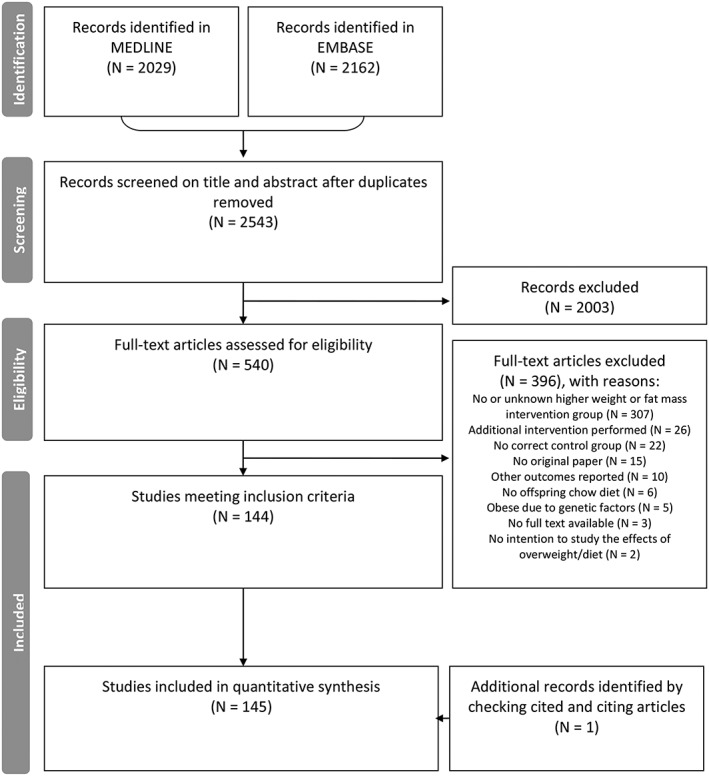
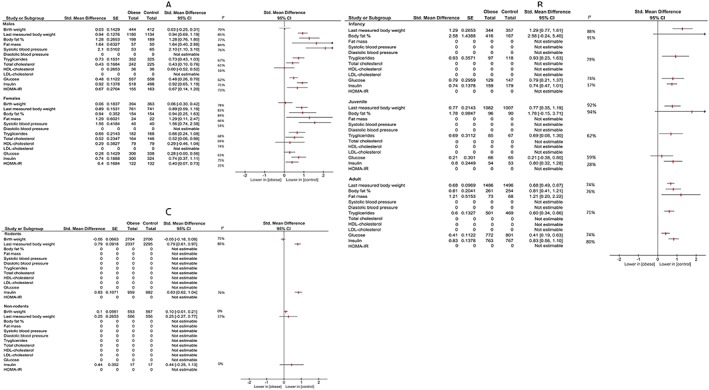
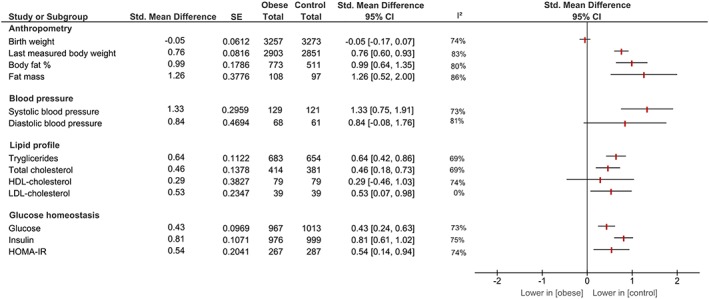
Obesity before and during pregnancy leads to reduced offspring cardiometabolic health. Here, we systematically reviewed animal experimental evidence of maternal obesity before and during pregnancy and offspring anthropometry and cardiometabolic health. We systematically searched Embase and Medline from inception until January 2018. Eligible publications compared offspring of mothers with obesity to mothers with a normal weight. We performed meta-analyses and subgroup analyses. We also examined methodological quality and publication bias. We screened 2543 publications and included 145 publications (N = 21 048 animals, five species). Essential methodological details were not reported in the majority of studies. We found evidence of publication bias for birth weight. Offspring of mothers with obesity had higher body weight (standardized mean difference (SMD) 0.76 [95% CI 0.60;0.93]), fat percentage (0.99 [0.64;1.35]), systolic blood pressure (1.33 [0.75;1.91]), triglycerides (0.64 [0.42;0.86], total cholesterol (0.46 [0.18;0.73]), glucose level (0.43 [0.24;0.63]), and insulin level (0.81 [0.61;1.02]) than offspring of control mothers, but similar birth weight. Sex, age, or species did not influence the effect of maternal obesity on offspring's cardiometabolic health. Obesity before and during pregnancy reduces offspring cardiometabolic health in animals. Future intervention studies should investigate whether reducing obesity prior to conception could prevent these detrimental programming effects and improve cardiometabolic health of future generations.
肥胖症在怀孕前和怀孕期间会导致后代的心脏代谢健康状况下降。在这里,我们系统地回顾了动物实验中关于母亲怀孕前和怀孕期间肥胖症与后代人体测量和心脏代谢健康的证据。我们系统地检索了 Embase 和 Medline,检索时间从建库开始到 2018 年 1 月。符合条件的出版物将肥胖症母亲的后代与体重正常的母亲的后代进行了比较。我们进行了荟萃分析和亚组分析。我们还检查了方法学质量和发表偏倚。我们筛选了 2543 篇出版物,纳入了 145 篇出版物(N=21048 只动物,5 个物种)。大多数研究没有报告基本的方法学细节。我们发现出生体重存在发表偏倚的证据。肥胖症母亲的后代体重更高(标准化均数差(SMD)0.76[95%CI 0.60;0.93])、体脂百分比更高(0.99[0.64;1.35])、收缩压更高(1.33[0.75;1.91])、甘油三酯更高(0.64[0.42;0.86])、总胆固醇更高(0.46[0.18;0.73])、血糖水平更高(0.43[0.24;0.63])和胰岛素水平更高(0.81[0.61;1.02]),而对照组母亲的后代出生体重相似。性别、年龄或物种并不影响母亲肥胖症对后代心脏代谢健康的影响。肥胖症在怀孕前和怀孕期间会降低动物后代的心脏代谢健康状况。未来的干预研究应调查在受孕前减少肥胖症是否可以预防这些不利的编程效应,并改善后代的心脏代谢健康。