Division of Cancer Biology, Nagoya University Graduate School of Medicine, Nagoya, Japan.
Department of Obstetrics and Gynecology, Nagoya City University, Graduate School of Medical Sciences, Nagoya, Japan.
Cancer Sci. 2019 Mar;110(3):1105-1116. doi: 10.1111/cas.13936. Epub 2019 Jan 31.
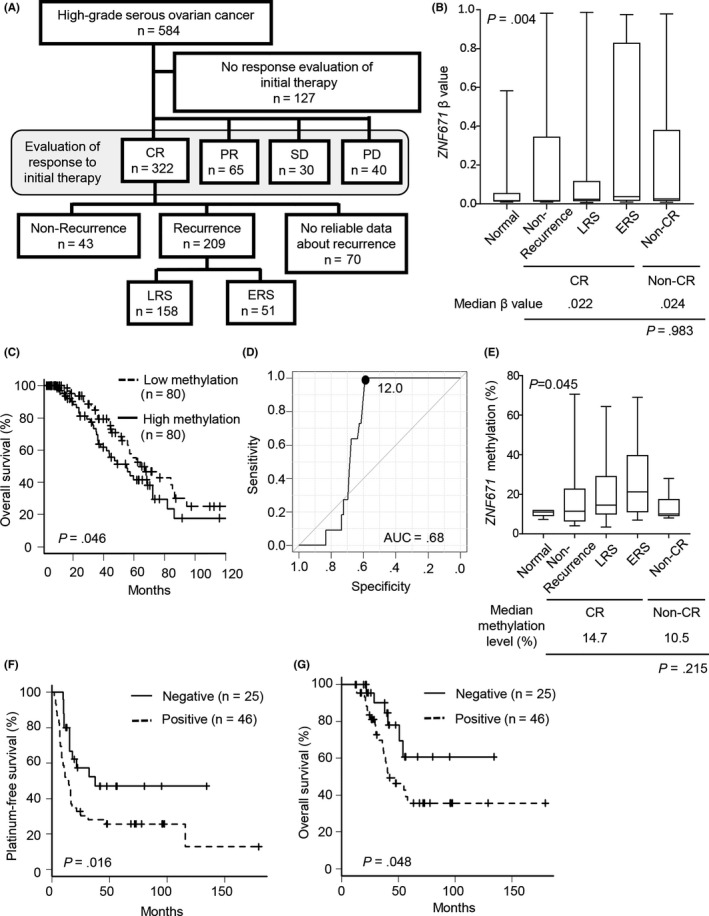
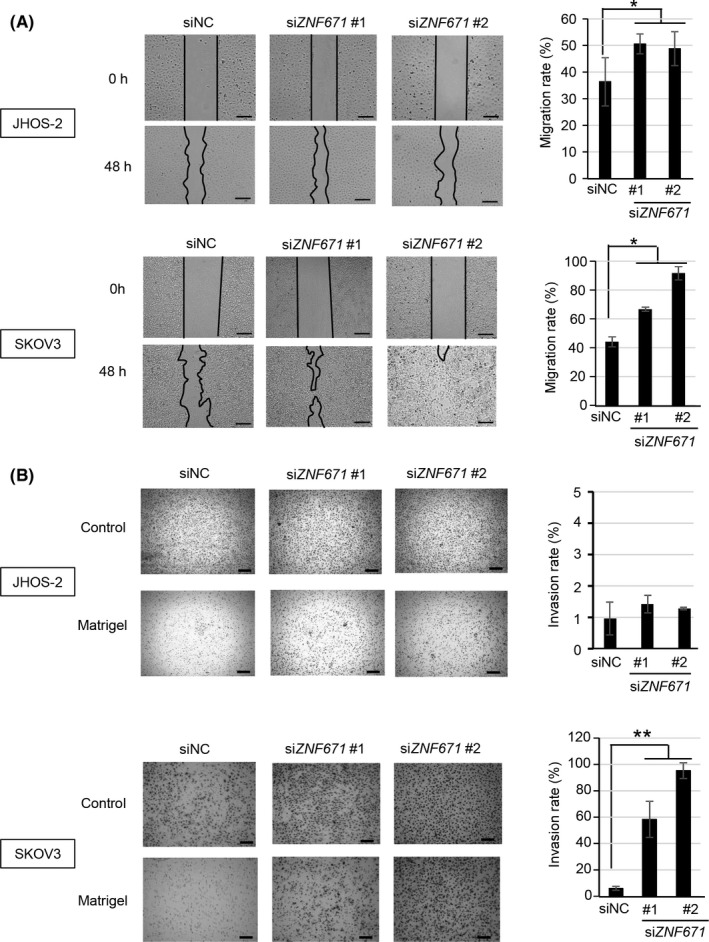
Serous ovarian cancer is the most frequent type of epithelial ovarian cancer. Despite the use of surgery and platinum-based chemotherapy, many patients suffer from recurrence within 6 months, termed platinum resistance. Currently, the lack of relevant molecular biomarkers for the prediction of the early recurrence of serous ovarian cancers is linked to the poor prognosis. To identify an effective biomarker for early recurrence, we analyzed the genome-wide DNA methylation status characteristic of early recurrence after treatment. The patients in The Cancer Genome Atlas (TCGA) dataset who showed a complete response after the first therapy were categorized into 2 groups: early recurrence serous ovarian cancer (ERS, recurrence ≤12 months, n = 51) and late recurrence serous ovarian cancer (LRS, recurrence >12 months, n = 158). Among the 12 differently methylated probes identified between the 2 groups, we found that ZNF671 was the most significantly methylated gene in the early recurrence group. A validation cohort of 78 serous ovarian cancers showed that patients with ZNF671 DNA methylation had a worse prognosis (P < .05). The multivariate analysis revealed that the methylation status of ZNF671 was an independent factor for predicting the recurrence of serous ovarian cancer patients both in the TCGA dataset and our cohort (P = .049 and P = .021, respectively). Functional analysis revealed that the depletion of ZNF671 expression conferred a more migratory and invasive phenotype to the ovarian cancer cells. Our data indicate that ZNF671 functions as a tumor suppressor in ovarian cancer and that the DNA methylation status of ZNF671 might be an effective biomarker for the recurrence of serous ovarian cancer after platinum-based adjuvant chemotherapy.
浆液性卵巢癌是最常见的上皮性卵巢癌类型。尽管采用了手术和铂类化疗,许多患者在 6 个月内仍会复发,称为铂耐药。目前,缺乏用于预测浆液性卵巢癌早期复发的相关分子生物标志物,这与预后不良有关。为了确定早期复发的有效生物标志物,我们分析了治疗后早期复发的全基因组 DNA 甲基化特征。在癌症基因组图谱(TCGA)数据集中,首次治疗后表现出完全缓解的患者被分为 2 组:早期复发浆液性卵巢癌(ERS,复发≤12 个月,n=51)和晚期复发浆液性卵巢癌(LRS,复发>12 个月,n=158)。在这 2 组之间鉴定出的 12 个不同甲基化探针中,我们发现 ZNF671 是早期复发组中甲基化程度最显著的基因。在 78 例浆液性卵巢癌的验证队列中,发现 ZNF671 DNA 甲基化的患者预后较差(P<.05)。多变量分析显示,ZNF671 的甲基化状态是 TCGA 数据集和我们队列中预测浆液性卵巢癌患者复发的独立因素(P=.049 和 P=.021)。功能分析表明,ZNF671 表达的缺失赋予卵巢癌细胞更具迁移和侵袭性的表型。我们的数据表明,ZNF671 在上皮性卵巢癌中作为肿瘤抑制因子发挥作用,ZNF671 的 DNA 甲基化状态可能是铂类辅助化疗后浆液性卵巢癌复发的有效生物标志物。