Department of Nutrition and Movement Sciences, NUTRIM School of Nutrition and Translational Research in Metabolism, Maastricht University Medical Center, 6200 MD Maastricht, The Netherlands.
Nutrients. 2019 Jan 9;11(1):124. doi: 10.3390/nu11010124.
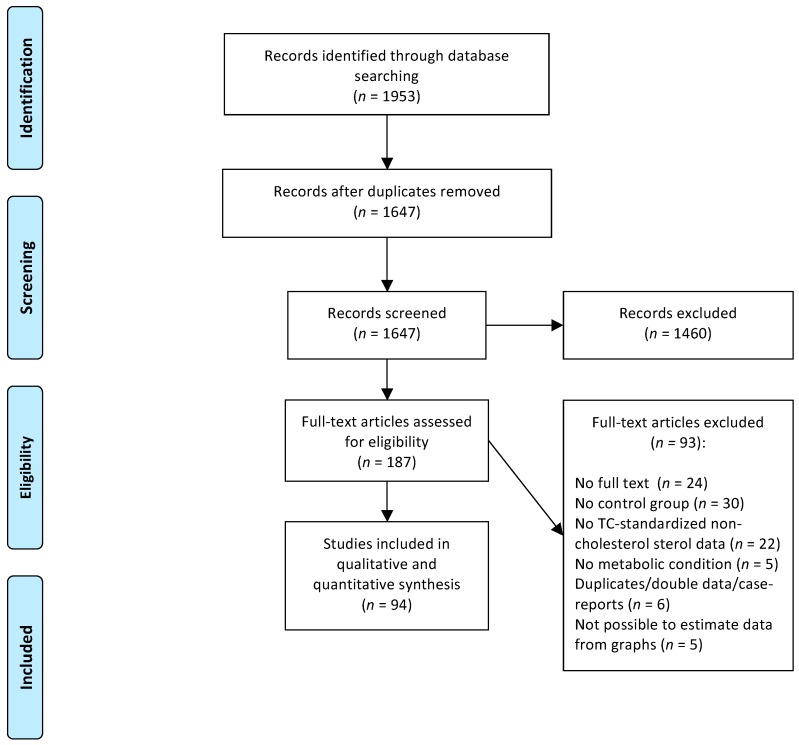
Non-cholesterol sterols are validated biomarkers for intestinal cholesterol absorption and endogenous cholesterol synthesis. However, their use in metabolic disturbances has not been systematically explored. Therefore, we conducted a systematic review to provide an overview of non-cholesterol sterols as markers for cholesterol metabolism in different metabolic disorders. Potentially relevant studies were retrieved by a systematic search of three databases in July 2018 and ninety-four human studies were included. Cholesterol-standardized levels of campesterol, sitosterol and cholestanol were collected to reflect cholesterol absorption and those of lathosterol and desmosterol to reflect cholesterol synthesis. Their use as biomarkers was examined in the following metabolic disorders: overweight/obesity ( = 16), diabetes mellitus ( = 15), metabolic syndrome ( = 5), hyperlipidemia ( = 11), cardiovascular disease ( = 17), and diseases related to intestine ( = 16), liver ( = 22) or kidney ( = 2). In general, markers for cholesterol absorption and synthesis displayed reciprocal patterns, showing that cholesterol metabolism is tightly regulated by the interplay of intestinal absorption and endogenous synthesis. Distinctive patterns for cholesterol absorption or cholesterol synthesis could be identified, suggesting that metabolic disorders can be classified as 'cholesterol absorbers or cholesterol synthesizers'. Future studies should be performed to confirm or refute these findings and to examine whether this information can be used for targeted (dietary) interventions.
非胆固醇甾醇是肠道胆固醇吸收和内源性胆固醇合成的有效生物标志物。然而,它们在代谢紊乱中的应用尚未得到系统的探索。因此,我们进行了一项系统综述,以提供不同代谢紊乱中非胆固醇甾醇作为胆固醇代谢标志物的概述。通过 2018 年 7 月对三个数据库的系统搜索,检索到了潜在相关的研究,共纳入 94 项人体研究。收集了菜油固醇、豆固醇和胆甾烷醇的胆固醇标准化水平来反映胆固醇吸收,以及羊毛固醇和粪甾烷醇的胆固醇标准化水平来反映胆固醇合成。在以下代谢紊乱中检查了它们作为生物标志物的用途:超重/肥胖症(=16)、糖尿病(=15)、代谢综合征(=5)、高脂血症(=11)、心血管疾病(=17),以及与肠道(=16)、肝脏(=22)或肾脏(=2)相关的疾病。一般来说,胆固醇吸收和合成的标志物呈现出相反的模式,表明胆固醇代谢受到肠道吸收和内源性合成相互作用的严格调节。可以识别出不同的胆固醇吸收或胆固醇合成模式,这表明代谢紊乱可以分为“胆固醇吸收者或胆固醇合成者”。未来的研究应证实或反驳这些发现,并研究这些信息是否可用于有针对性的(饮食)干预。