State Key Laboratory of Catalysis, CAS Center for Excellence in Nanoscience, Dalian Institute of Chemical Physics, Chinese Academy of Sciences, 116023, Dalian, China.
University of Chinese Academy of Sciences, 100049, Beijing, China.
Nat Commun. 2019 Jan 11;10(1):138. doi: 10.1038/s41467-018-07860-0.
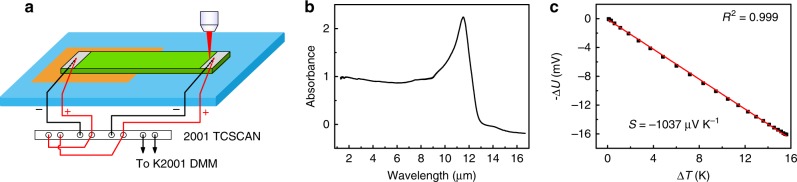
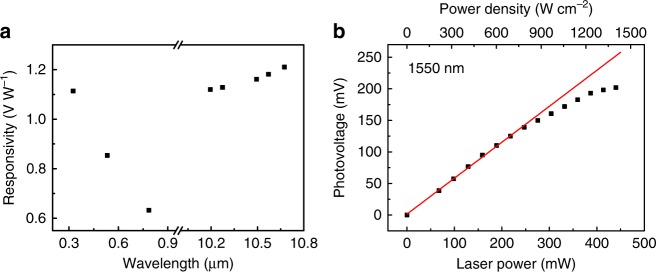
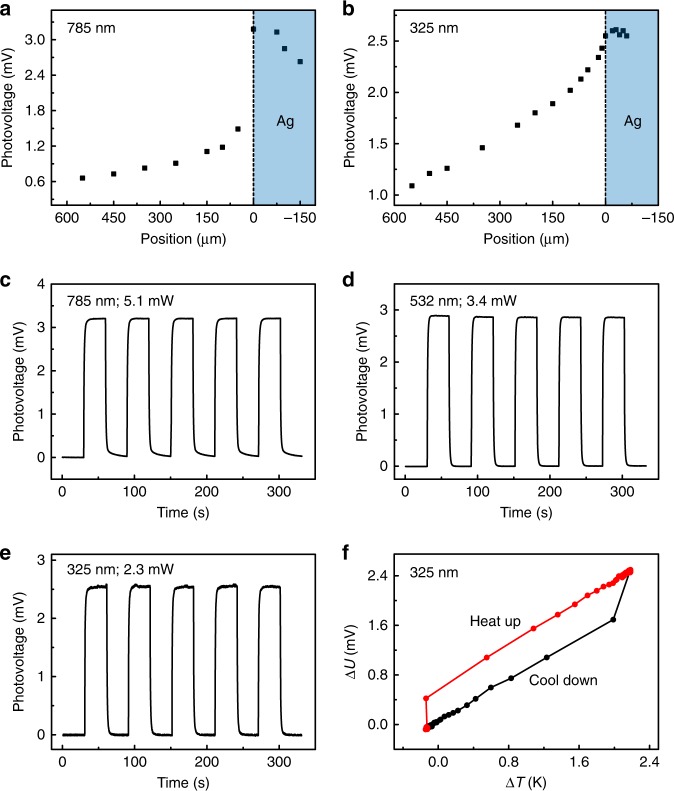
The self-powered and ultra-broadband photodetectors based on photothermoelectric (PTE) effect are promising for diverse applications such as sensing, environmental monitoring, night vision and astronomy. The sensitivity of PTE photodetectors is determined by the Seebeck coefficient and the rising temperature under illumination. Previous PTE photodetectors mostly rely on traditional thermoelectric materials with Seebeck coefficients in the range of 100 μV K, and array structures with multiple units are usually employed to enhance the photodetection performance. Herein, we demonstrate a reduced SrTiO (r-STO) based PTE photodetector with sensitivity up to 1.2 V W and broadband spectral response from 325 nm to 10.67 μm. The high performance of r-STO PTE photodetector is attributed to its intrinsic high Seebeck coefficient and phonon-enhanced photoresponse in the long wavelength infrared region. Our results open up a new avenue towards searching for novel PTE materials beyond traditional thermoelectric materials for low-cost and high-performance photodetector at room temperature.
基于光热电(PTE)效应的自供电超宽频带光电探测器在传感、环境监测、夜视和天文学等领域具有广阔的应用前景。PTE 光电探测器的灵敏度取决于塞贝克系数和光照下的温升。以前的 PTE 光电探测器大多依赖于塞贝克系数在 100 μV K 范围内的传统热电材料,并且通常采用具有多个单元的阵列结构来增强光电检测性能。在此,我们展示了一种基于 SrTiO(r-STO)的 PTE 光电探测器,其灵敏度高达 1.2 V W,宽带光谱响应从 325nm 到 10.67μm。r-STO PTE 光电探测器的高性能归因于其固有较高的塞贝克系数和长波长红外区域的声子增强光响应。我们的研究结果为寻找新型 PTE 材料开辟了一条新途径,这些材料可超越传统的热电材料,用于实现低成本、高性能的室温光电探测器。