Zhou Shao Hu, Deng Yu Fei, Weng Zhi Wei, Weng Hao Wei, Liu Zhi Dan
Department of Reproductive Medicine, The First Affiliated Hospital of Guangzhou University of Chinese Medicine, Guangzhou, China.
The First Clinical Medical College, Guangzhou University of Chinese Medicine, Guangzhou, China.
World J Mens Health. 2019 May;37(2):175-185. doi: 10.5534/wjmh.180069. Epub 2019 Jan 10.
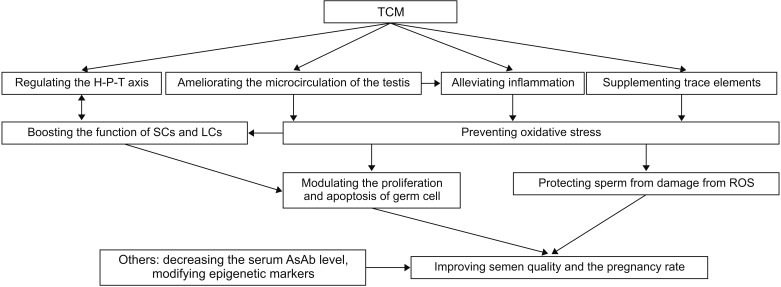
Male infertility (MI) is a complex multifactorial disease, and idiopathic infertility accounts for 30% of cases of MI. At present, the evidence for the effectiveness of empirical drugs is limited, and fertilization is costly and may increase the risk of birth defects and childhood cancers. Therefore, affected individuals may feel obliged to pursue natural remedies. Traditional Chinese medicine (TCM) may represent a useful option for infertile men. It has been demonstrated that TCM can regulate the hypothalamic-pituitary-testicular axis and boost the function of Sertoli cells and Leydig cells. TCM can also alleviate inflammation, prevent oxidative stress, reduce the DNA fragmentation index, and modulate the proliferation and apoptosis of germ cells. Furthermore, TCM can supply trace elements and vitamins, ameliorate the microcirculation of the testis, decrease the levels of serum anti-sperm antibody, and modify epigenetic markers. However, the evidence in favor of TCM is not compelling, which has hindered the development of TCM. This review attempts to elucidate the underlying therapeutic mechanisms of TCM. We also explore the advantages of TCM, differences between TCM and Western medicine, and problems in existing studies. Subsequently, we propose solutions to these problems and present perspectives for the future development of TCM.
男性不育症(MI)是一种复杂的多因素疾病,特发性不育症占MI病例的30%。目前,经验性药物有效性的证据有限,辅助生殖成本高昂,且可能增加出生缺陷和儿童期癌症的风险。因此,患者可能觉得有必要寻求天然疗法。中医(TCM)可能是不育男性的一个有用选择。已证明中医可以调节下丘脑-垂体-睾丸轴,增强支持细胞和间质细胞的功能。中医还可以减轻炎症、预防氧化应激、降低DNA碎片化指数,并调节生殖细胞的增殖和凋亡。此外,中医可以提供微量元素和维生素,改善睾丸的微循环,降低血清抗精子抗体水平,并改变表观遗传标记。然而,支持中医的证据并不确凿,这阻碍了中医的发展。本综述试图阐明中医的潜在治疗机制。我们还探讨了中医的优势、中医与西医的差异以及现有研究中的问题。随后,我们提出这些问题的解决方案,并展望中医未来的发展前景。