Keck Scholars, School of Biomedical Engineering, Colorado State University, Fort Collins, CO, USA.
Department of Chemical and Biological Engineering, Colorado State University, Fort Collins, CO, USA.
PLoS Comput Biol. 2019 Jan 15;15(1):e1006365. doi: 10.1371/journal.pcbi.1006365. eCollection 2019 Jan.
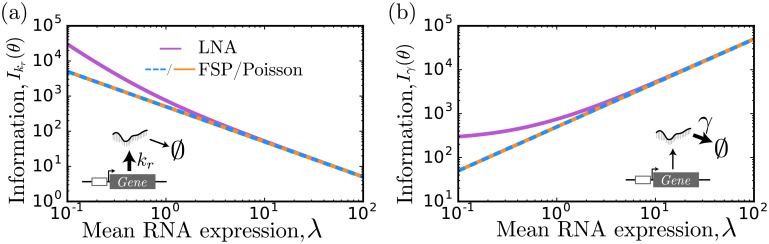
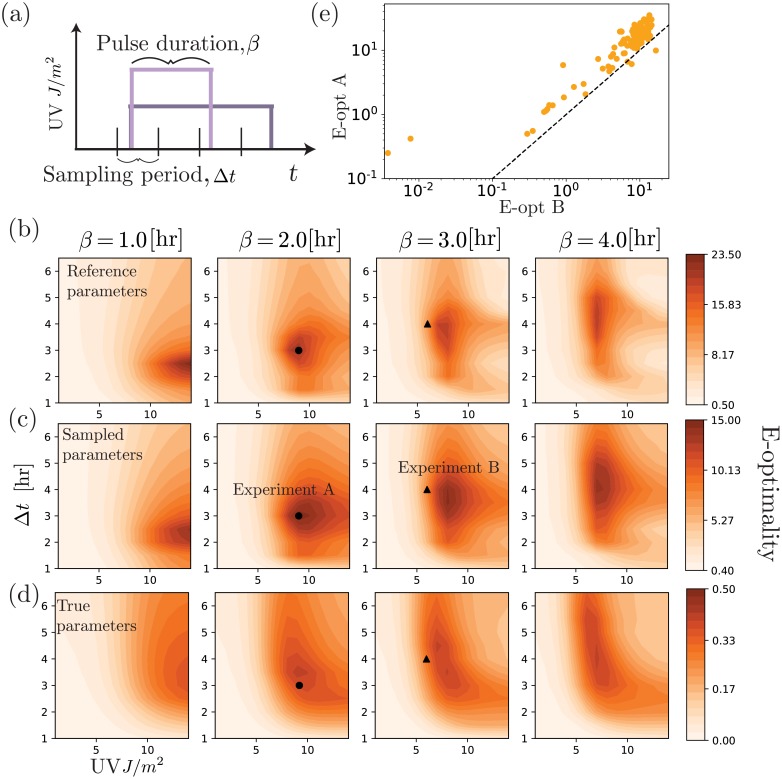
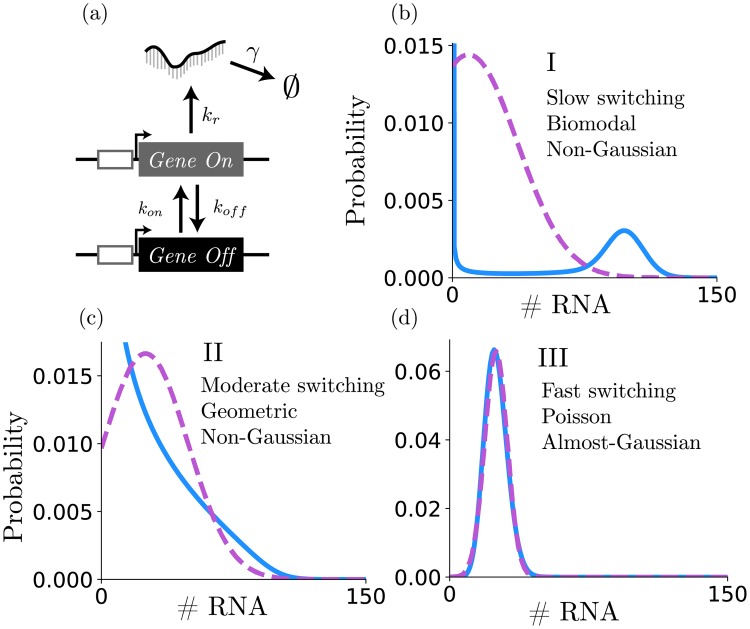
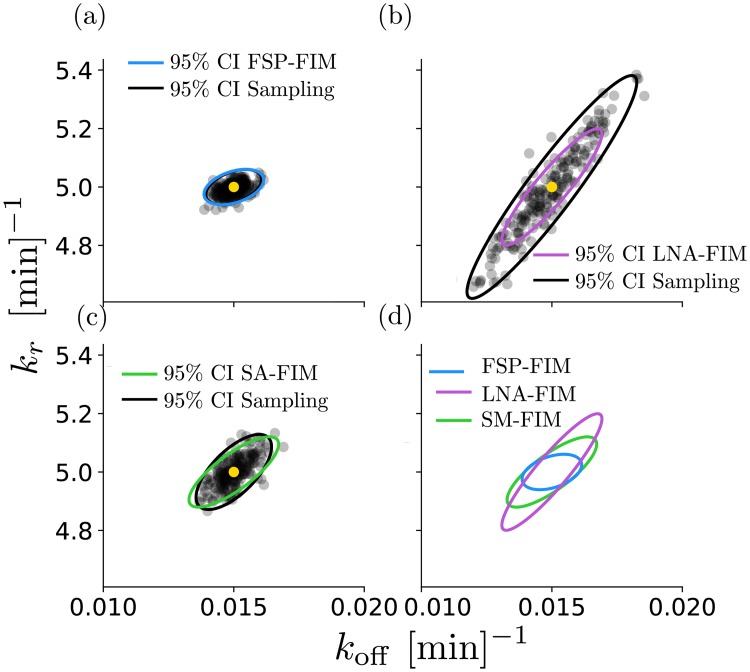
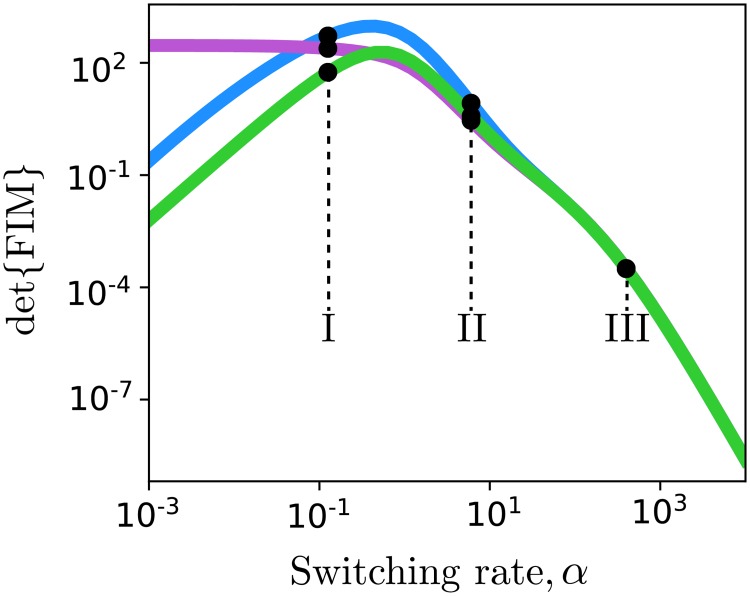
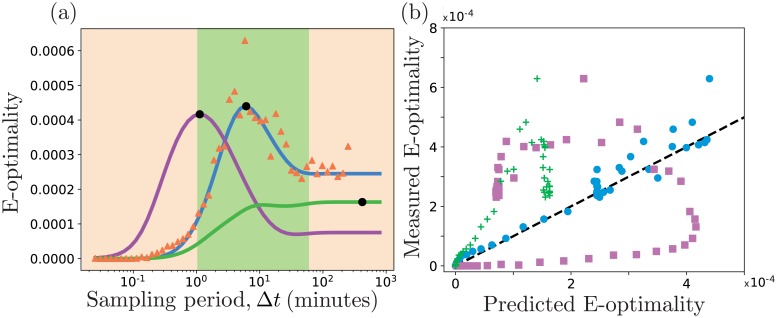
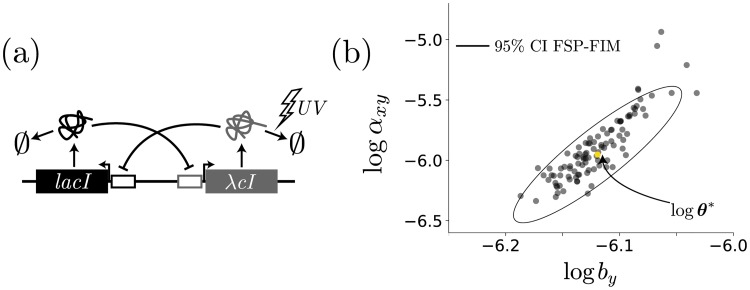
Modern optical imaging experiments not only measure single-cell and single-molecule dynamics with high precision, but they can also perturb the cellular environment in myriad controlled and novel settings. Techniques, such as single-molecule fluorescence in-situ hybridization, microfluidics, and optogenetics, have opened the door to a large number of potential experiments, which begs the question of how to choose the best possible experiment. The Fisher information matrix (FIM) estimates how well potential experiments will constrain model parameters and can be used to design optimal experiments. Here, we introduce the finite state projection (FSP) based FIM, which uses the formalism of the chemical master equation to derive and compute the FIM. The FSP-FIM makes no assumptions about the distribution shapes of single-cell data, and it does not require precise measurements of higher order moments of such distributions. We validate the FSP-FIM against well-known Fisher information results for the simple case of constitutive gene expression. We then use numerical simulations to demonstrate the use of the FSP-FIM to optimize the timing of single-cell experiments with more complex, non-Gaussian fluctuations. We validate optimal simulated experiments determined using the FSP-FIM with Monte-Carlo approaches and contrast these to experiment designs chosen by traditional analyses that assume Gaussian fluctuations or use the central limit theorem. By systematically designing experiments to use all of the measurable fluctuations, our method enables a key step to improve co-design of experiments and quantitative models.
现代光学成像实验不仅可以高精度地测量单细胞和单分子动力学,还可以在无数受控和新颖的环境中对细胞环境进行扰动。例如,单分子荧光原位杂交、微流控和光遗传学等技术为大量潜在实验开辟了大门,这就引出了如何选择最佳实验的问题。Fisher 信息矩阵 (FIM) 估计潜在实验将如何约束模型参数,并可用于设计最佳实验。在这里,我们引入了基于有限状态投影 (FSP) 的 FIM,它使用化学主方程的形式来推导和计算 FIM。FSP-FIM 不对单细胞数据的分布形状做出任何假设,也不需要对这些分布的更高阶矩进行精确测量。我们针对组成型基因表达的简单情况,验证了 FSP-FIM 与著名的 Fisher 信息结果的一致性。然后,我们使用数值模拟来演示如何使用 FSP-FIM 来优化具有更复杂、非高斯波动的单细胞实验的时间安排。我们使用蒙特卡罗方法验证了使用 FSP-FIM 确定的最佳模拟实验,并将其与假设高斯波动或使用中心极限定理的传统分析选择的实验设计进行对比。通过系统地设计实验以利用所有可测量的波动,我们的方法为改进实验和定量模型的共同设计提供了一个关键步骤。