Laboratory for Molecular and Translational Pharmacology, Department of Biomedical Sciences, Faculty of Health and Medical Sciences, University of Copenhagen, Copenhagen, Denmark.
Laboratory for Molecular and Translational Pharmacology, Department of Biomedical Sciences, Faculty of Health and Medical Sciences, University of Copenhagen, Copenhagen, Denmark
mBio. 2019 Jan 15;10(1):e01707-18. doi: 10.1128/mBio.01707-18.
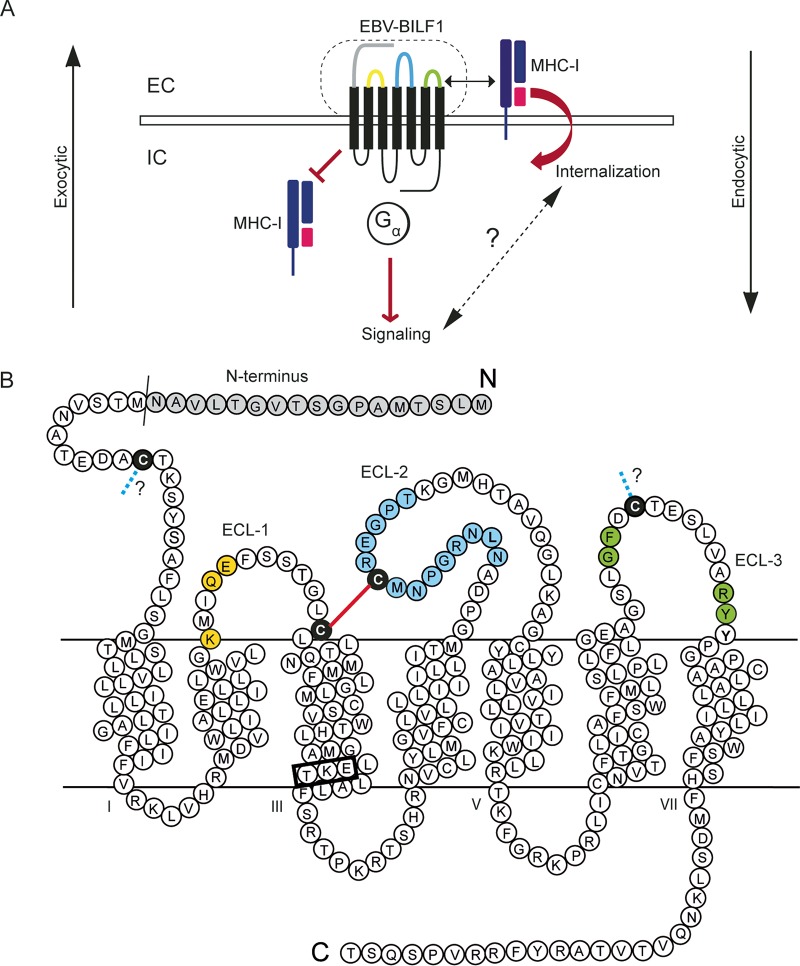
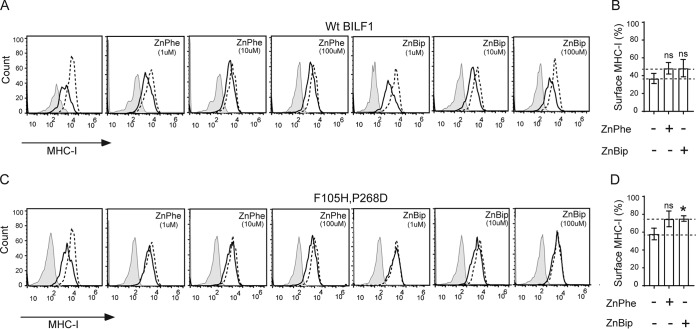
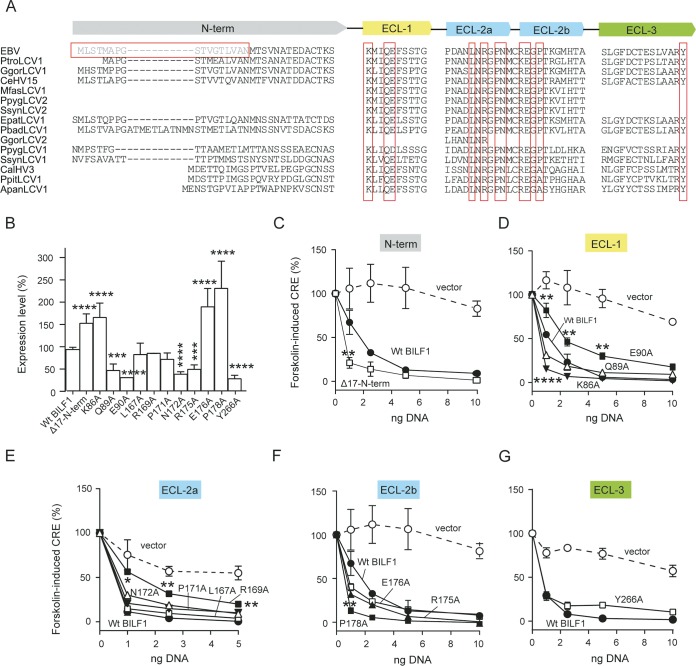
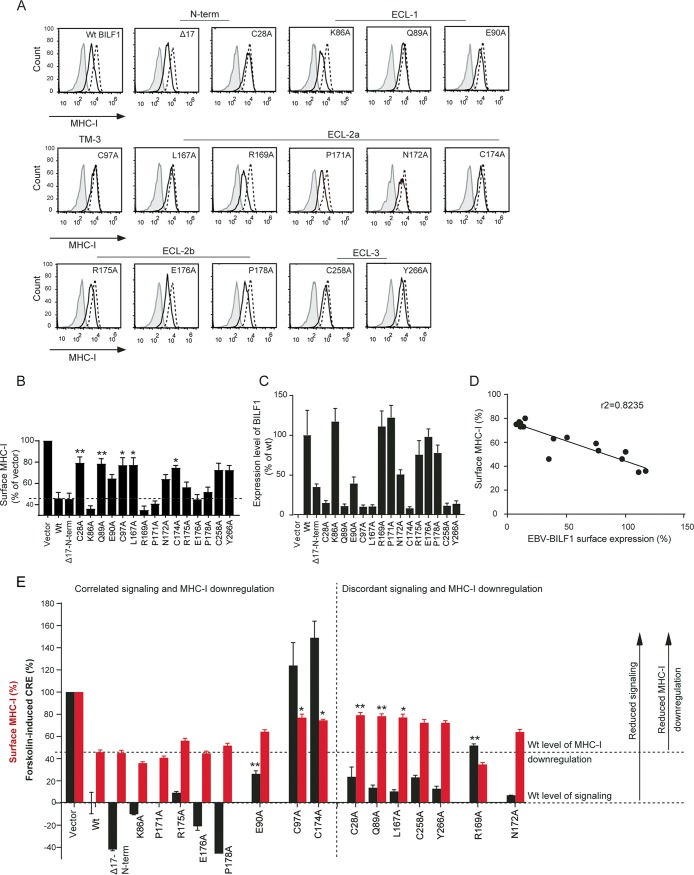
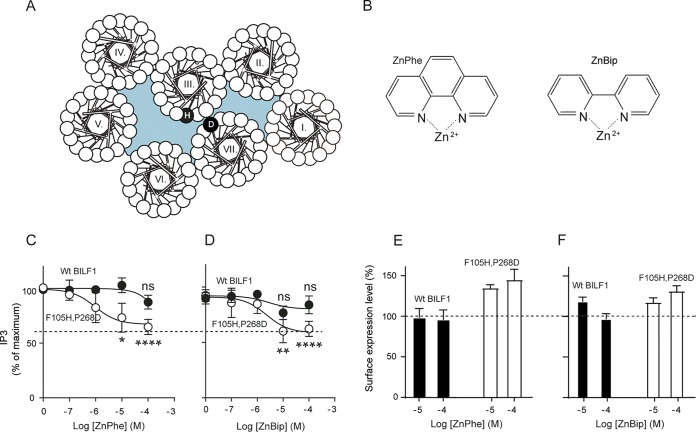
The Epstein-Barr virus (EBV) BILF1 gene encodes a constitutively active G protein-coupled receptor (GPCR) that downregulates major histocompatibility complex (MHC) class I and induces signaling-dependent tumorigenesis. Different BILF1 homologs display highly conserved extracellular loops (ECLs) including the conserved cysteine residues involved in disulfide bridges present in class A GPCRs (GPCR bridge between transmembrane helix 3 [TM-3] and ECL-2) and in chemokine receptors (CKR bridge between the N terminus and ECL-3). In order to investigate the roles of the conserved residues in the receptor functions, 25 mutations were created in the extracellular domains. Luciferase reporter assays and flow cytometry were used to investigate the G protein signaling and MHC class I downregulation in HEK293 cells. We find that the cysteine residues involved in the GPCR bridge are important for both signaling and MHC class I downregulation, whereas the cysteine residues in the N terminus and ECL-3 are dispensable for signaling but important for MHC class I downregulation. Multiple conserved residues in the extracellular regions are important for the receptor-induced MHC class I downregulation, but not for signaling, indicating distinct structural requirements for these two functions. In an engineered receptor containing a binding site for Zn ions in a complex with an aromatic chelator (phenanthroline or bipyridine), a ligand-driven inhibition of both the receptor signaling and MHC class I downregulation was observed. Taken together, this suggests that distinct regions in EBV-BILF1 can be pharmacologically targeted to inhibit the signaling-mediated tumorigenesis and interfere with the MHC class I downregulation. G protein-coupled receptors constitute the largest family of membrane proteins. As targets of >30% of the FDA-approved drugs, they are valuable for drug discovery. The receptor is composed of seven membrane-spanning helices and intracellular and extracellular domains. BILF1 is a receptor encoded by Epstein-Barr virus (EBV), which evades the host immune system by various strategies. BILF1 facilitates the virus immune evasion by downregulating MHC class I and is capable of inducing signaling-mediated tumorigenesis. BILF1 homologs from primate viruses show highly conserved extracellular domains. Here, we show that conserved residues in the extracellular domains of EBV-BILF1 are important for downregulating MHC class I and that the receptor signaling and immune evasion can be inhibited by drug-like small molecules. This suggests that BILF1 could be a target to inhibit the signaling-mediated tumorigenesis and interfere with the MHC class I downregulation, thereby facilitating virus recognition by the immune system.
EB 病毒(EBV)BILF1 基因编码一种组成型激活的 G 蛋白偶联受体(GPCR),它下调主要组织相容性复合体(MHC)I 类并诱导信号依赖性肿瘤发生。不同的 BILF1 同源物显示高度保守的细胞外环(ECL),包括涉及 A 类 GPCR 中二硫键的保守半胱氨酸残基(跨膜螺旋 3 [TM-3]和 ECL-2 之间的 GPCR 桥)和趋化因子受体(N 末端和 ECL-3 之间的 CKR 桥)。为了研究保守残基在受体功能中的作用,在细胞外结构域中创建了 25 个突变。使用荧光素酶报告基因测定和流式细胞术研究了 HEK293 细胞中的 G 蛋白信号和 MHC I 类下调。我们发现,涉及 GPCR 桥的半胱氨酸残基对于信号和 MHC I 类下调都是重要的,而 N 末端和 ECL-3 中的半胱氨酸残基对于信号是可有可无的,但对于 MHC I 类下调是重要的。细胞外区域的多个保守残基对于受体诱导的 MHC I 类下调很重要,但对于信号不是必需的,表明这两种功能具有不同的结构要求。在含有与芳族螯合剂(邻菲咯啉或联吡啶)结合的 Zn 离子结合位点的工程化受体中,观察到配体驱动的受体信号和 MHC I 类下调的抑制。综上所述,这表明 EBV-BILF1 中的不同区域可以通过药理学靶向来抑制信号介导的肿瘤发生并干扰 MHC I 类下调。G 蛋白偶联受体构成最大的膜蛋白家族。作为 >30%FDA 批准药物的靶点,它们是药物发现的宝贵资源。该受体由七个跨膜螺旋和细胞内和细胞外结构域组成。BILF1 是 Epstein-Barr 病毒(EBV)编码的受体,它通过各种策略逃避宿主免疫系统。BILF1 通过下调 MHC I 类来促进病毒免疫逃逸,并能够诱导信号介导的肿瘤发生。来自灵长类病毒的 BILF1 同源物显示出高度保守的细胞外结构域。在这里,我们表明 EBV-BILF1 的细胞外结构域中的保守残基对于下调 MHC I 类很重要,并且可以通过类药小分子抑制受体信号和免疫逃逸。这表明 BILF1 可以作为抑制信号介导的肿瘤发生和干扰 MHC I 类下调的靶点,从而促进免疫系统对病毒的识别。