Zuo Jianmin, Currin Andrew, Griffin Bryan D, Shannon-Lowe Claire, Thomas Wendy A, Ressing Maaike E, Wiertz Emmanuel J H J, Rowe Martin
Cancer Research-UK Institute for Cancer Studies, School of Cancer Sciences, University of Birmingham, Edgbaston, Birmingham, United Kingdom.
PLoS Pathog. 2009 Jan;5(1):e1000255. doi: 10.1371/journal.ppat.1000255. Epub 2009 Jan 2.
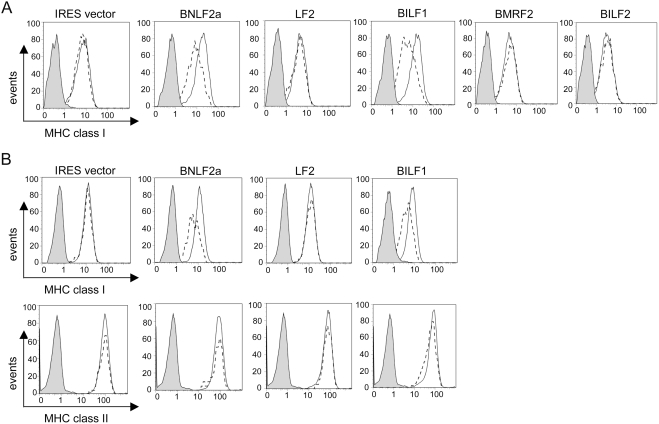
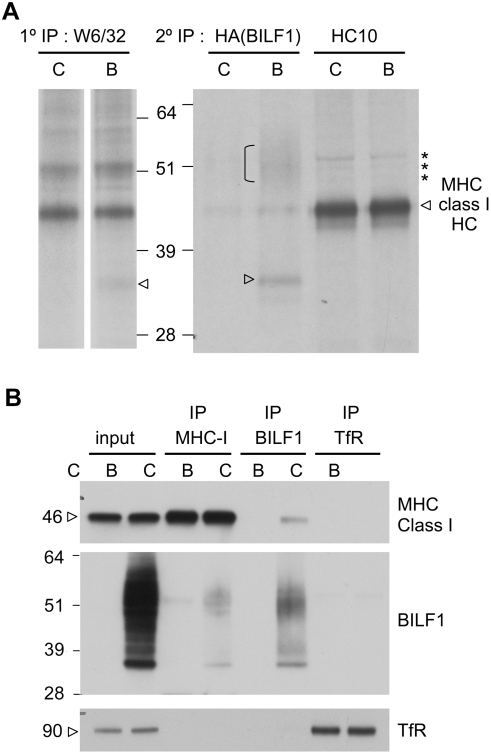
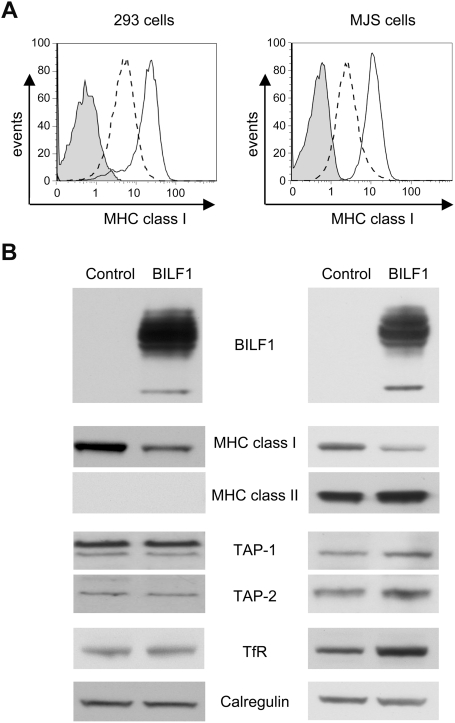
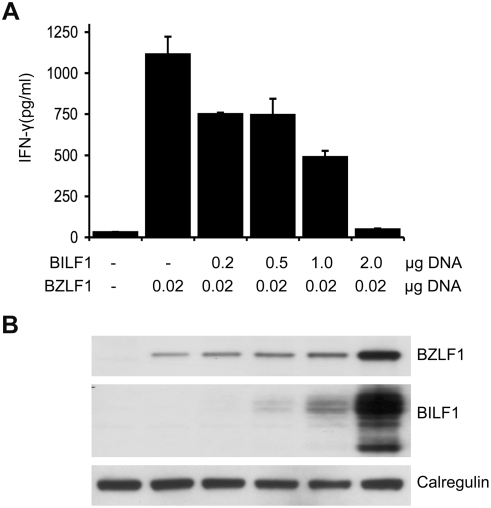
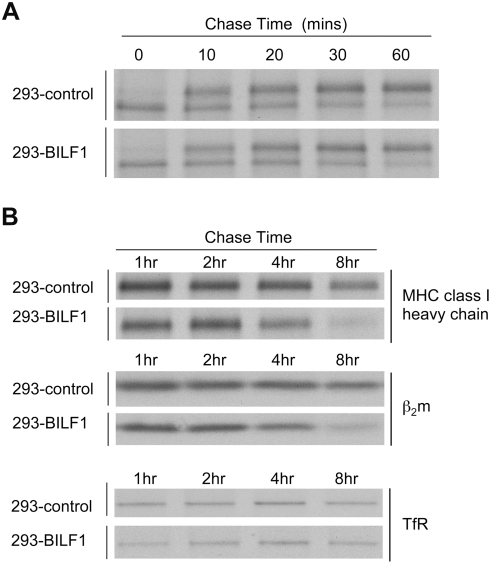
Epstein-Barr virus (EBV) is a human herpesvirus that persists as a largely subclinical infection in the vast majority of adults worldwide. Recent evidence indicates that an important component of the persistence strategy involves active interference with the MHC class I antigen processing pathway during the lytic replication cycle. We have now identified a novel role for the lytic cycle gene, BILF1, which encodes a glycoprotein with the properties of a constitutive signaling G-protein-coupled receptor (GPCR). BILF1 reduced the levels of MHC class I at the cell surface and inhibited CD8(+) T cell recognition of endogenous target antigens. The underlying mechanism involves physical association of BILF1 with MHC class I molecules, an increased turnover from the cell surface, and enhanced degradation via lysosomal proteases. The BILF1 protein of the closely related CeHV15 gamma(1)-herpesvirus of the Rhesus Old World primate (80% amino acid sequence identity) downregulated surface MHC class I similarly to EBV BILF1. Amongst the human herpesviruses, the GPCR encoded by the ORF74 of the KSHV gamma(2)-herpesvirus is most closely related to EBV BILF1 (15% amino acid sequence identity) but did not affect levels of surface MHC class I. An engineered mutant of BILF1 that was unable to activate G protein signaling pathways retained the ability to downregulate MHC class I, indicating that the immune-modulating and GPCR-signaling properties are two distinct functions of BILF1. These findings extend our understanding of the normal biology of an important human pathogen. The discovery of a third EBV lytic cycle gene that cooperates to interfere with MHC class I antigen processing underscores the importance of the need for EBV to be able to evade CD8(+) T cell responses during the lytic replication cycle, at a time when such a large number of potential viral targets are expressed.
爱泼斯坦-巴尔病毒(EBV)是一种人类疱疹病毒,在全球绝大多数成年人中主要以亚临床感染的形式持续存在。最近的证据表明,这种持续感染策略的一个重要组成部分涉及在裂解复制周期中对MHC I类抗原加工途径的主动干扰。我们现在已经确定了裂解周期基因BILF1的一个新作用,该基因编码一种具有组成型信号传导G蛋白偶联受体(GPCR)特性的糖蛋白。BILF1降低了细胞表面MHC I类分子的水平,并抑制了CD8(+) T细胞对内源性靶抗原的识别。其潜在机制包括BILF1与MHC I类分子的物理结合、细胞表面周转率的增加以及通过溶酶体蛋白酶的降解增强。恒河猴旧世界灵长类动物的密切相关的CeHV15γ(1)-疱疹病毒的BILF1蛋白(氨基酸序列同一性为80%)与EBV BILF1类似地下调表面MHC I类分子。在人类疱疹病毒中,卡波西肉瘤相关疱疹病毒(KSHV)γ(2)-疱疹病毒的ORF74编码的GPCR与EBV BILF1关系最为密切(氨基酸序列同一性为15%)但不影响表面MHC I类分子的水平。一种无法激活G蛋白信号通路的BILF1工程突变体保留了下调MHC I类分子的能力,这表明免疫调节和GPCR信号传导特性是BILF1的两种不同功能。这些发现扩展了我们对一种重要人类病原体正常生物学的理解。发现第三个协同干扰MHC I类抗原加工的EBV裂解周期基因强调了EBV在裂解复制周期中能够逃避CD8(+) T细胞反应的重要性,此时会表达大量潜在的病毒靶标。