Department of Veterinary and Animal Sciences, University of Copenhagen, Frederiksberg, Denmark
Department of Bacteria, Parasites and Fungi, Statens Serum Institut, Copenhagen, Denmark.
mSphere. 2019 Jan 16;4(1):e00333-18. doi: 10.1128/mSphere.00333-18.
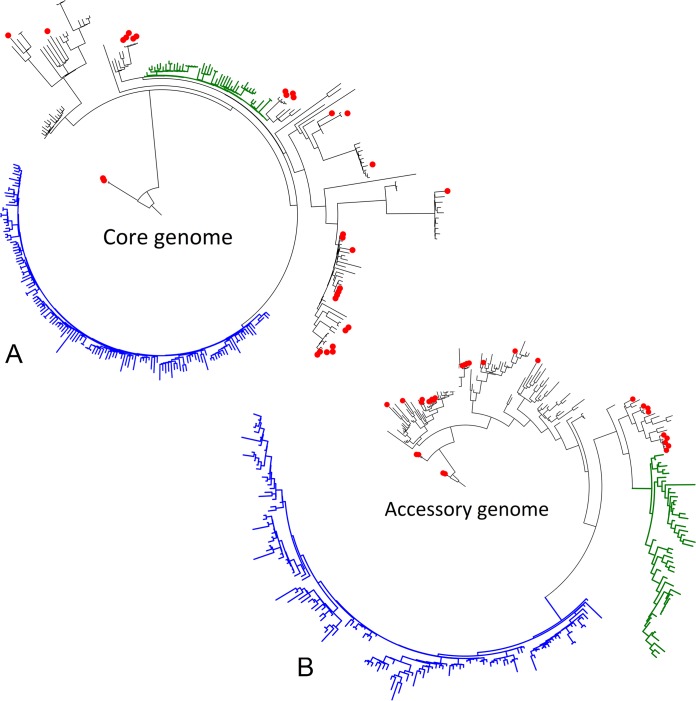
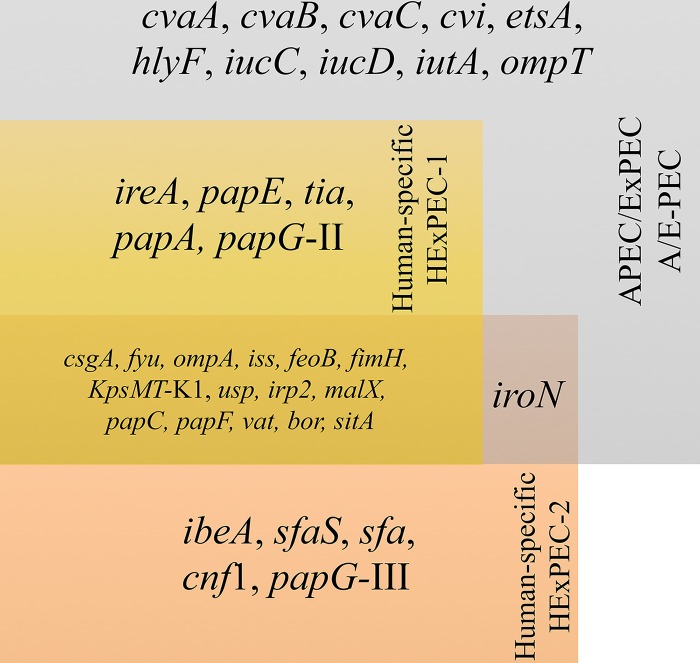
Avian-pathogenic (APEC) is a subgroup of extraintestinal pathogenic (ExPEC) presumed to be zoonotic and to represent an external reservoir for extraintestinal infections in humans, including uropathogenic (UPEC) causing urinary tract infections. Comparative genomics has previously been applied to investigate whether APEC and human ExPEC are distinct entities. Even so, whole-genome-based studies are limited, and large-scale comparisons focused on single sequence types (STs) are not available yet. In this study, comparative genomic analysis was performed on 323 APEC and human ExPEC genomes belonging to sequence type 95 (ST95) to investigate whether APEC and human ExPEC are distinct entities. Our study showed that APEC of ST95 did not constitute a unique ExPEC branch and was genetically diverse. A large genetic overlap between APEC and certain human ExPEC was observed, with APEC located on multiple branches together with closely related human ExPEC, including nearly identical APEC and human ExPEC. These results illustrate that certain ExPEC clones may indeed have the potential to cause infection in both poultry and humans. Previously described ExPEC-associated genes were found to be encoded on ColV plasmids. These virulence-associated plasmids seem to be crucial for ExPEC strains to cause avian colibacillosis and are strongly associated with strains of the mixed APEC/human ExPEC clusters. The phylogenetic analysis revealed two distinct branches consisting of exclusively closely related human ExPEC which did not carry the virulence-associated plasmids, emphasizing a lower avian virulence potential of human ExPEC in relation to an avian host. APEC causes a range of infections in poultry, collectively called colibacillosis, and is the leading cause of mortality and is associated with major economic significance in the poultry industry. A growing number of studies have suggested APEC as an external reservoir of human ExPEC, including UPEC, which is a reservoir. ExPEC belonging to ST95 is considered one of the most important pathogens in both poultry and humans. This study is the first in-depth whole-genome-based comparison of ST95 which investigates both the core genomes as well as the accessory genomes of avian and human ExPEC. We demonstrated that multiple lineages of ExPEC belonging to ST95 exist, of which the majority may cause infection in humans, while only part of the ST95 cluster seem to be avian pathogenic. These findings further support the idea that urinary tract infections may be a zoonotic infection.
禽致病性大肠杆菌(APEC)是肠外致病性大肠杆菌(ExPEC)的一个亚群,被认为具有人畜共患性,并代表人类肠外感染的外部储库,包括引起尿路感染的尿路致病性大肠杆菌(UPEC)。比较基因组学以前曾被用于研究 APEC 和人 ExPEC 是否为不同的实体。即便如此,基于全基因组的研究仍然有限,而且针对单一序列型(ST)的大规模比较尚未进行。在这项研究中,对属于序列型 95(ST95)的 323 株 APEC 和人 ExPEC 基因组进行了比较基因组分析,以研究 APEC 和人 ExPEC 是否为不同的实体。我们的研究表明,ST95 的 APEC 并未构成独特的 ExPEC 分支,而是具有遗传多样性。APEC 和某些人 ExPEC 之间存在大量的遗传重叠,APEC 位于与密切相关的人 ExPEC 一起的多个分支上,包括几乎相同的 APEC 和人 ExPEC。这些结果表明,某些 ExPEC 克隆确实有可能在禽类和人类中引起感染。以前描述的 ExPEC 相关基因被发现编码在 ColV 质粒上。这些与毒力相关的质粒似乎对 ExPEC 菌株引起禽大肠杆菌病至关重要,并且与混合的 APEC/人 ExPEC 群的菌株密切相关。系统发育分析显示,由仅密切相关的人 ExPEC 组成的两个独特分支不携带毒力相关质粒,这强调了人 ExPEC 对禽类宿主的低禽致病性潜力。APEC 引起家禽的多种感染,统称为大肠杆菌病,是死亡率的主要原因,在禽类行业具有重大的经济意义。越来越多的研究表明,APEC 是人 ExPEC,包括 UPEC 的外部储库。属于 ST95 的 ExPEC 被认为是禽类和人类中最重要的病原体之一。这项研究是对 ST95 进行的首次深入的基于全基因组的比较,研究了禽和人 ExPEC 的核心基因组和辅助基因组。我们证明了属于 ST95 的 ExPEC 存在多个谱系,其中大多数可能导致人类感染,而只有一部分 ST95 簇似乎对禽类具有致病性。这些发现进一步支持了尿路感染可能是一种人畜共患感染的观点。