Wang Yeli, Sun Liang, Lin Xu, Yuan Jian-Min, Koh Woon-Puay, Pan An
1Health Services and Systems Research, Duke-NUS Medical School, Singapore, 169857 Singapore.
2CAS Key Laboratory of Nutrition, Metabolism and Food safety, Shanghai Institute of Nutrition and Health, Shanghai Institutes for Biological Sciences, University of Chinese Academy of Sciences, Chinese Academy of Sciences, Shanghai, 200031 China.
Nutr Metab (Lond). 2019 Jan 10;16:3. doi: 10.1186/s12986-018-0329-0. eCollection 2019.
Although retinol binding protein 4 (RBP4) has been implicated in insulin resistance in experimental studies, the association between RBP4 and risk of type 2 diabetes remains unclear. We assessed this association in a Chinese population, and pooled our results with those from two prior studies.
Plasma RBP4 levels were measured among 571 incident type 2 diabetes cases and 571 controls nested within the Singapore Chinese Health Study. All participants were free of diabetes, cancer and cardiovascular disease at blood collection (1999-2004). Incident cases of physician-diagnosed diabetes were self-reported at subsequent interviews (2006-2010).
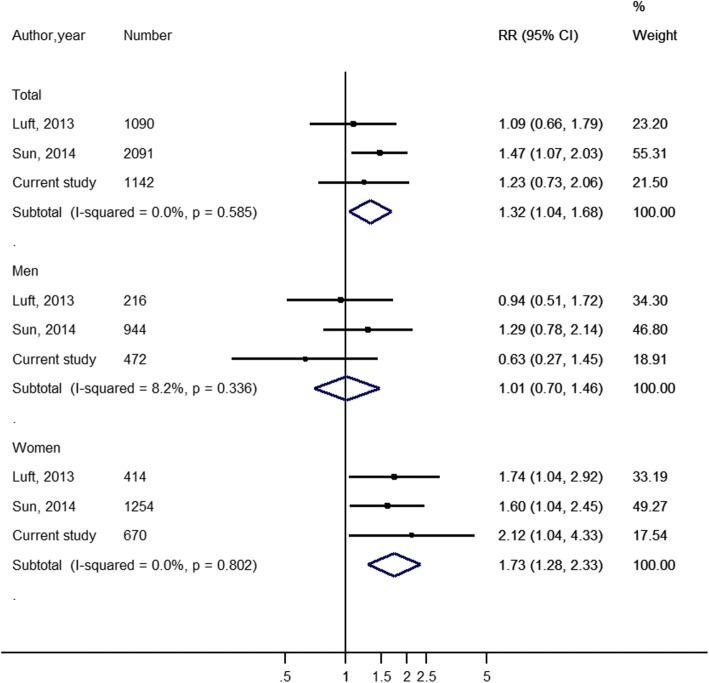
Plasma RBP4 levels were significantly higher in men than women, and the respective median values were 30 (interquartile range: 24-35) μg/mL and 25 (interquartile range: 21-31) μg/mL, respectively. With adjustment for diabetes risk factors, compared to the lowest quartile, the odds ratio (OR) and confidence interval (CI) for risk of type 2 diabetes associated with the highest quartile of RBP4 levels were 1.23 (0.73-2.07; -trend = 0.14) in all subjects, 0.63 (0.27-1.45; -trend = 0.65) in men, and 2.29 (1.05-5.00; -trend = 0.018) in women. The difference in the risk estimates between men and women was statistically significant (-interaction = 0.032). When we pooled our results with two prior studies, ORs (95% CIs) comparing high versus low category of RBP4 was 1.01 (0.70-1.46; = 8.2%; -heterogeneity = 0.34) in men, and 1.73 (1.28-2.33; = 0%; -heterogeneity = 0.80) in women.
Increased plasma RBP4 levels were associated with higher risk of type 2 diabetes in women but not in men.
尽管在实验研究中视黄醇结合蛋白4(RBP4)与胰岛素抵抗有关,但RBP4与2型糖尿病风险之间的关联仍不明确。我们在中国人群中评估了这种关联,并将我们的结果与之前两项研究的结果进行了汇总。
在新加坡华人健康研究中纳入的571例2型糖尿病新发病例和571例对照中测量血浆RBP4水平。所有参与者在采血时(1999 - 2004年)均无糖尿病、癌症和心血管疾病。医生诊断的糖尿病新发病例在随后的访谈中(2006 - 2010年)进行自我报告。
男性的血浆RBP4水平显著高于女性,各自的中位数分别为30(四分位间距:24 - 35)μg/mL和25(四分位间距:21 - 31)μg/mL。在调整糖尿病风险因素后,与最低四分位数相比,RBP4水平最高四分位数与2型糖尿病风险相关的比值比(OR)和置信区间(CI)在所有受试者中为1.23(0.73 - 2.07;P趋势 = 0.14),在男性中为0.63(0.27 - 1.45;P趋势 = 0.65),在女性中为2.29(1.05 - 5.00;P趋势 = 0.018)。男性和女性风险估计值的差异具有统计学意义(P交互作用 = 0.032)。当我们将我们的结果与之前两项研究的结果进行汇总时,比较RBP4高类别与低类别的OR(95%CI)在男性中为1.01(0.70 - 1.46;P = 8.2%;P异质性 = 0.34),在女性中为1.73(1.28 - 2.33;P = 0%;P异质性 = 0.80)。
血浆RBP4水平升高与女性而非男性患2型糖尿病的风险较高有关。