Pathogen and Microbiome Institute, Northern Arizona University, Flagstaff, Arizona.
Department of Biological Sciences, Northern Arizona University, Flagstaff, Arizona.
Cancer Med. 2019 Feb;8(2):617-628. doi: 10.1002/cam4.1965. Epub 2019 Jan 16.
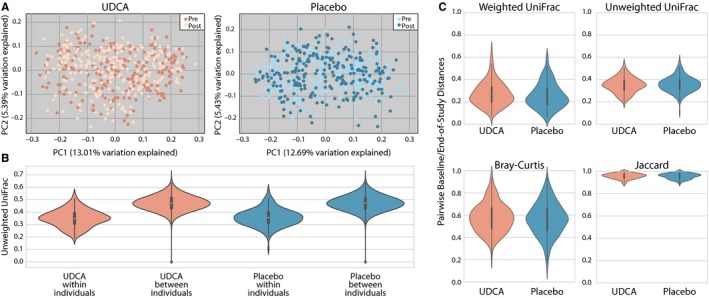
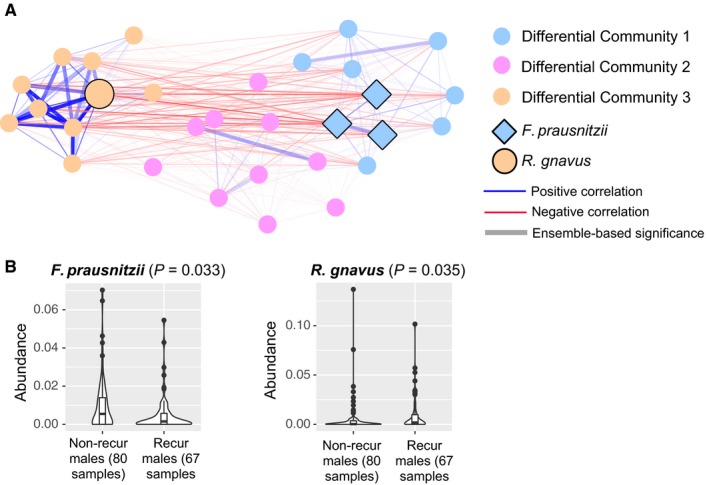
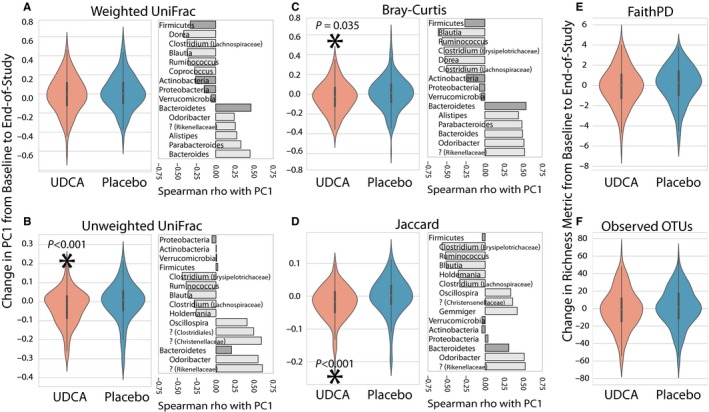
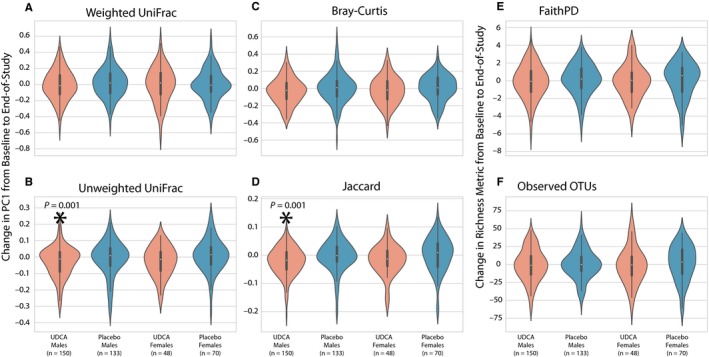
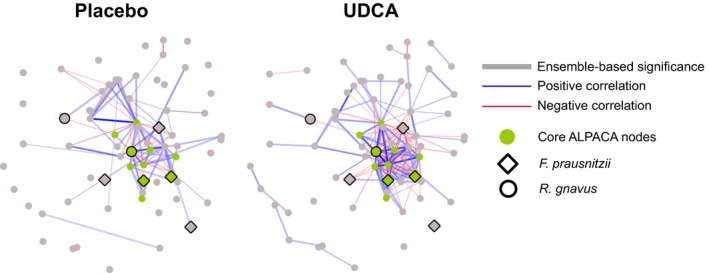
It has been previously reported that ursodeoxycholic acid (UDCA), a therapeutic bile acid, reduced risk for advanced colorectal adenoma in men but not women. Interactions between the gut microbiome and fecal bile acid composition as a factor in colorectal cancer neoplasia have been postulated but evidence is limited to small cohorts and animal studies. Using banked stool samples collected as part of a phase III randomized clinical trial of UDCA for the prevention of colorectal adenomatous polyps, we compared change in the microbiome composition after a 3-year intervention in a subset of participants randomized to oral UDCA at 8-10 mg/kg of body weight per day (n = 198) or placebo (n = 203). Study participants randomized to UDCA experienced compositional changes in their microbiome that were statistically more similar to other individuals in the UDCA arm than to those in the placebo arm. This reflected a UDCA-associated shift in microbial community composition (P < 0.001), independent of sex, with no evidence of a UDCA effect on microbial richness (P > 0.05). These UDCA-associated shifts in microbial community distance metrics from baseline to end-of-study were not associated with risk of any or advanced adenoma (all P > 0.05) in men or women. Separate analyses of microbial networks revealed an overrepresentation of Faecalibacterium prausnitzii in the post-UDCA arm and an inverse relationship between F prausnitzii and Ruminococcus gnavus. In men who received UDCA, the overrepresentation of F prausnitzii and underrepresentation of R gnavus were more prominent in those with no adenoma recurrence at follow-up compared to men with recurrence. This relationship was not observed in women. Daily UDCA use modestly influences the relative abundance of microbial species in stool and affects the microbial network composition with suggestive evidence for sex-specific effects of UDCA on stool microbial community composition as a modifier of colorectal adenoma risk.
先前有报道称,熊去氧胆酸(UDCA)作为一种治疗性胆酸,可以降低男性而不是女性发生晚期结直肠腺瘤的风险。肠道微生物组与粪便胆酸组成之间的相互作用作为结直肠癌肿瘤发生的一个因素已经被提出,但证据仅限于小队列和动物研究。本研究使用作为 III 期随机临床试验的一部分收集的银行粪便样本,该试验评估了 UDCA 用于预防结直肠腺瘤性息肉,我们比较了在一组参与者中,经过 3 年的干预后微生物组组成的变化,这些参与者被随机分配口服 UDCA 8-10mg/kg 体重/天(n=198)或安慰剂(n=203)。与安慰剂组相比,随机分配到 UDCA 组的研究参与者的微生物组发生了统计学上更相似的组成变化。这反映了 UDCA 相关的微生物群落组成的变化(P<0.001),与性别无关,没有证据表明 UDCA 对微生物丰富度有影响(P>0.05)。这些 UDCA 相关的微生物群落距离指标从基线到研究结束的变化与男性或女性的任何或晚期腺瘤的风险无关(所有 P>0.05)。对微生物网络的单独分析显示,在 UDCA 后组中普氏粪杆菌的过度表达,以及 F prausnitzii 和 Ruminococcus gnavus 之间的反比关系。在接受 UDCA 的男性中,与无腺瘤复发的男性相比,F prausnitzii 的过度表达和 R gnavus 的低表达在随访时更为突出。在女性中没有观察到这种关系。UDCA 的每日使用适度影响粪便中微生物物种的相对丰度,并影响微生物网络组成,提示 UDCA 对粪便微生物群落组成具有性别特异性影响,作为结直肠腺瘤风险的修饰剂。