Laboratory of Vaccines and Immunotherapeutics, Institute of Bioscience, Universiti Putra Malaysia, 43400, Serdang, Selangor, Malaysia.
Centre of Drug Delivery Research, Faculty of Pharmacy, Universiti Kebangsaan Malaysia, Jalan Raja Muda Abdul Aziz, 50300, Kuala Lumpur, Malaysia.
BMC Complement Altern Med. 2019 Jan 17;19(1):20. doi: 10.1186/s12906-018-2427-y.
Impaired wound healing is a debilitating complication of diabetes that leads to significant morbidity, particularly foot ulcers. The risk of developing diabetic foot ulcers for diabetic patients is 15% over their lifetime and approximately 85% of limb amputations is caused by non-healing ulcers. Unhealed, gangrenous wounds destroy the structural integrity of the skin, which acts as a protective barrier that prevents the invasion of external noxious agents into the body. Vicenin-2 (VCN-2) has been reported to contain prospective anti-oxidant and anti-inflammatory properties that enhance cell proliferation and migration. Sodium Alginate (SA) is a natural polysaccharide that possesses gel forming properties and has biodegradable and biocompatible characteristics. Therefore, the objective of this study is to evaluate the effect of SA wound dressings containing VCN-2 on diabetic wounds.
Wounds were inflicted in type-1 diabetic-streptozotocin (STZ) induced male Sprague Dawley rats. Subsequently, relevant groups were topically treated with the indicated concentrations (12.5, 25 and 50 μM) of VCN-2 hydrocolloid film over the study duration (14 days). The control group was treated with vehicle dressing (blank or allantoin). Wounded tissues and blood serum were collected on 0, 7 and 14 days prior to sacrifice. Appropriate wound assessments such as histological tests, nitric oxide assays, enzyme-linked immunosorbent assays (ELISA) and immunoblotting assays were conducted to confirm wound healing efficacy in the in vivo model. One-way Analysis of Variance (ANOVA) was used for statistical analysis.
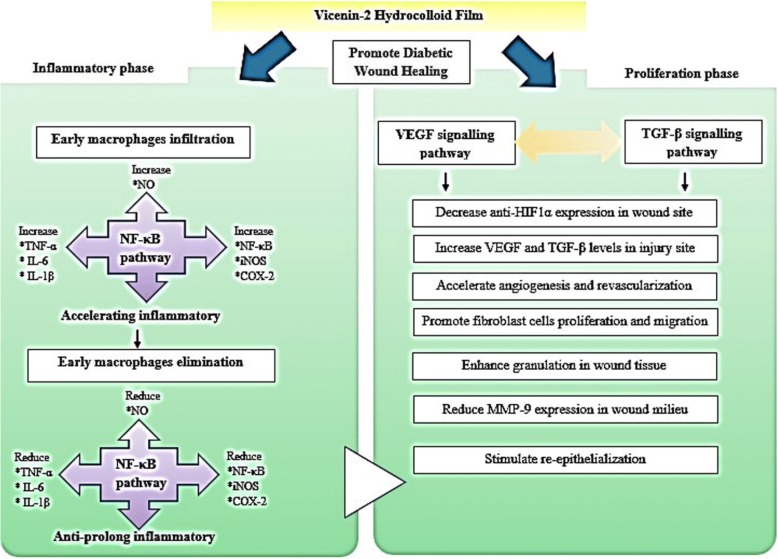
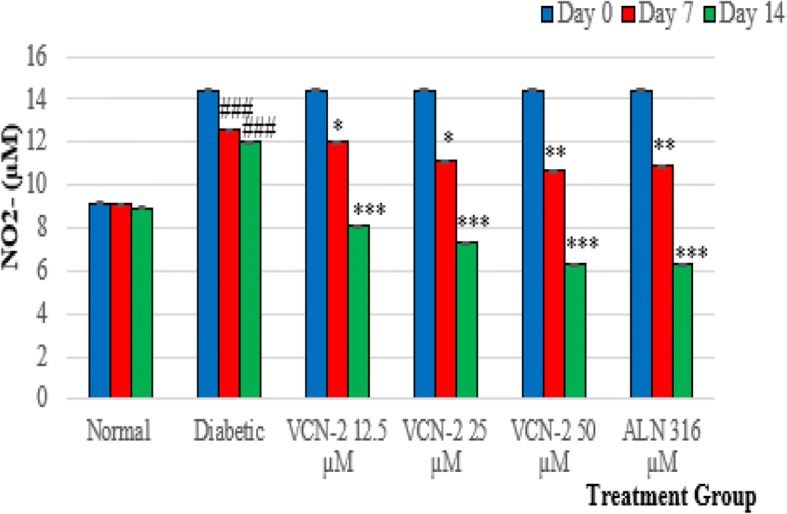
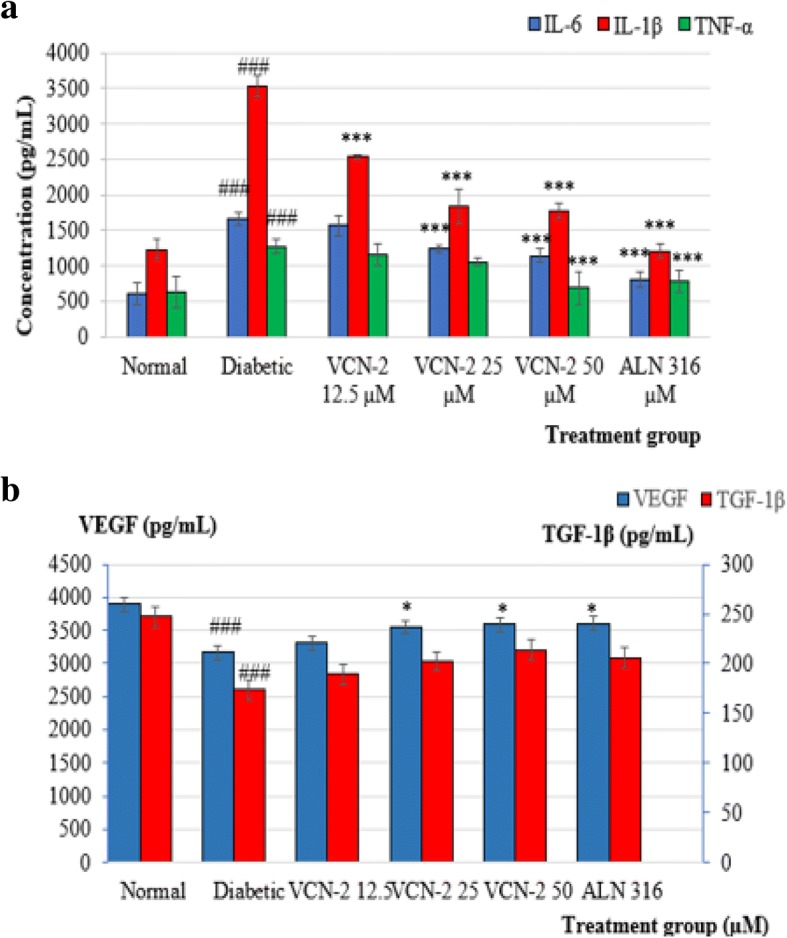
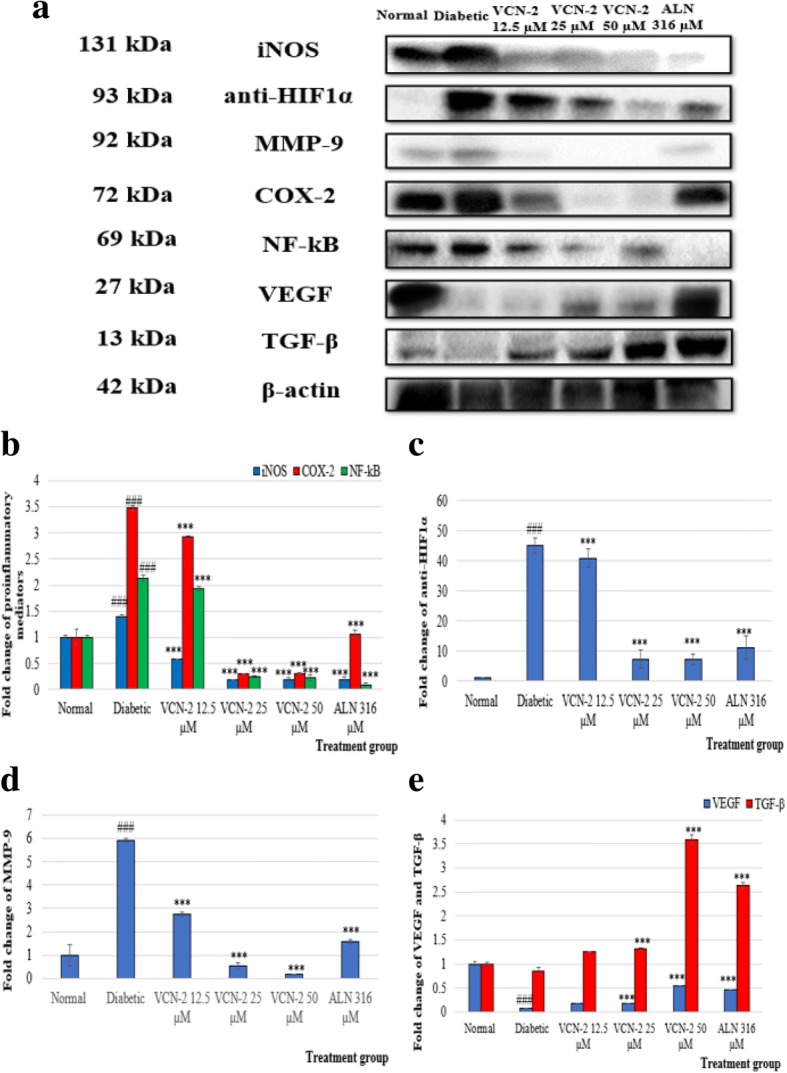
Results showed that hydrocolloid film was recapitulated with VCN-2 enhanced diabetic wound healing in a dose-dependent manner. VCN-2 reduced pro-inflammatory cytokines (IL-1β, IL-6 and TNF-α), mediators (iNOS and COX-2), and nitric oxide (NO) via the NF-κB pathway. Data suggests that the VCN-2 film facilitated healing in hyperglycemic conditions by releasing growth factors such as (VEGF and TGF-β) to enhance cell proliferation, migration, and wound contraction via the VEGF and TGF-β mechanism pathways.
This study's findings suggest that VCN-2 may possess wound healing potential since topical treatment with VCN-2 hydrocolloid films effectively enhanced wound healing in hyperglycemic conditions.
伤口愈合受损是糖尿病的一种使人虚弱的并发症,会导致严重的发病率,尤其是足部溃疡。糖尿病患者一生中患糖尿病足溃疡的风险为 15%,大约 85%的肢体截肢是由于溃疡无法愈合引起的。未愈合的坏疽性伤口会破坏皮肤的结构完整性,皮肤作为一种保护屏障,可防止外部有害物质侵入体内。vicenin-2 (VCN-2) 已被报道具有有前景的抗氧化和抗炎特性,可增强细胞增殖和迁移。海藻酸钠 (SA) 是一种天然多糖,具有形成凝胶的特性,具有可生物降解和生物相容性的特点。因此,本研究的目的是评估含有 VCN-2 的 SA 伤口敷料对糖尿病伤口的影响。
在 1 型糖尿病-链脲佐菌素 (STZ) 诱导的雄性 Sprague Dawley 大鼠中造成伤口。随后,在研究期间(14 天),相关组用 12.5、25 和 50 μM 浓度的 VCN-2 水胶体膜进行局部治疗。对照组用载体敷料(空白或尿囊素)治疗。在处死前的 0、7 和 14 天收集受伤组织和血清。进行适当的伤口评估,如组织学测试、一氧化氮测定、酶联免疫吸附测定 (ELISA) 和免疫印迹测定,以确认体内模型中的伤口愈合效果。使用单因素方差分析 (ANOVA) 进行统计分析。
结果表明,水胶体膜与 VCN-2 一起以剂量依赖性方式增强糖尿病伤口愈合。VCN-2 通过 NF-κB 途径减少促炎细胞因子(IL-1β、IL-6 和 TNF-α)、介质(iNOS 和 COX-2)和一氧化氮 (NO)。数据表明,VCN-2 膜通过释放生长因子(如 VEGF 和 TGF-β)来促进细胞增殖、迁移和通过 VEGF 和 TGF-β 机制途径收缩来促进伤口愈合,从而在高血糖条件下促进愈合。
本研究的结果表明,VCN-2 可能具有伤口愈合潜力,因为局部应用 VCN-2 水胶体膜可有效增强高血糖条件下的伤口愈合。