Blough Jordan T, Vu Michael M, Qiu Cecil S, Mlodinow Alexei S, Khavanin Nima, Fine Neil A, Kim John Y S
Department of Surgery, Division of Plastic and Reconstructive Surgery, Northwestern University Feinberg School of Medicine, Chicago, Ill.
Department of Plastic and Reconstructive Surgery, Johns Hopkins Hospital, Baltimore, Md.
Plast Reconstr Surg Glob Open. 2018 Dec 12;6(12):e2065. doi: 10.1097/GOX.0000000000002065. eCollection 2018 Dec.
Despite growing use of surgical risk calculators, many are limited to 30-day outcomes due to the constraints of their underlying datasets. Because complications of breast reconstruction can occur well beyond 30 days after surgery, we endeavored to expand the Breast Reconstruction Risk Assessment (BRA) Score to prediction of 1-year complications after primary prosthetic breast reconstruction.
We examined our prospective intrainstitutional database of prosthetic breast reconstructions from 2004 to 2015. Patients without 1-year follow-up were excluded. Pertinent patient variables include those enumerated in past iterations of the BRA Score. Outcomes of interest include seroma, surgical site infection (SSI), implant exposure, and explantation occurring within 1 year of tissue expander placement. Risk calculators were developed for each outcome using multivariate logistic regression models and made available online at www.BRAScore.org. Internal validity was assessed using C-statistic, Hosmer-Lemeshow test, and Brier score.
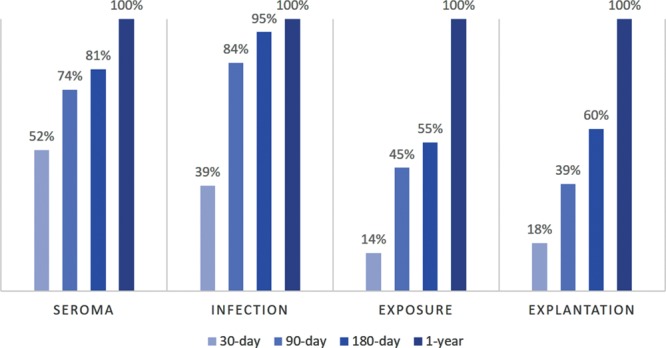
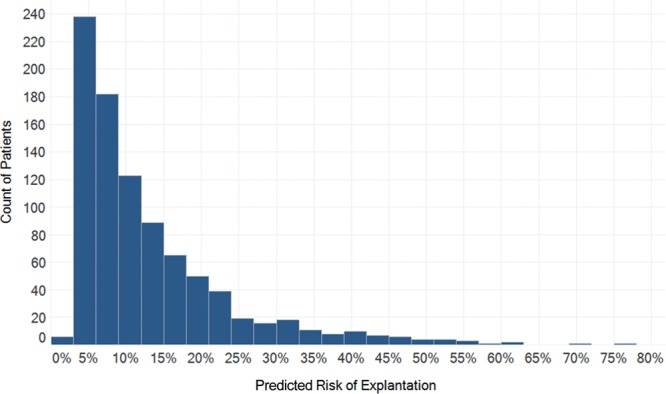
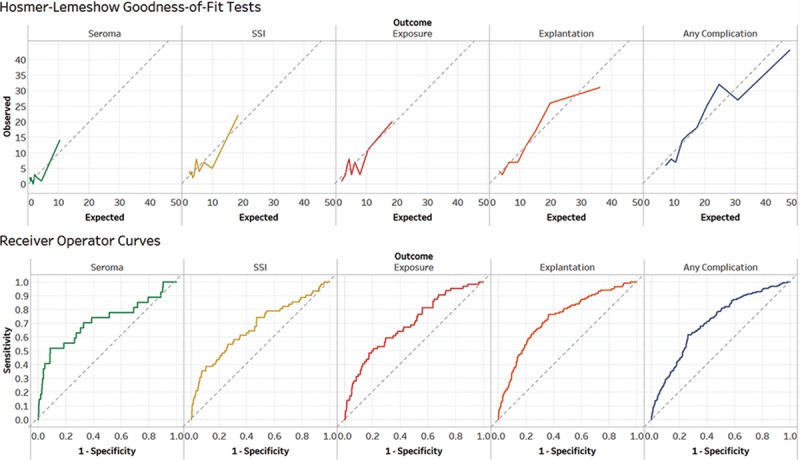
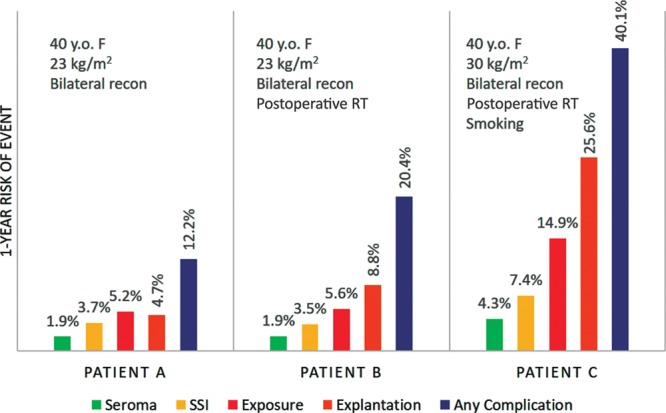
Nine-hundred three patients met inclusion criteria. Within 1-year, 3.0% of patients experienced seroma, 6.9% infection, 7.1% implant exposure, and 13.2% explantation. Thirty-day, 90-day, and 180-day windows captured 17.6%, 39.5%, and 59.7% of explantations, respectively. One-year risk calculators were developed for each complication of interest, and all demonstrated good internal validity: C-statistics for the 5 models ranged from 0.674 to 0.739, Hosmer-Lemeshow tests were uniformly nonsignificant, and Brier scores ranged from 0.027 to 0.154.
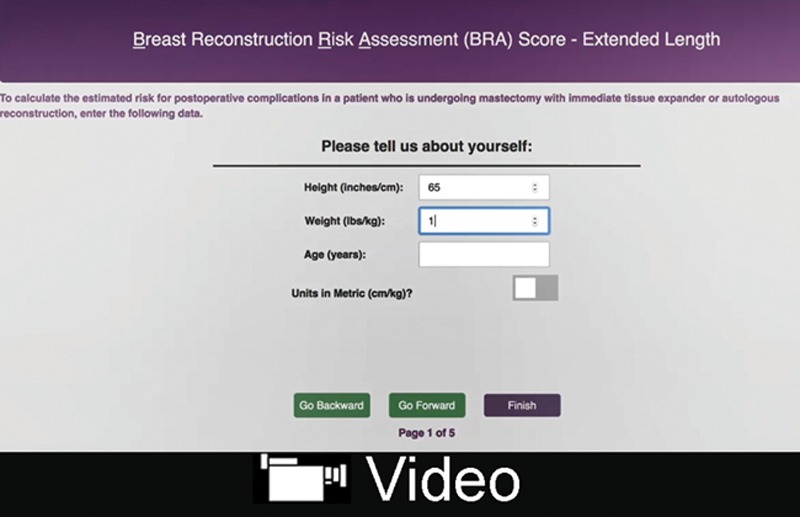
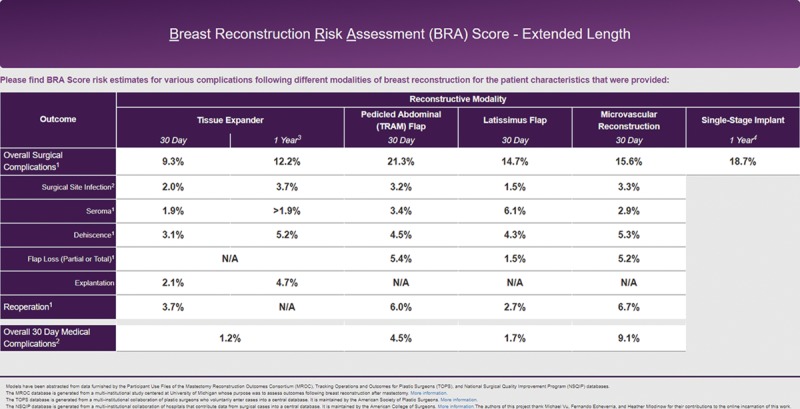
Clinically significant complications of prosthetic breast reconstruction usually occur beyond the 30-day window following tissue expander placement. To better reflect long-term patient experiences, the BRA Score was enhanced with individualized risk models that predicted 1-year complications after prosthetic reconstruction (BRA Score XL). All models performed as well as, if not better than, the original BRA Score models and other popular risk calculators such as the CHADSVASc Score. The patient-friendly BRA Score XL risk calculator is available at www.brascore.org to facilitate operative decision-making and heighten the informed consent process for patients.
尽管手术风险计算器的使用越来越广泛,但由于其基础数据集的限制,许多计算器仅限于预测30天的结果。由于乳房重建的并发症可能在手术后30天以上出现,我们致力于将乳房重建风险评估(BRA)评分扩展到预测初次假体乳房重建后1年的并发症。
我们检查了2004年至2015年我们机构内部的假体乳房重建前瞻性数据库。排除没有1年随访的患者。相关的患者变量包括BRA评分以往版本中列举的那些变量。感兴趣的结果包括血清肿、手术部位感染(SSI)、植入物暴露以及在组织扩张器放置后1年内发生的取出植入物情况。使用多变量逻辑回归模型为每个结果开发风险计算器,并在www.BRAScore.org上在线提供。使用C统计量、Hosmer-Lemeshow检验和Brier评分评估内部有效性。
903例患者符合纳入标准。在1年内,3.0%的患者出现血清肿,6.9%的患者发生感染,7.1%的患者出现植入物暴露,13.2%的患者取出植入物。30天、90天和180天窗口分别捕捉到了17.6%、39.5%和59.7%的取出植入物情况。为每种感兴趣的并发症开发了1年风险计算器,所有计算器均显示出良好的内部有效性:5个模型的C统计量范围为0.674至0.739,Hosmer-Lemeshow检验均无统计学意义,Brier评分范围为0.027至0.154。
假体乳房重建的具有临床意义的并发症通常发生在组织扩张器放置后的30天窗口之后。为了更好地反映患者的长期经历,通过预测假体重建后1年并发症的个体化风险模型(BRA评分XL)增强了BRA评分。所有模型的表现与原始BRA评分模型以及其他流行的风险计算器(如CHADSVASc评分)相当,甚至可能更好。患者友好的BRA评分XL风险计算器可在www.brascore.org上获取,以促进手术决策并加强患者的知情同意过程。