Devarajan Kavya, Di Lee Wen, Ong Hon Shing, Lwin Nyein C, Chua Jacqueline, Schmetterer Leopold, Mehta Jodhbir S, Ang Marcus
1Singapore Eye Research Institute, Singapore, Singapore.
2Singapore National Eye Center, Singapore, Singapore.
Eye Vis (Lond). 2019 Jan 8;6:2. doi: 10.1186/s40662-018-0128-8. eCollection 2019.
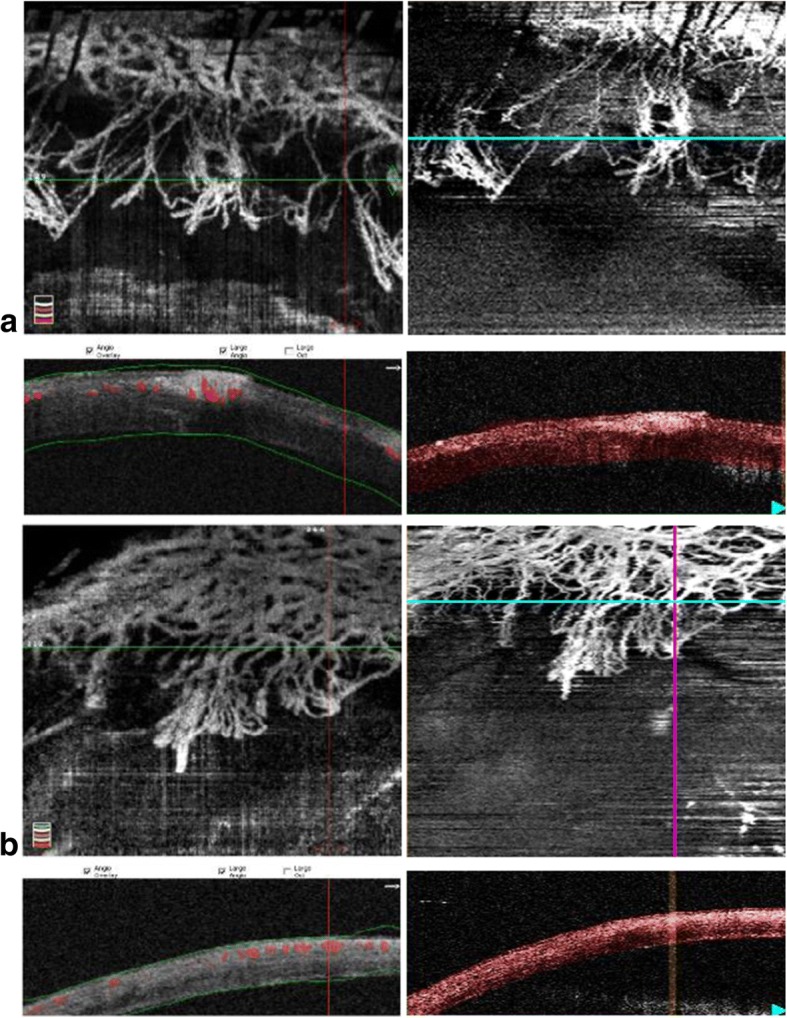
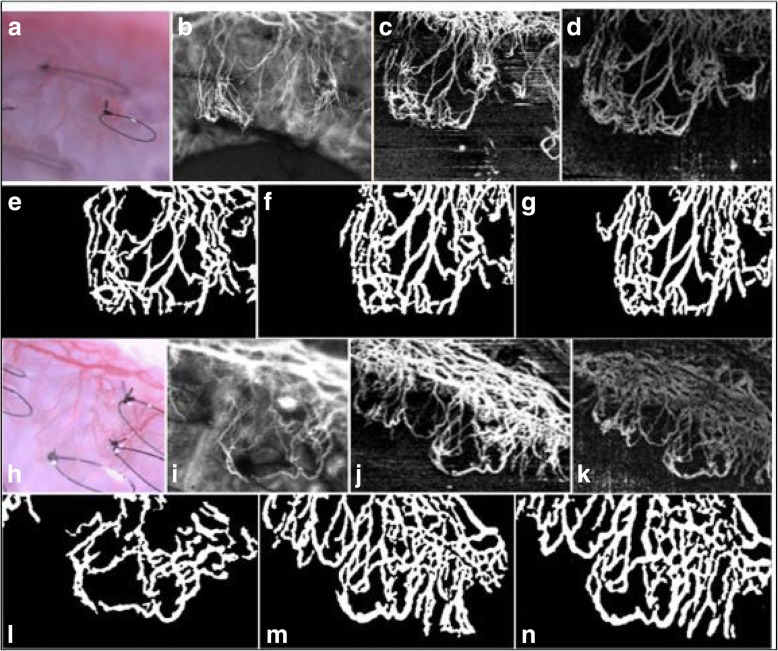
Optical coherence tomography angiography (OCTA) is a novel non-invasive angiography technology that has recently been extensively studied for its utility in anterior segment imaging. In this study, we compared a split-spectrum amplitude decorrelation angiography (SSADA) OCTA and an Complex OCT signal difference angiography [corrected] (CODAA SD) [corrected] OCTA system to current angiographic technique, indocyanine green angiography (ICGA), to assess corneal vascularisation in an animal model.
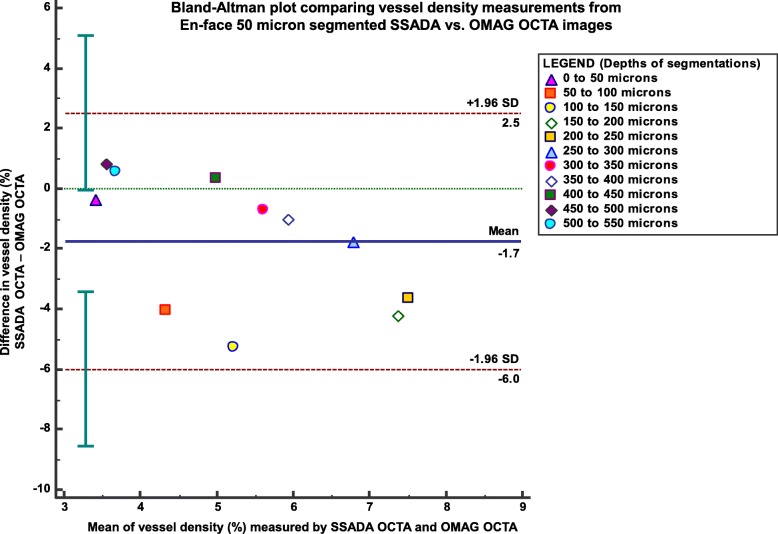
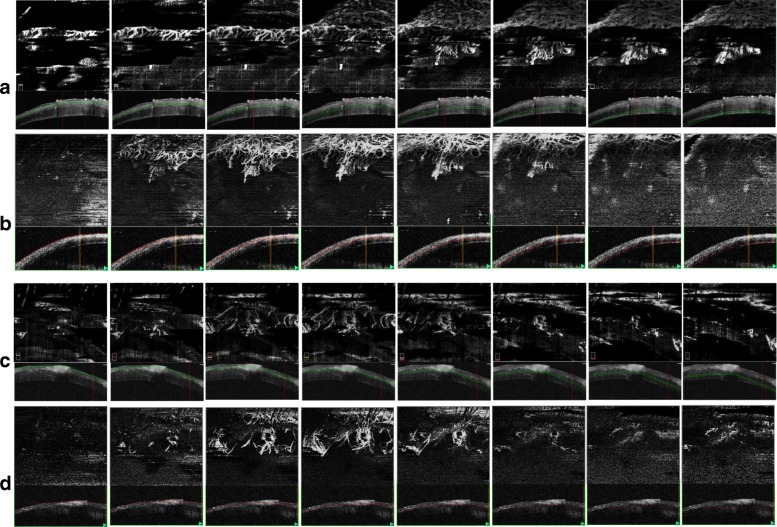
We imaged 16 rabbits, (one eye per animal) with corneal vascularisation using SSADA OCTA (AngioVue; Optovue Inc., USA), CODAA OCTA [corrected] (Angioscan; RS-3000 Nidek Co. Ltd., Japan) and ICGA in the same region of interest of the cornea at successive time-points. We then analysed all scanned images for vessel density measurements and used paired t-tests and Bland-Altman plots to examine for significant differences. The en-face segmentation images from each of the OCTA scans were also extracted and were matched at every 50 μm segmentation to be compared for vessel density at the respective depths.
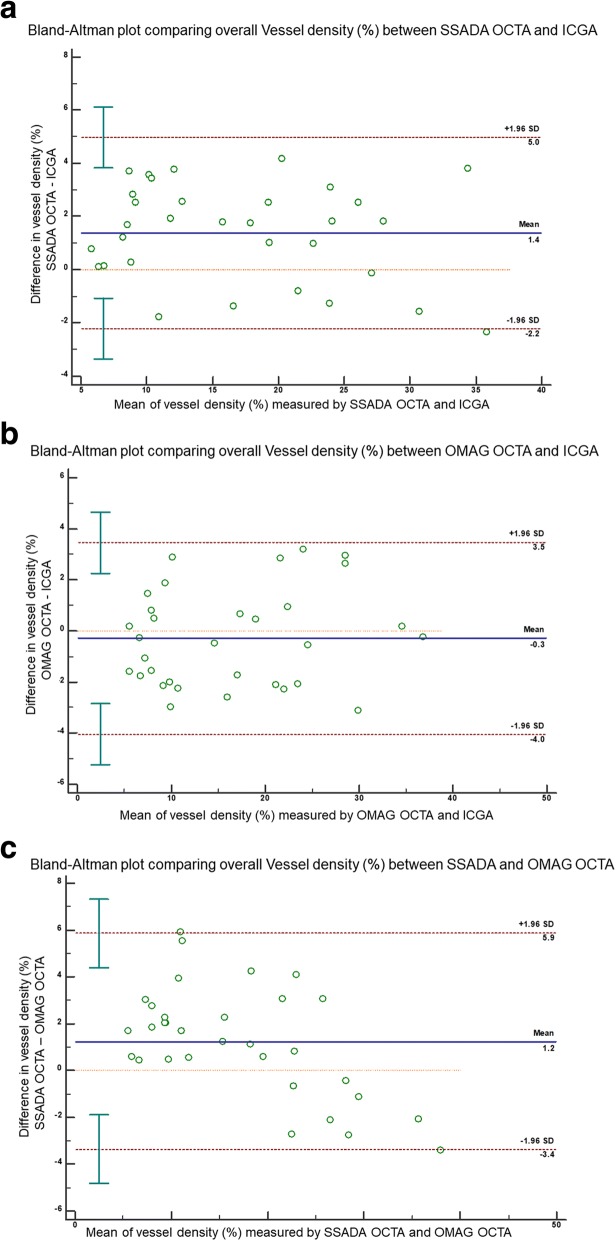
Bland-Altman plots revealed a good agreement between all three imaging techniques ( > 0.05) for all vessel density measurements computed, and the ranges of 95% limit of agreement were acceptable from a clinical perspective. No significant difference was reported, with ICGA (μ = 16.52 ± 8.94%) being more comparable to the CODAA [corrected] OCTA (μ = 16.23 ± 9.51%; = 0.50) than the SSADA OCTA (μ = 17.09 ± 7.34%; = 0.33) system. Also, a good correlation value ( > 0.9) was obtained when comparing the vessel density measurements of the en-face segmentations between the OCTA systems.
Comparable vessel density quantification between the two OCTA systems, and with ICGA was obtained. Segmentation analysis of the vasculature at different depths showed varied performance in the two OCTA systems relative to each other. The implications of the study may help to aid in the development of better OCTA algorithms for the anterior segment and its use in clinical translational research.
光学相干断层扫描血管造影(OCTA)是一种新型无创血管造影技术,最近已对其在前节成像中的应用进行了广泛研究。在本研究中,我们将分裂谱幅度去相关血管造影(SSADA)OCTA和复OCT信号差异血管造影(CODAA SD)OCTA系统与当前血管造影技术吲哚菁绿血管造影(ICGA)进行比较,以评估动物模型中的角膜血管化情况。
我们使用SSADA OCTA(AngioVue;美国Optovue公司)、CODAA OCTA(Angioscan;日本尼德克公司RS - 3000)和ICGA在16只患有角膜血管化的兔子(每只动物一只眼)的角膜同一感兴趣区域连续时间点进行成像。然后我们分析所有扫描图像以测量血管密度,并使用配对t检验和布兰德 - 奥特曼图来检查是否存在显著差异。还提取了每个OCTA扫描的正面分割图像,并在每50μm分割处进行匹配,以比较各自深度处的血管密度。
布兰德 - 奥特曼图显示,对于所有计算的血管密度测量值,三种成像技术之间均具有良好的一致性(>0.05),并且从临床角度来看,95%一致性界限的范围是可接受的。未报告显著差异,ICGA(μ = 16.52±8.94%)与CODAA OCTA(μ = 16.23±9.51%;= 0.50)比与SSADA OCTA(μ = 17.09±7.34%;= 0.33)系统更具可比性。此外,在比较OCTA系统之间正面分割的血管密度测量值时,获得了良好的相关性值(>0.9)。
获得了两种OCTA系统之间以及与ICGA相当的血管密度定量结果。在不同深度对脉管系统进行分割分析显示,两种OCTA系统相对于彼此的性能有所不同。该研究的意义可能有助于开发更好的用于前节的OCTA算法及其在临床转化研究中的应用。