Drewnowski A, Arterburn D, Zane J, Aggarwal A, Gupta S, Hurvitz P M, Moudon A V, Bobb J, Cook A, Lozano P, Rosenberg D
Center for Public Health Nutrition, 305 Raitt Hall, #353410, University of Washington, Seattle, WA 98195-03410, USA.
Kaiser Permanente Washington Health Research Institute, 1730 Minor Ave. Suite 1600, Seattle, WA 98101, USA.
SSM Popul Health. 2018 Dec 28;7:100345. doi: 10.1016/j.ssmph.2018.100345. eCollection 2019 Apr.
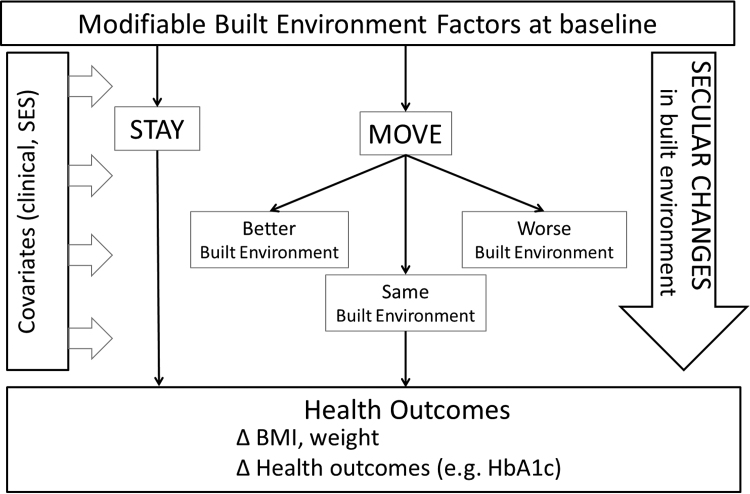
Improving the built environment (BE) is viewed as one strategy to improve community diets and health. The present goal is to review the literature on the effects of BE on health, highlight its limitations, and explore the growing use of natural experiments in BE research, such as the advent of new supermarkets, revitalized parks, or new transportation systems. Based on recent studies on movers, a paradigm shift in built-environment health research may be imminent. Following the classic Moving to Opportunity study in the US, the present Moving to Health (M2H) strategy takes advantage of the fact that changing residential location can entail overnight changes in multiple BE variables. The necessary conditions for applying the M2H strategy to Geographic Information Systems (GIS) databases and to large longitudinal cohorts are outlined below. Also outlined are significant limitations of this approach, including the use of electronic medical records in lieu of survey data. The key research question is whether documented changes in BE exposure can be linked to changes in health outcomes in a causal manner. The use of geo-localized clinical information from regional health care systems should permit new insights into the social and environmental determinants of health.
改善建筑环境(BE)被视为改善社区饮食和健康的一种策略。当前的目标是回顾关于建筑环境对健康影响的文献,突出其局限性,并探讨自然实验在建筑环境研究中的日益广泛应用,如新超市的出现、复兴的公园或新的交通系统。基于近期对迁居者的研究,建筑环境健康研究中的范式转变可能即将到来。继美国经典的“搬到机会”研究之后,当前的“搬到健康”(M2H)策略利用了这样一个事实,即改变居住地点可能会导致多个建筑环境变量在一夜之间发生变化。以下概述了将M2H策略应用于地理信息系统(GIS)数据库和大型纵向队列的必要条件。还概述了这种方法的重大局限性,包括使用电子病历代替调查数据。关键的研究问题是,记录在案的建筑环境暴露变化是否能够以因果关系与健康结果的变化联系起来。利用来自区域医疗系统的地理定位临床信息应该能够对健康的社会和环境决定因素有新的认识。