Eichenfield Lawrence F, Sugarman Jeffrey L, Guenin Eric, Harris Susan, Bhatt Varsha
Departments of Dermatology and Pediatrics, University of California, San Diego School of Medicine and Rady Children's Hospital, San Diego, California.
University of California, San Francisco, California.
Pediatr Dermatol. 2019 Mar;36(2):193-199. doi: 10.1111/pde.13744. Epub 2019 Jan 18.
Acne vulgaris (acne) is a common skin condition in children and adolescents. Efficacy of tretinoin is well documented in studies that included pediatric patients (12-18 years of age). With acne routinely presenting in younger patients, data are needed in this important group. Lotion formulations are commonly used across dermatology and are well liked by patients.
To evaluate the safety and efficacy of a novel once-daily tretinoin 0.05% lotion in preadolescent subjects (≤ 13 years) with moderate-to-severe acne.
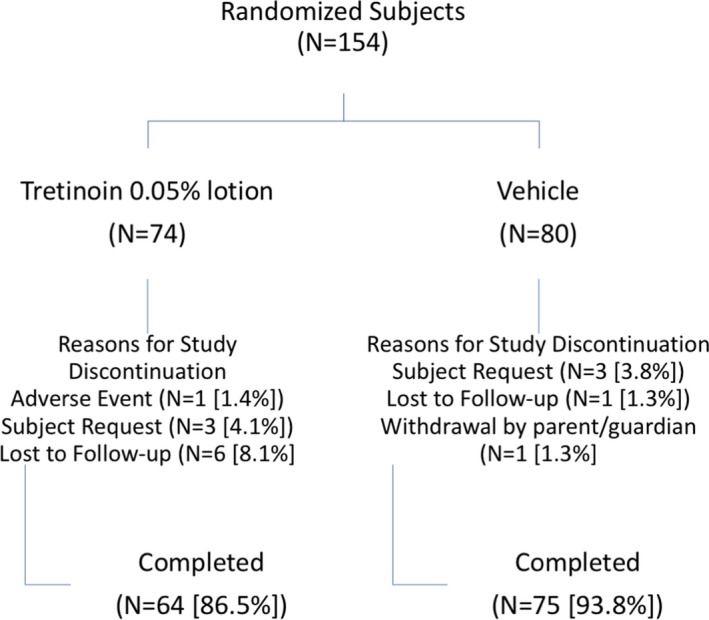
Post hoc analysis of two multicenter, randomized, double-blind, vehicle-controlled phase 3 studies in moderate-to-severe acne. Preadolescent subjects (N = 154) randomized (1:1) to receive tretinoin 0.05% lotion or vehicle, once daily for 12 weeks. Efficacy assessments included changes in baseline inflammatory/noninflammatory lesions and treatment success (at least 2-grade reduction in Evaluator's Global Severity Score [EGSS] and clear/almost clear). Safety, adverse events (AEs), and cutaneous tolerability evaluated throughout.
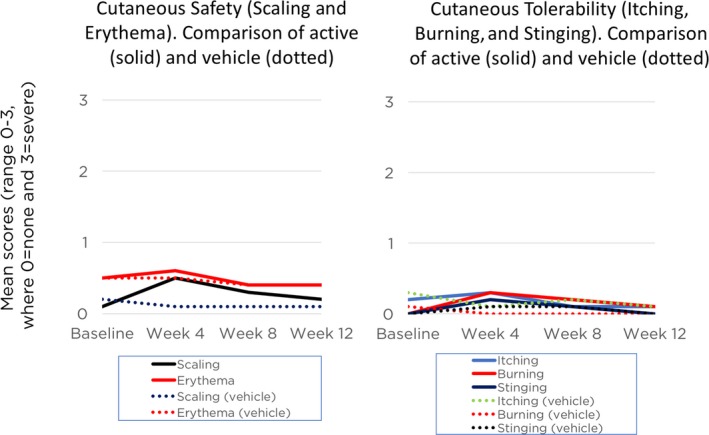
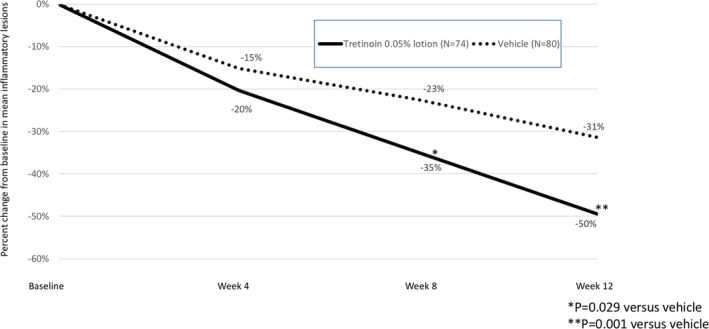
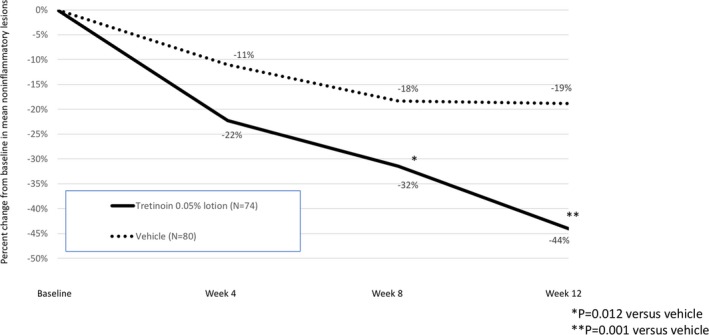
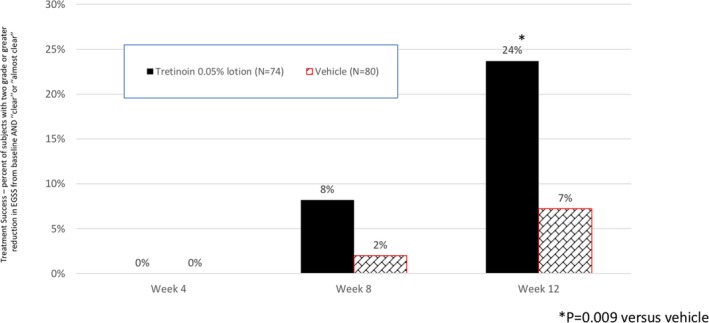
At Week 12, mean percent reduction in inflammatory and noninflammatory lesion counts were 49.5% and 44.0% compared with 31.4% and 18.8% with vehicle (both P = 0.001). Treatment success was achieved by 23.7% of subjects by Week 12, compared with 7.2% (P = 0.009). The majority of AEs were mild and transient: most frequently were application site pain (5.6%) and application site dryness (2.8%). Local cutaneous safety and tolerability assessments were generally mild-to-moderate and improved by Week 12.
Tretinoin 0.05% lotion was significantly more effective than vehicle in achieving treatment success and reducing inflammatory and noninflammatory lesions in preadolescent acne. It was well tolerated, with all treatment-related AEs deemed mild or moderate.
寻常痤疮是儿童和青少年常见的皮肤疾病。维甲酸在纳入儿科患者(12 - 18岁)的研究中的疗效已有充分记录。由于痤疮在更年轻的患者中也很常见,因此这一重要群体的数据很有必要。洗剂配方在皮肤科中常用,且深受患者喜爱。
评估一种新型每日一次的0.05%维甲酸洗剂在患有中度至重度痤疮的青春期前受试者(≤13岁)中的安全性和疗效。
对两项针对中度至重度痤疮的多中心、随机、双盲、赋形剂对照3期研究进行事后分析。青春期前受试者(N = 154)随机(1:1)接受0.05%维甲酸洗剂或赋形剂,每日一次,共12周。疗效评估包括基线炎症性/非炎症性皮损的变化以及治疗成功情况(评估者整体严重程度评分[EGSS]至少降低2级且皮肤清除/几乎清除)。在整个过程中评估安全性、不良事件(AE)和皮肤耐受性。
在第12周时,炎症性和非炎症性皮损计数的平均减少百分比分别为49.5%和44.0%,而赋形剂组分别为31.4%和18.8%(两者P = 0.001)。到第12周时,23.7%的受试者实现了治疗成功,而赋形剂组为7.2%(P = 0.009)。大多数不良事件为轻度且短暂:最常见的是用药部位疼痛(5.6%)和用药部位干燥(2.8%)。局部皮肤安全性和耐受性评估一般为轻度至中度,并在第12周时有所改善。
0.05%维甲酸洗剂在青春期前痤疮的治疗成功以及减少炎症性和非炎症性皮损方面明显比赋形剂更有效。它耐受性良好,所有与治疗相关的不良事件均被认为是轻度或中度。