School of Biomedical Engineering, Science and Health Systems, Drexel University, 3141 Chestnut Street, Philadelphia, PA, 19104, USA.
Department of Biomedical Engineering, School of Engineering & School of Medicine, University of Virginia, 415 Lane Road, Charlottesville, VA, 22904, USA.
Adv Healthc Mater. 2019 Feb;8(4):e1801451. doi: 10.1002/adhm.201801451. Epub 2019 Jan 18.
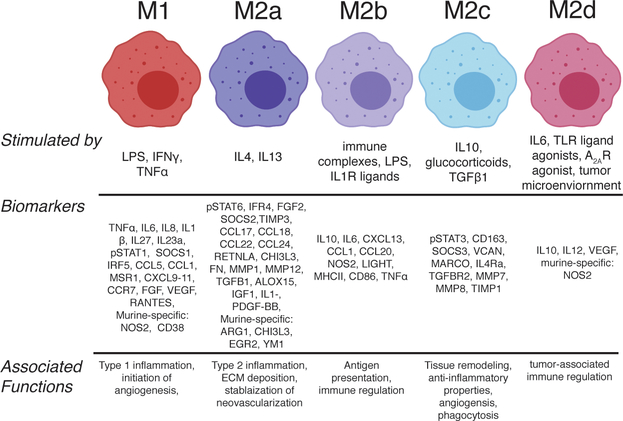
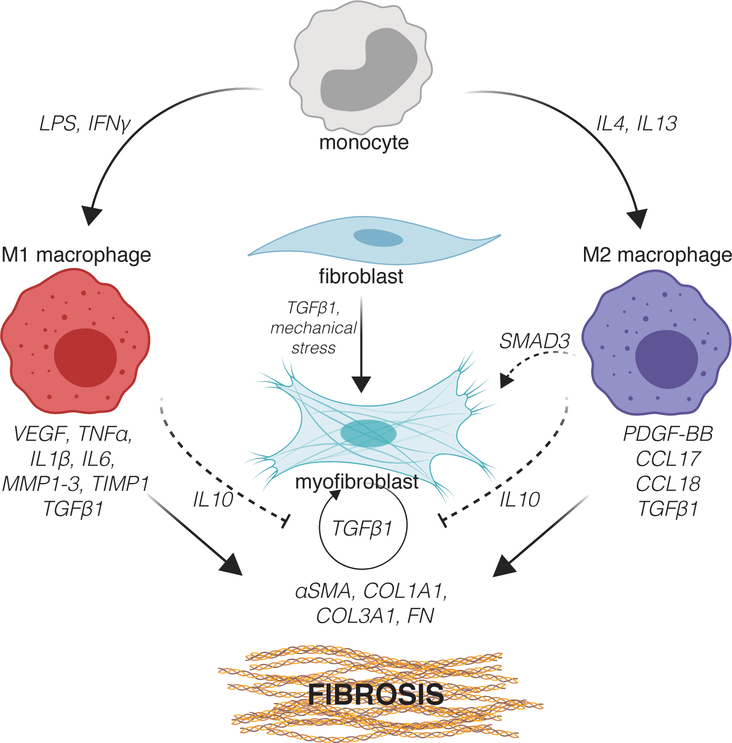
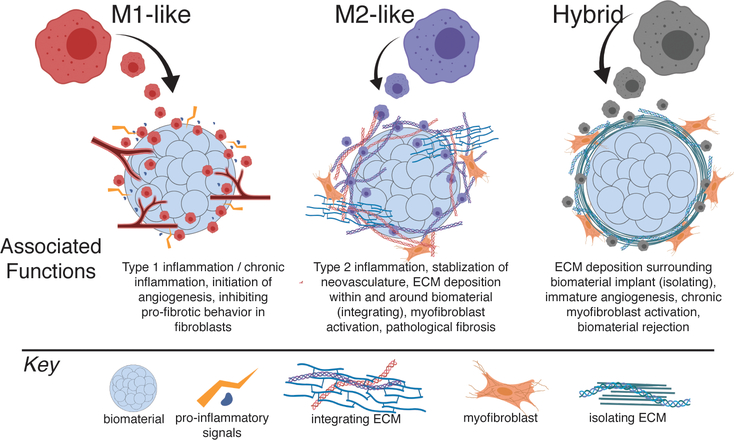
Biomaterial-mediated inflammation and fibrosis remain a prominent challenge in designing materials to support tissue repair and regeneration. Despite the many biomaterial technologies that have been designed to evade or suppress inflammation (i.e., delivery of anti-inflammatory drugs, hydrophobic coatings, etc.), many materials are still subject to a foreign body response, resulting in encapsulation of dense, scar-like extracellular matrix. The primary cells involved in biomaterial-mediated fibrosis are macrophages, which modulate inflammation, and fibroblasts, which primarily lay down new extracellular matrix. While macrophages and fibroblasts are implicated in driving biomaterial-mediated fibrosis, the signaling pathways and spatiotemporal crosstalk between these cell types remain loosely defined. In this review, the role of M1 and M2 macrophages (and soluble cues) involved in the fibrous encapsulation of biomaterials in vivo is investigated, with additional focus on fibroblast and macrophage crosstalk in vitro along with in vitro models to study the foreign body response. Lastly, several strategies that have been used to specifically modulate macrophage and fibroblast behavior in vitro and in vivo to control biomaterial-mediated fibrosis are highlighted.
生物材料介导的炎症和纤维化仍然是设计材料以支持组织修复和再生的突出挑战。尽管已经设计了许多旨在逃避或抑制炎症的生物材料技术(例如,递抗炎药物、疏水性涂层等),但许多材料仍会引起异物反应,导致致密的瘢痕样细胞外基质的包裹。参与生物材料介导纤维化的主要细胞是巨噬细胞,其调节炎症,和成纤维细胞,其主要沉积新的细胞外基质。虽然巨噬细胞和成纤维细胞被认为是驱动生物材料介导纤维化的原因,但这些细胞类型之间的信号通路和时空串扰仍然定义不明确。在这篇综述中,研究了体内生物材料纤维包裹中 M1 和 M2 巨噬细胞(和可溶性线索)的作用,此外还重点研究了体外成纤维细胞和巨噬细胞的串扰以及体外模型研究异物反应。最后,强调了几种已被用于在体外和体内特异性调节巨噬细胞和成纤维细胞行为以控制生物材料介导纤维化的策略。