Shrivastava Ritu, Fonjungo Peter N, Kebede Yenew, Bhimaraj Rajendra, Zavahir Shabnam, Mwangi Christina, Gadde Renuka, Alexander Heather, Riley Patricia L, Kim Andrea, Nkengasong John N
International Laboratory Branch, Division of Global HIV/AIDS, Center for Global Health, Centers for Disease Control and Prevention, 1600 Clifton Road NE, Atlanta, GA, 30333, USA.
Centers for Disease Control and Prevention, Addis Ababa, Ethiopia.
BMC Health Serv Res. 2019 Jan 18;19(1):46. doi: 10.1186/s12913-018-3744-z.
Despite progress towards achieving UNAIDS 90-90-90 goals, barriers persist in laboratory systems in sub-Saharan Africa (SSA) restricting scale up of early infant diagnosis (EID) and viral load (VL) test monitoring of patients on antiretroviral therapy. If these facilities and system challenges persist, they may undermine recorded gains and appropriate management of patients. The aim of this review is to identify Public Private Partnerships (PPP) in SSA that have resolved systemic barriers within the VL and EID treatment cascade and demonstrated impact in the scale up of VL and EID.
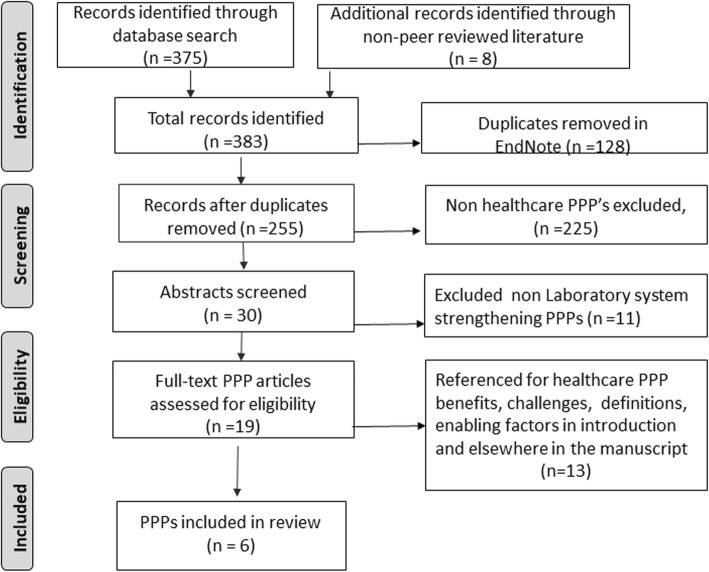
We queried five HIV and TB laboratory databases from 2007 to 2017 for studies related to laboratory system strengthening and PPP. We identified, screened and included PPPs that demonstrated evidence in alleviating known system level barriers to scale up national VL and EID testing programs. PPPs that improved associated systems from the point of viral load test request to the use of the test result for patient management were deemed eligible.
We identified six PPPs collaborations with multiple activities in select countries that are contributing to address challenges to scale up national viral load programs. One of the six PPPs reached 14.5 million patients in remote communities and transported up to 400,000 specimens in a year. Another PPP enabled an unprecedented 94% of specimens to reach national laboratory through improved sample referral network and enabled a cost savings of 62%. Also PPPs reduced cost of reagents and enabled 300,000 tested infants to be enrolled in care as well as reduced turnaround time of reporting results by 50%.
Our review identified the benefits, enabling factors, and associated challenges for public and private sectors to engage in PPPs. PPP contributions to laboratory systems strengthening are a model and present opportunities that can be leveraged to strengthen systems to achieve the UNAIDS 90-90-90 treatment targets for HIV/AIDS. Despite growing emphasis on engaging the private sector as a critical partner to address global disease burden, PPPs that specifically strengthen laboratories, the cornerstone of public health programs, remain largely untapped.
尽管在实现联合国艾滋病规划署90-90-90目标方面取得了进展,但撒哈拉以南非洲(SSA)的实验室系统仍存在障碍,限制了早期婴儿诊断(EID)的扩大以及对抗逆转录病毒治疗患者的病毒载量(VL)检测监测。如果这些设施和系统挑战持续存在,可能会破坏已记录的成果以及对患者的适当管理。本综述的目的是确定撒哈拉以南非洲地区解决了病毒载量和早期婴儿诊断治疗级联中的系统性障碍并在扩大病毒载量和早期婴儿诊断方面显示出影响的公私合作伙伴关系(PPP)。
我们查询了2007年至2017年的五个艾滋病毒和结核病实验室数据库,以获取与实验室系统加强和公私合作伙伴关系相关的研究。我们确定、筛选并纳入了在缓解扩大国家病毒载量和早期婴儿诊断检测计划的已知系统层面障碍方面有证据的公私合作伙伴关系。从病毒载量检测请求点到将检测结果用于患者管理而改善相关系统的公私合作伙伴关系被视为合格。
我们确定了六个公私合作伙伴关系合作项目,这些项目在选定国家开展了多项活动,有助于应对扩大国家病毒载量项目的挑战。六个公私合作伙伴关系项目之一覆盖了偏远社区的1450万患者,每年运送多达40万份样本。另一个公私合作伙伴关系项目通过改善样本转诊网络,使前所未有的94%的样本能够送达国家实验室,并节省了62%的成本。公私合作伙伴关系项目还降低了试剂成本,使30万名接受检测的婴儿能够获得护理,并将报告结果的周转时间缩短了50%。
我们的综述确定了公私部门参与公私合作伙伴关系的益处、促成因素和相关挑战。公私合作伙伴关系对实验室系统加强的贡献是一种模式,并提供了可加以利用的机会,以加强系统,实现联合国艾滋病规划署针对艾滋病毒/艾滋病的90-90-90治疗目标。尽管越来越强调让私营部门作为应对全球疾病负担的关键伙伴参与进来,但专门加强作为公共卫生项目基石的实验室的公私合作伙伴关系在很大程度上仍未得到利用。