Park Han-Hee, Choi Seung-Won, Lee Gwang Jin, Kim Young-Dae, Noh Hyun-Jin, Oh Seung-Jae, Yoo Iseul, Ha Yu-Jin, Koo Gi-Bang, Hong Soon-Sun, Kwon Sung Won, Kim You-Sun
Department of Biochemistry, Ajou University School of Medicine, Suwon, Republic of Korea.
Department of Biomedical Sciences, Graduate School, Ajou University, Suwon, Republic of Korea.
J Ginseng Res. 2019 Jan;43(1):86-94. doi: 10.1016/j.jgr.2017.08.006. Epub 2017 Aug 19.
Ginseng is believed to have antitumor activity. Autophagy is largely a prosurvival cellular process that is activated in response to cellular stressors, including cytotoxic chemotherapy; therefore, agents that inhibit autophagy can be used as chemosensitizers in cancer treatment. We examined the ability of Korean Red Ginseng extract (RGE) to prevent autophagic flux and to make hepatocellular carcinoma (HCC) cells become more sensitive to doxorubicin.
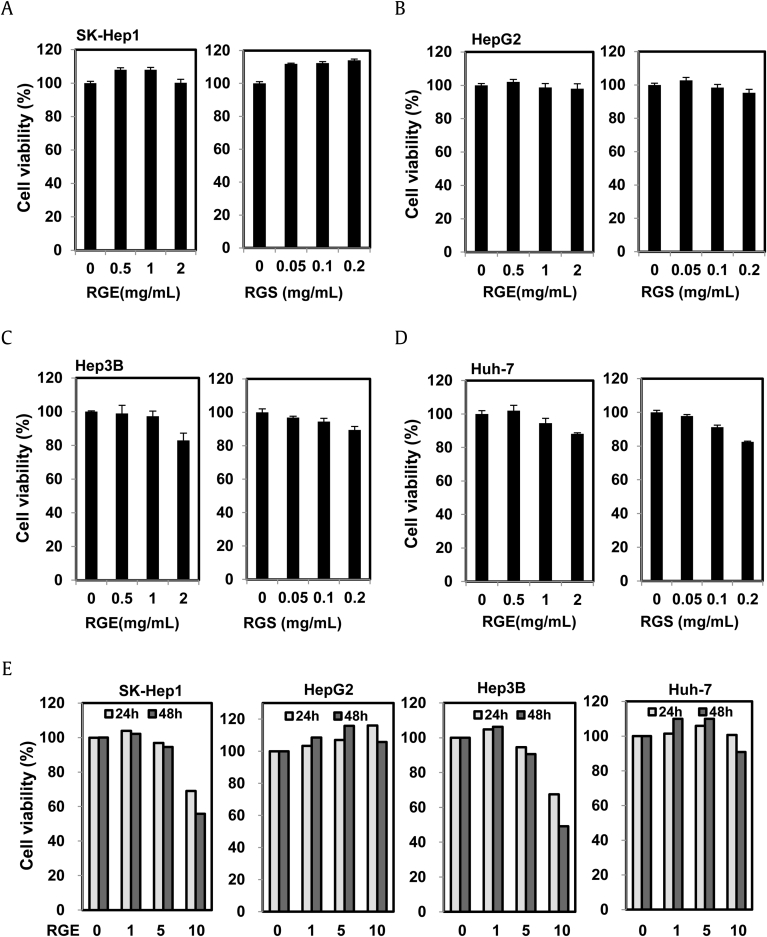
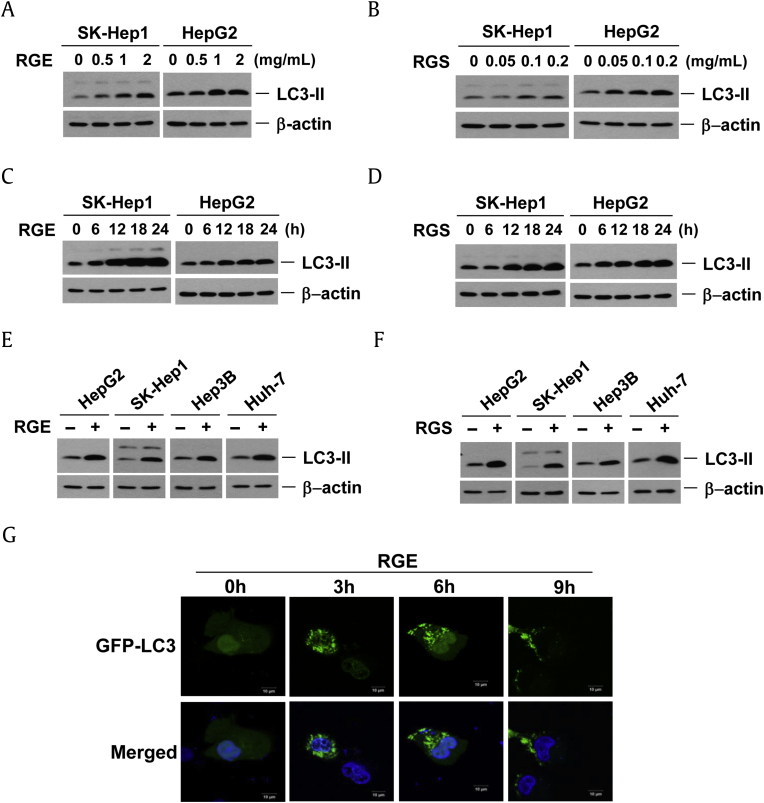
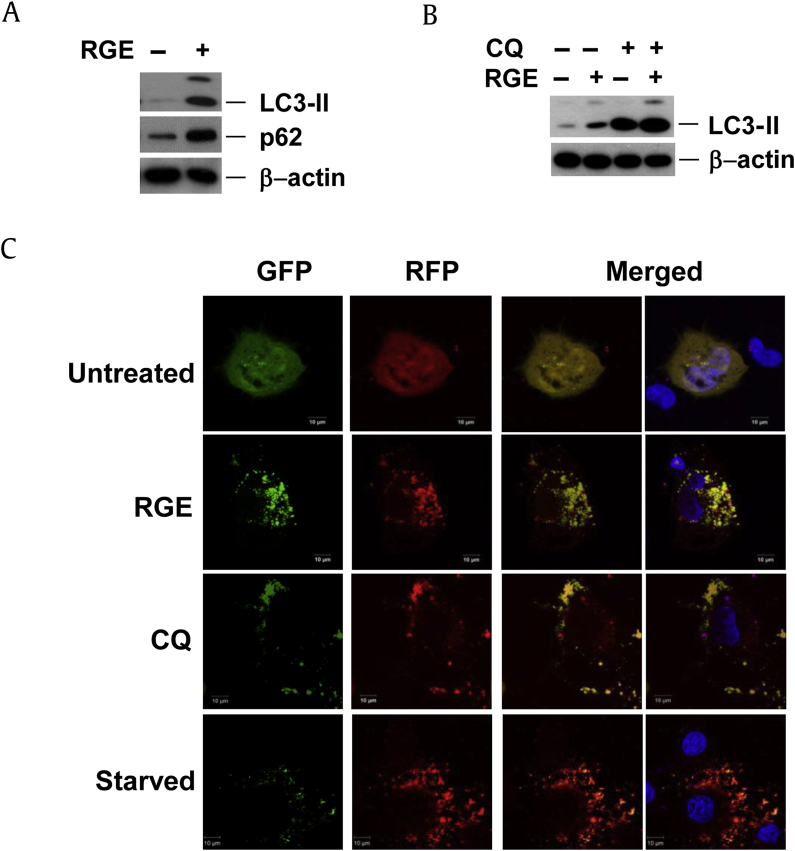
The cytotoxic effects of total RGE or its saponin fraction (RGS) on HCC cells were examined by the lactate dehydrogenase assay in a dose- or time-dependent manner. The effect of RGE or RGS on autophagy was measured by analyzing microtubule-associated protein 1A/1B-light chain (LC)3-II expression and LC3 puncta formation in HCC cells. Late-stage autophagy suppression was tested using tandem-labeled green fluorescent protein (GFP)-monomeric red fluorescent protein (mRFP)-LC3.
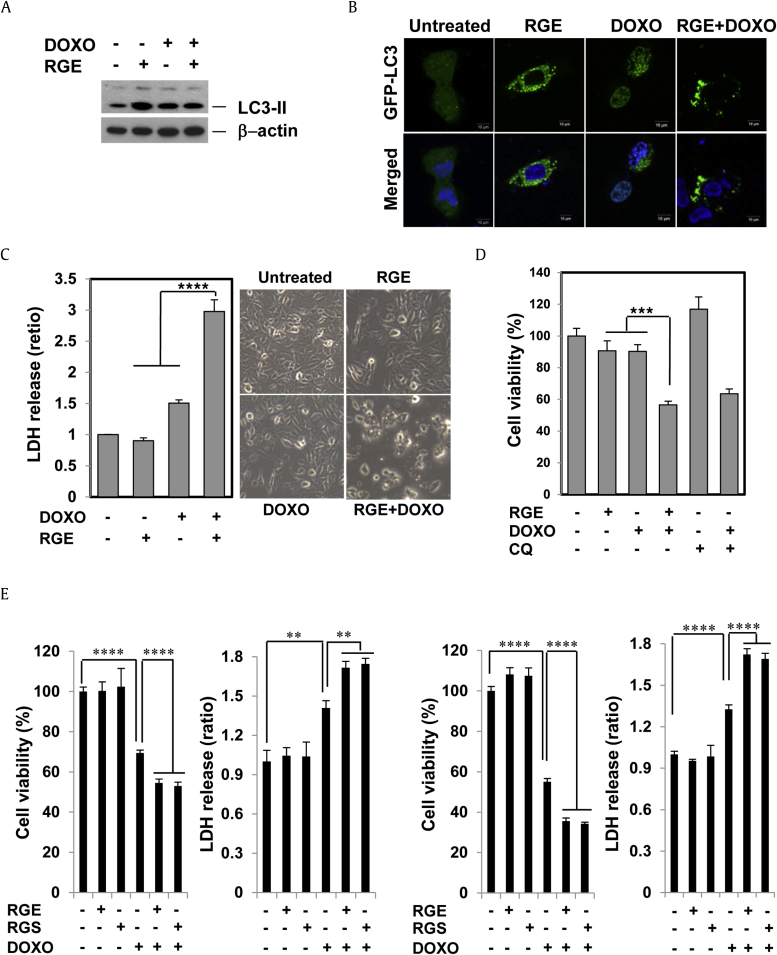
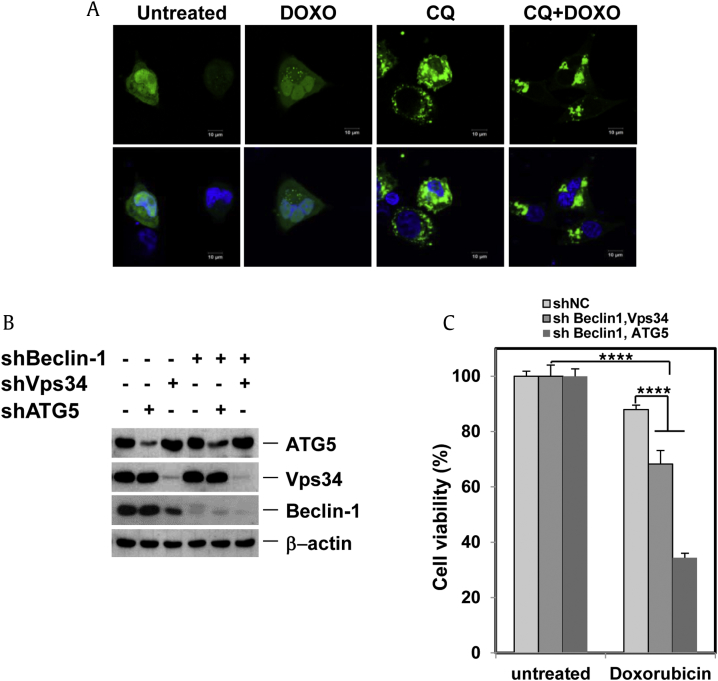
RGE markedly increased the amount of LC3-II, but green and red puncta in tandem-labeled GFP-mRFP-LC3 remained colocalized over time, indicating that RGE inhibited autophagy at a late stage. Suppression of autophagy through knockdown of key ATG genes increased doxorubicin-induced cell death, suggesting that autophagy induced by doxorubicin has a protective function in HCC. Finally, RGE and RGS markedly sensitized HCC cells, (but not normal liver cells), to doxorubicin-induced cell death.
Our data suggest that inhibition of late-stage autophagic flux by RGE is important for its potentiation of doxorubicin-induced cancer cell death. Therapy combining RGE with doxorubicin could serve as an effective strategy in the treatment of HCC.
人参被认为具有抗肿瘤活性。自噬在很大程度上是一种细胞存活过程,在包括细胞毒性化疗在内的细胞应激源作用下被激活;因此,抑制自噬的药物可作为癌症治疗中的化学增敏剂。我们研究了韩国红参提取物(RGE)阻止自噬流以及使肝癌(HCC)细胞对多柔比星更敏感的能力。
通过乳酸脱氢酶测定法以剂量或时间依赖性方式检测总RGE或其皂苷组分(RGS)对HCC细胞的细胞毒性作用。通过分析HCC细胞中微管相关蛋白1A/1B轻链(LC)3-II的表达和LC3斑点形成来测定RGE或RGS对自噬的影响。使用串联标记的绿色荧光蛋白(GFP)-单体红色荧光蛋白(mRFP)-LC3测试晚期自噬抑制。
RGE显著增加了LC3-II的量,但随着时间的推移,串联标记的GFP-mRFP-LC3中的绿色和红色斑点仍保持共定位,表明RGE在晚期抑制自噬。通过敲低关键自噬相关基因抑制自噬增加了多柔比星诱导的细胞死亡,表明多柔比星诱导的自噬在HCC中具有保护作用。最后,RGE和RGS显著使HCC细胞(而非正常肝细胞)对多柔比星诱导的细胞死亡敏感。
我们的数据表明,RGE对晚期自噬流的抑制对于其增强多柔比星诱导的癌细胞死亡很重要。RGE与多柔比星联合治疗可作为治疗HCC的有效策略。