Frank Megan L, Flynn Anna, Farnell Gregory S, Barkley Jacob E
Baldwin Wallace University, Berea, OH, United States.
Davey Elementary School, Kent, OH, United States.
J Exerc Sci Fit. 2018 Apr;16(1):37-42. doi: 10.1016/j.jesf.2018.03.001. Epub 2018 Mar 26.
BACKGROUND/OBJECTIVE: Physical activity (PA) is important in reducing childhood obesity, yet a majority of children are not meeting PA guidelines. Schools have been identified as a place to promote childhood PA. The purpose of this study was to determine the best type of physically active recess period to increase preschool-aged children's PA.
PA was measured via accelerometers in preschool-aged children ( = 29) during three, 30-min recess conditions (control; structured play; free play) on separate school days. Tertile splits were performed based on PA during the condition and children were divided into three groups: highly, moderately and least active.
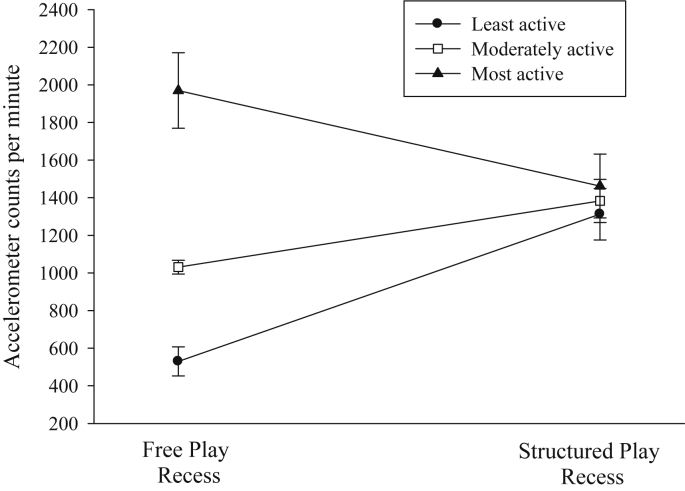
For the aggregated sample, children were more ( ≤ 0.001) active during the (1282 ± 662 counts min) and (1416 ± 448 counts min) recess versus the condition (570 ± 460 counts min) and activity was not different between the and conditions. However, children who were the most active during (1970 ± 647 counts·min) decreased ( ≤ 0.05) activity during (1462 ± 535 counts·min), whereas children who were moderately active (1031 ± 112 counts·min) or the least (530 ± 239 counts·min) active during increased activity during (1383 ± 345 counts·min moderately active, 1313 ± 413 counts·min least active).
Providing a physically-active recess period will contribute to preschool-aged children meeting the recommended PA guidelines; however, different children may respond in a different way based upon the structure of the recess period.
背景/目的:体育活动对减少儿童肥胖很重要,但大多数儿童未达到体育活动指南的要求。学校已被确定为促进儿童体育活动的场所。本研究的目的是确定最佳类型的体育活动课间休息,以增加学龄前儿童的体育活动。
在不同的上学日,通过加速度计对学龄前儿童(n = 29)在三种30分钟课间休息条件下(对照;结构化游戏;自由游戏)的体育活动进行测量。根据对照条件下的体育活动进行三分位数划分,将儿童分为三组:高活动量、中等活动量和低活动量组。
对于总体样本,与对照条件(570±460次/分钟)相比,儿童在结构化游戏(1282±662次/分钟)和自由游戏(1416±448次/分钟)课间休息时更活跃(P≤0.001),且结构化游戏和自由游戏条件下的活动量没有差异。然而,在对照条件下最活跃的儿童(1970±647次·分钟)在结构化游戏期间活动量下降(P≤0.05)(1462±535次/分钟),而在对照条件下中等活跃(1031±112次/分钟)或最不活跃(530±239次/分钟)的儿童在结构化游戏期间活动量增加(中等活跃为1383±345次/分钟,最不活跃为1313±413次/分钟)。
提供体育活动课间休息将有助于学龄前儿童达到推荐的体育活动指南要求;然而,不同的儿童可能会根据课间休息的结构以不同方式做出反应。