Iwata Atsushi, Iwatsubo Takeshi, Ihara Ryoko, Suzuki Kazushi, Matsuyama Yutaka, Tomita Naoki, Arai Hiroyuki, Ishii Kenji, Senda Michio, Ito Kengo, Ikeuchi Takeshi, Kuwano Ryozo, Matsuda Hiroshi
Department of Neurology, The University of Tokyo Hospital, Tokyo, Japan.
Unit for Early and Exploratory Clinical Development, The University of Tokyo Hospital, Tokyo, Japan.
Alzheimers Dement (N Y). 2018 Jul 12;4:765-774. doi: 10.1016/j.trci.2018.06.008. eCollection 2018.
The objective of this study was to determine whether sex or education level affects the longitudinal rate of cognitive decline in Japanese patients in the Alzheimer's disease Neuroimaging Initiative study with defined mild cognitive impairment (MCI).
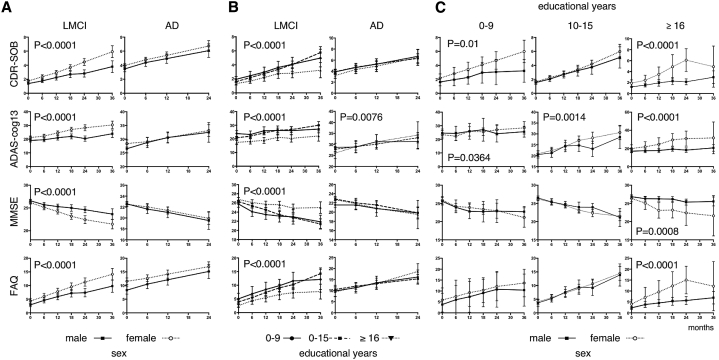
We accessed the entire Japanese Alzheimer's Disease Neuroimaging Initiative data set of 537 individuals, among whom 234 had MCI and 149 had Alzheimer's disease. We classified participants into three categories of educational history: (1) low, 0 to 9 years; (2) moderate, 10 to 15 years; and (3) high ≥16 years. We examined the main effects and interactions of visit, sex, and educational achievement on scores for the Clinical Dementia Rating Sum of Boxes, Alzheimer's Disease Assessment Scale-cognitive subscale 13, Mini-Mental State Examination, and Functional Activities Questionnaire in a longitudinal manner.
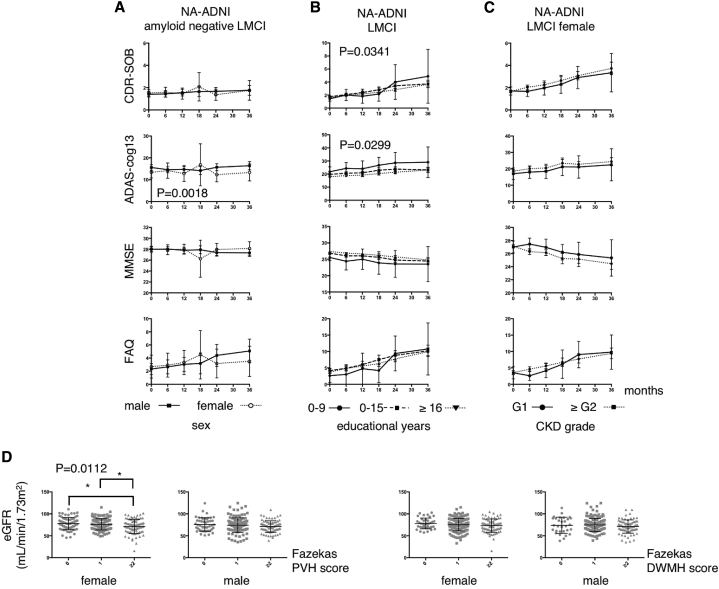
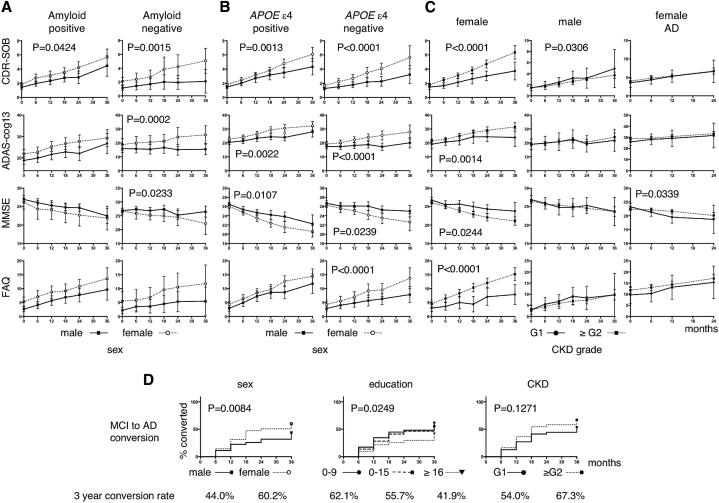
Women with MCI had a significantly faster rate of decline than men over a 3-year period. Highly educated men showed a significantly slower rate of decline than the other groups. Sex differences in the rates of decline remained after stratification by amyloid or apolipoprotein E () ε4 status but were absent in Alzheimer's disease over a 2-year period. Subtle differences in chronic kidney disease grade affected the rate of decline. A higher Fazekas periventricular hyperintensity score was associated with a lower estimated glomerular filtration rate in women only.
In patients with MCI, sex and educational history significantly affected the rate of change in cognitive and clinical assessments. Furthermore, a subtle decline in chronic kidney disease grade was associated with a faster rate of decline regardless of amyloid pathology in women.
本研究的目的是确定在阿尔茨海默病神经影像学倡议研究中,性别或教育水平是否会影响患有明确轻度认知障碍(MCI)的日本患者认知衰退的纵向速率。
我们获取了日本阿尔茨海默病神经影像学倡议研究中537名个体的全部数据集,其中234人患有MCI,149人患有阿尔茨海默病。我们将参与者按教育史分为三类:(1)低,0至9年;(2)中等,10至15年;(3)高,≥16年。我们纵向研究了访视、性别和教育成就对临床痴呆评定量表总分、阿尔茨海默病评估量表认知子量表13、简易精神状态检查表和功能活动问卷得分的主要影响及相互作用。
在3年期间,患有MCI的女性衰退速率明显快于男性。受过高等教育的男性衰退速率明显慢于其他组。按淀粉样蛋白或载脂蛋白E(ApoE)ε4状态分层后,衰退速率的性别差异仍然存在,但在2年期间,阿尔茨海默病患者中不存在这种差异。慢性肾病分级的细微差异影响衰退速率。仅在女性中,较高的脑室周围白质高信号Fazekas评分与较低的估计肾小球滤过率相关。
在患有MCI的患者中,性别和教育史显著影响认知和临床评估的变化速率。此外,无论女性淀粉样蛋白病理情况如何,慢性肾病分级的细微下降都与较快的衰退速率相关。