Geobiotec Research Centre, Department of Geosciences, University of Aveiro, 3810-193 Aveiro, Portugal.
Instituto de Ciências da Terra, University of Minho, 4710-057 Braga, Portugal.
Int J Environ Res Public Health. 2019 Nov 18;16(22):4560. doi: 10.3390/ijerph16224560.
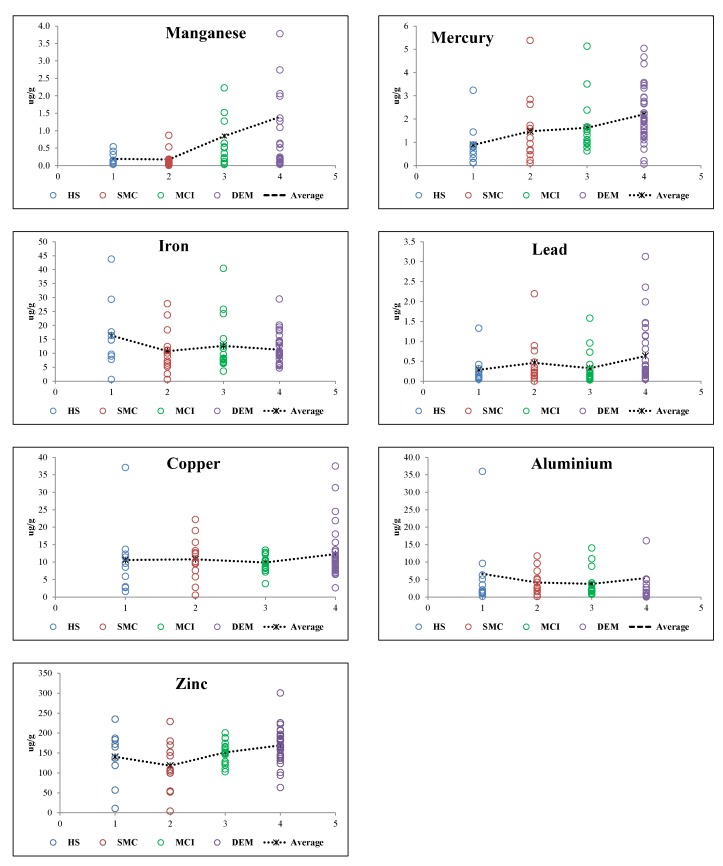
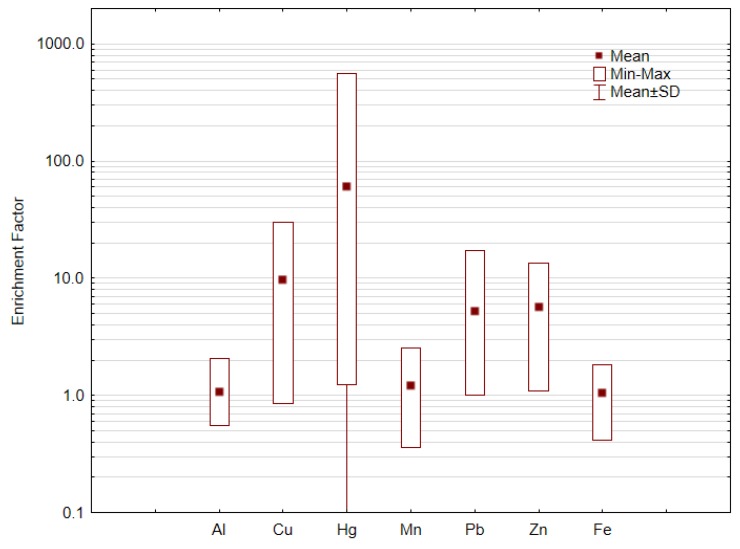
In the present study, trace elements (TE) levels were evaluated in scalp hair along the continuum from healthy subjects (HS) to patients suffering from subjective memory concerns (SMC), and/or mild cognitive impairment (MCI), and those with already installed dementia (DEM) in order to: (i) assess the effects of environmental and lifestyle factors on TE concentrations and (ii) evaluate the analyzed elements as possible diagnostic biomarkers for the disease. The study involved 79 mainly permanent residents, >55 years old, from the city of Estarreja (northern Portugal), a former industrial area. The health status of the participants was assessed by means of a complete socio-demographic questionnaire and through cognitive screening tests, namely the Mini-Mental State Examination (MMSE). The test scores were categorized and used in the statistical analysis. Hair samples were collected and analyzed by inductively coupled plasma-mass spectrometry (ICP-MS) ICP-MS for selected TE. Dementia appears to be associated with higher age, the female gender, lower education level, and longer residence time in the study area. In addition, most of the participants diagnosed with dementia frequently consume home-grown foodstuffs, some irrigated with contaminated well water. The calculation of the TE enrichment factors of soil samples collected in kitchen gardens/small farms in the vicinity of the Estarreja Chemical Complex (ECC) reinforces the degree of Hg soil contamination in the area, due to anthropogenic sources that can be a source for the population Hg exposure route among others. Mercury levels in hair differed significantly between the four individual groups (HS, SMC, MCI, and DEM), increasing from healthy to dementia participants. Improved diagnostic results can be obtained using hair TE signatures coupled with MMSE scores. This strategy may prove useful for predictive diagnosis in population screening for cognitive impairment.
在本研究中,评估了头皮头发中的微量元素 (TE) 水平,范围从健康受试者 (HS) 到患有主观记忆问题 (SMC) 和/或轻度认知障碍 (MCI) 以及已患有痴呆症 (DEM) 的患者,目的是:(i) 评估环境和生活方式因素对 TE 浓度的影响;(ii) 评估分析元素作为疾病的可能诊断生物标志物。该研究涉及来自葡萄牙北部埃斯特雷拉市(前工业区)的 79 名主要是 55 岁以上的常住居民。通过完整的社会人口学问卷和认知筛查测试,即简易精神状态检查 (MMSE),评估参与者的健康状况。测试分数进行了分类并用于统计分析。采集头发样本,通过电感耦合等离子体质谱法 (ICP-MS) ICP-MS 对选定的 TE 进行分析。痴呆症与较高的年龄、女性性别、较低的教育水平和在研究区域的居住时间较长有关。此外,大多数被诊断为痴呆症的参与者经常食用自家种植的食品,其中一些用受污染的井水灌溉。在埃斯特雷拉化学综合设施 (ECC) 附近的菜园/小农场采集的土壤样本的 TE 富集因子的计算,加强了该地区土壤中汞污染的程度,由于人为来源,可能是人群汞暴露途径的来源之一。头发中的汞水平在四个个体组(HS、SMC、MCI 和 DEM)之间差异显著,从健康组到痴呆症组逐渐增加。使用头发 TE 特征与 MMSE 评分相结合,可以获得更好的诊断结果。这种策略可能对认知障碍人群筛查的预测诊断有用。