Population Wellbeing and Environment Research Lab (PowerLab), Faculty of Social Sciences, School of Health and Society, University of Wollongong, Wollongong, New South Wales, Australia.
Menzies Centre for Health Policy, University of Sydney, Sydney, New South Wales, Australia.
J Epidemiol Community Health. 2019 Apr;73(4):295-302. doi: 10.1136/jech-2018-211133. Epub 2019 Jan 23.
Postpartum weight gain is a well-known challenge for many mothers, but associations with green space quantity and quality have not been investigated.
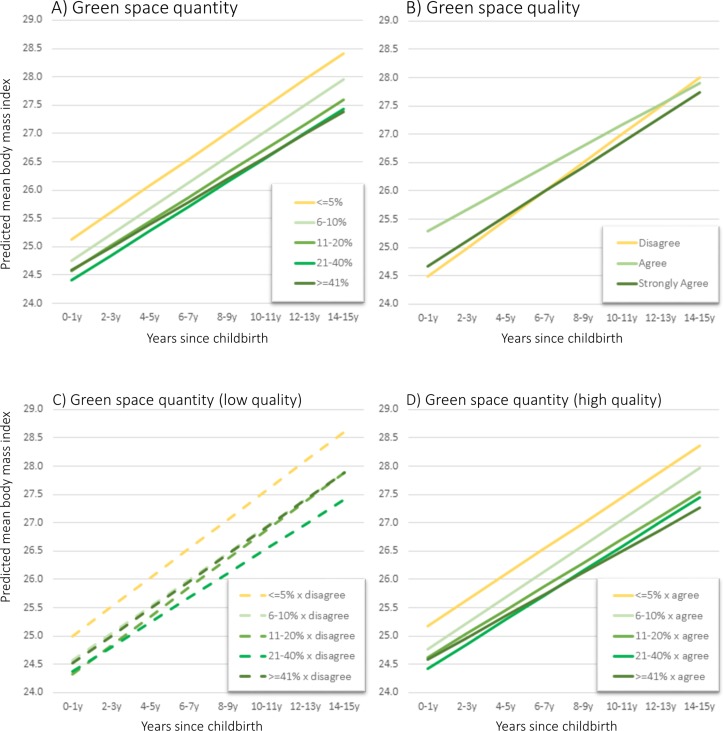
This longitudinal study used data on 3843 mothers living in Australia tracked biennially for 15 years post partum from 2004 onwards. Multilevel growth curve models adjusted for confounding were used to examine the patterning of body mass index (BMI) in relation to green space quantity, measured by percentage land use, and green space quality, measured by self-report. Two-way interaction terms were fitted to investigate time-contingent associations between BMI and green space.
Compared with mothers in areas with ≤5% green space, adjusted BMI coefficients were -0.43 kg/m (SE 0.37), -0.69 kg/m (SE 0.32) -0.86 kg/m (SE 0.33) and -0.80 kg/m (SE 0.41) among mothers in areas with 6%-10%, 11%-20%, 21%-40% and ≥41% green space, respectively. There were no independent associations between BMI and green space quality. Evidence suggested mothers living in areas with 21%-40% green space had the lowest BMI, whether they agreed that local parks were good quality (-0.89 kg/m (SE 0.34)) or not (-0.93 kg/m (SE 0.35)). Mothers in the greenest areas only had statistically significantly lower BMI if they perceived local parks as high quality (-0.89 kg/m (SE 0.41)). There was limited evidence that these associations varied with respect to the number of years post partum.
These findings may suggest that urban greening strategies to achieve a threshold of at least 21% or more green space in an area may help reduce, but not fully prevent postpartum weight gain. Potential mechanisms warrant investigation.
产后体重增加是许多母亲面临的一个众所周知的挑战,但尚未研究绿地数量和质量与之相关的问题。
本纵向研究使用了自 2004 年以来澳大利亚 3843 名产后 15 年内每两年跟踪一次的母亲的数据。使用多层次增长曲线模型,对混杂因素进行了调整,以检验与绿地数量(用地百分比测量)和绿地质量(自我报告测量)相关的体重指数(BMI)模式。拟合了双向交互项,以调查 BMI 与绿地之间的时间相关关联。
与绿地面积≤5%的母亲相比,绿地面积分别为 6%-10%、11%-20%、21%-40%和≥41%的母亲的调整 BMI 系数分别为-0.43kg/m(SE 0.37)、-0.69kg/m(SE 0.32)、-0.86kg/m(SE 0.33)和-0.80kg/m(SE 0.41)。BMI 与绿地质量之间没有独立的关联。有证据表明,居住在绿地面积为 21%-40%的母亲的 BMI 最低,无论她们是否认为当地公园的质量良好(-0.89kg/m(SE 0.34))或不好(-0.93kg/m(SE 0.35))。只有当母亲认为当地公园质量较高时(-0.89kg/m(SE 0.41)),居住在最绿色地区的母亲的 BMI 才有统计学意义上的显著降低。有有限的证据表明,这些关联在产后年限方面存在差异。
这些发现可能表明,城市绿化策略旨在使一个地区的绿地面积至少达到 21%或更高,可能有助于减少,但不能完全预防产后体重增加。潜在的机制值得研究。