Banawas Saeed, Abdel-Hadi Ahmed, Alaidarous Mohammed, Alshehri Bader, Bin Dukhyil Abdul Aziz, Alsaweed Mohammed, Aboamer Mohamed
Department of Medical Laboratory Sciences, College of Applied Medical Sciences, Majmaah University, Majmaah 11952, Saudi Arabia.
Department of Botany and Microbiology, Faculty of Science, Al-Azhar University, Assuit Branch, Cairo, Egypt.
Can J Infect Dis Med Microbiol. 2018 Dec 24;2018:6598918. doi: 10.1155/2018/6598918. eCollection 2018.
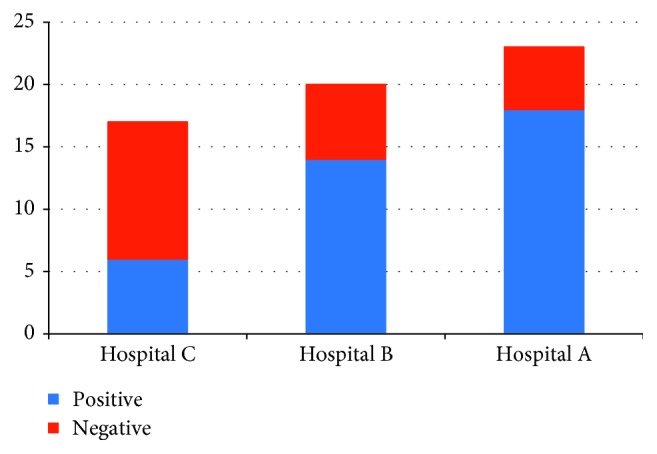
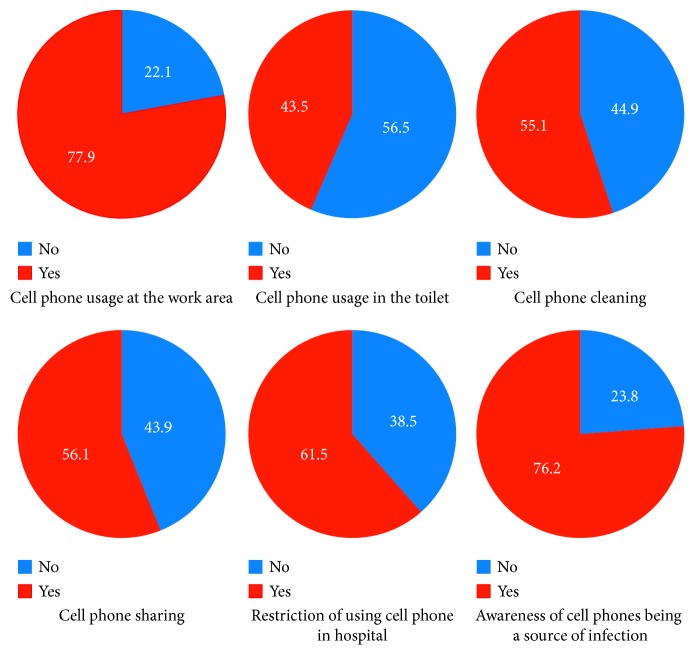
Cell phones may be an ideal habitat for colonization by bacterial pathogens, especially in hot climates, and may be a reservoir or vehicle in transmitting nosocomial infections. We investigated bacterial contamination on cell phones of healthcare workers in three hospitals in Saudi Arabia and determined antibacterial resistance of selected bacteria. A questionnaire was submitted to 285 healthcare workers in three hospitals, and information was collected on cell phone usage at the work area and in the toilet, cell phone cleaning and sharing, and awareness of cell phones being a source of infection. Screening on the Vitek 2 Compact system (bioMérieux Inc., USA) was done to characterize bacterial isolates. Of the 60 samples collected from three hospitals, 38 (63.3%) were positive with 38 bacterial isolates (4 Gram-negative and 34 Gram-positive bacteria). We found 38.3% of cell phones were contaminated with coagulase-negative staphylococci, particularly (10 isolates). Other bacterial agents identified were , , , , and . Antimicrobial susceptibility testing showed that most coagulase-negative staphylococci were resistant to benzylpenicillin, erythromycin, and rifampicin. Eight isolates were resistant to oxacillin, specifically (3), (2), and (2). , a cause of acute otitis media showed multidrug resistance. One isolate, a confirmed hetero-vancomycin intermediate-resistant , was resistant to antibiotics, commonly used to treat skin infection. There was a significant correlation between the level of contamination and usage of cell phone at toilet and sharing. Our findings emphasize the importance of hygiene practices in cell phone usage among healthcare workers in preventing the transmission of multidrug-resistant microbes.
手机可能是细菌病原体定植的理想场所,尤其是在炎热气候下,并且可能是医院感染传播的储存库或传播媒介。我们调查了沙特阿拉伯三家医院医护人员手机上的细菌污染情况,并确定了所选细菌的抗菌耐药性。向三家医院的285名医护人员发放了问卷,收集了有关工作区域和卫生间手机使用情况、手机清洁与共享以及对手机作为感染源的认识等信息。使用Vitek 2 Compact系统(美国生物梅里埃公司)进行筛选以鉴定细菌分离株。从三家医院收集的60个样本中,38个(63.3%)呈阳性,共分离出38株细菌(4株革兰氏阴性菌和34株革兰氏阳性菌)。我们发现38.3%的手机被凝固酶阴性葡萄球菌污染,尤其是(10株分离株)。鉴定出的其他细菌病原体有、、、、和。抗菌药敏试验表明,大多数凝固酶阴性葡萄球菌对苄青霉素、红霉素和利福平耐药。8株分离株对苯唑西林耐药,具体为(3株)、(2株)和(2株)。,急性中耳炎的病原体,表现出多重耐药性。1株经确认的异质性万古霉素中介耐药菌对常用于治疗皮肤感染的抗生素耐药。污染程度与在卫生间使用手机及共享手机之间存在显著相关性。我们的研究结果强调了医护人员在使用手机时保持卫生习惯对于预防多重耐药微生物传播的重要性。