Clinic for Trauma, Hand and Reconstructive Surgery, Division of Motor Research, Pathophysiology and Biomechanics, Jena University Hospital, Jena, Germany.
PLoS One. 2019 Jan 24;14(1):e0211042. doi: 10.1371/journal.pone.0211042. eCollection 2019.
A well-known supportive treatment for acute nonspecific back pain, elastic back support belts, are valued for their ability to accelerate natural self-healing, but there are concerns of a deconditioning effect due to their reliance on passive stabilization.
To evaluate the systematic effects of elastic abdominal belts on the trunk musculature, a total of 36 persons with acute lumbar back pain (no longer than one week) were divided into two groups: an abdominal belt wearing group (B) and a non-abdominal belt wearing control group (C). All were examined over a period of three weeks at three time points: T1 just after assignment, T2 one week later, and T3 further two weeks later. Surface EMG (sEMG) was used to record trunk muscle activation when walking on a treadmill at walking speeds of 2, 3, 4, 5, and 6 km/h. Similarly, pain intensity (VAS) and functional impairment (ODI) over time were recorded in both groups.
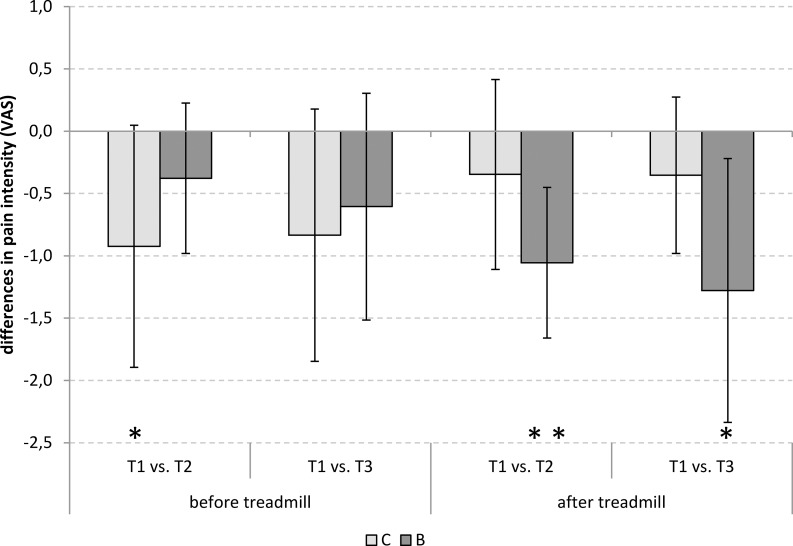
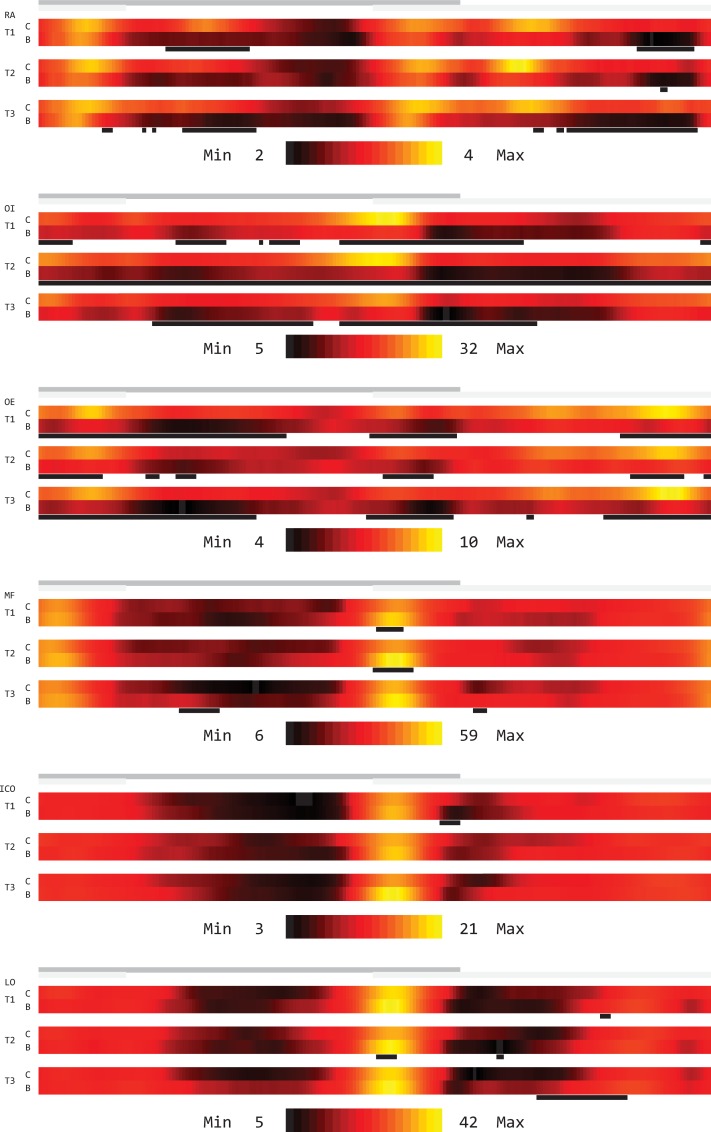
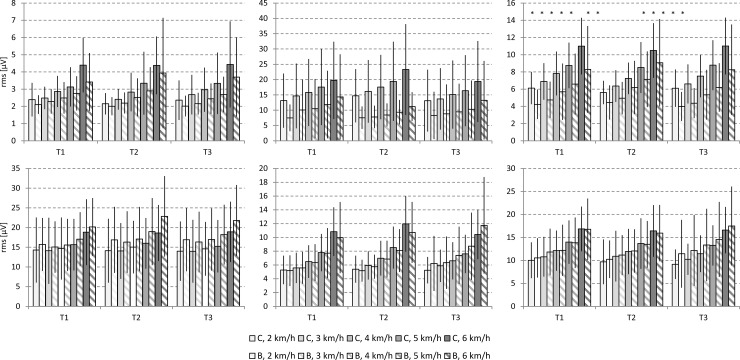
Over the observation period, a slight advantage for decreased pain intensity (C: p<0.05 T2 vs. T1; B: p<0.01 T2 vs. T1, p<0.05 T3 vs. T1) and decreased functional impairment (Cohen's d vs. T1, C: T2 0.45, T3 0.86; B: T2 1.1, T3 1.0) was observed for the belt group. For the belt group both oblique abdominal muscles exhibited significantly lower sEMG throughout the observation period (external abdominal oblique muscle: (T1), T2, (T3), internal abdominal oblique muscle: T1, (T2), (T3)) and the sEMG for the back muscles ranged from unchanged to slightly elevated for this group, but never reached statistical significance.
The reduced abdominal amplitude levels in the belt group likely result from the permanent elastic stabilization provided by the belt: the required elevated intra-abdominal pressure to enhance spinal stability is then provided by lessened abdominal muscle activity complemented by the belt's elastic support. With regard to the back muscles, the belt, due to its movement-restricting effect, tends to activate the paravertebral musculature. In this respect, the effect of elastic abdominal belts on the trunk muscles is not uniform. Therefore, the present results suggest that the effect of elastic abdominal belts appears to be more of a temporary neutral alteration of trunk muscle coordination, with some trunk muscles becoming more active and others less, and not a case of uniform deconditioning as is suspected.
弹性背部支撑带是一种治疗急性非特异性背痛的常用辅助治疗方法,其价值在于能够加速自然愈合,但由于其依赖于被动稳定,人们担心会产生去适应效应。
为了评估弹性腹部腰带对躯干肌肉系统的系统影响,共有 36 名急性腰痛(不超过一周)的患者分为两组:腹部腰带佩戴组(B 组)和非腹部腰带佩戴对照组(C 组)。所有患者在三个时间点进行了为期三周的检查:T1 是分配后立即检查,T2 是一周后检查,T3 是两周后进一步检查。使用表面肌电图(sEMG)记录在跑步机上以 2、3、4、5 和 6 公里/小时的速度行走时躯干肌肉的激活情况。同样,在两组中记录了随时间推移的疼痛强度(VAS)和功能障碍(ODI)。
在观察期间,腰带组的疼痛强度(C:p<0.05 T2 与 T1;B:p<0.01 T2 与 T1,p<0.05 T3 与 T1)和功能障碍(Cohen's d 与 T1,C:T2 0.45,T3 0.86;B:T2 1.1,T3 1.0)均略有下降。对于腰带组,两条腹外斜肌的 sEMG 均在整个观察期间显著降低(腹外斜肌:(T1)、T2、(T3),腹内斜肌:T1、(T2)、(T3)),而背部肌肉的 sEMG 水平不变或略有升高,但从未达到统计学意义。
腰带组的腹部幅度水平降低可能是由于腰带提供的永久性弹性稳定所致:通过减少腹部肌肉活动并辅以腰带的弹性支撑,提供增强脊柱稳定性所需的升高的腹腔内压力。至于背部肌肉,由于其运动限制作用,倾向于激活椎旁肌肉。在这方面,弹性腹部腰带对躯干肌肉的影响并不均匀。因此,目前的结果表明,弹性腹部腰带的作用似乎更多的是对躯干肌肉协调的暂时中性改变,一些躯干肌肉变得更加活跃,而另一些则不那么活跃,而不是像人们怀疑的那样是均匀去适应的情况。