Valizadeh-Haghi Saeideh, Rahmatizadeh Shahabedin
Department of Medical Library and Information Sciences, School of Allied Medical Sciences, Shahid Beheshti University of Medical Sciences, Tehran, Iran.
Department of Health Information Technology and Management, School of Allied Medical Sciences, Shahid Beheshti University of Medical Sciences, Tehran, Iran.
Online J Public Health Inform. 2018 Dec 30;10(3):e219. doi: 10.5210/ojphi.v10i3.9487. eCollection 2018.
The aim of the study is to explore the eHealth literacy and general interest in using eHealth information among patients with dental diseases.
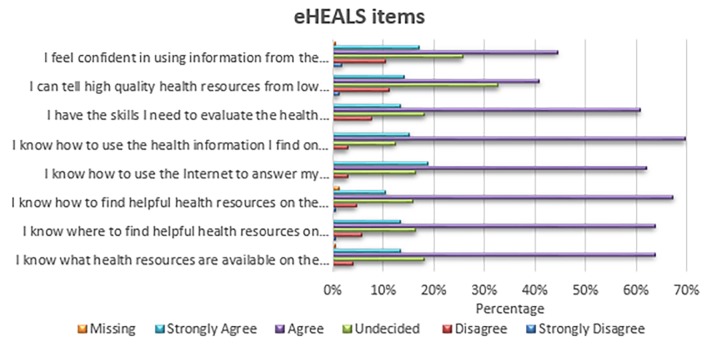
A total of 171 patients with dental diseases completed the survey including the eHEALS. The effect of participants' age, gender and education on eHealth literacy was assessed. Spearman's correlation coefficient was also used to assess the correlation between the importance of access to health information and the usefulness of the internet for decision-making.
The mean score of eHealth literacy in the participants was 30.55 (SD=4.069). The participants' age has significant effect on eHealth literacy level (t=3.573, P-value=0.002). Moreover, there was a significant correlation between the total score of eHealth literacy and the importance of access to eHealth information (r=0.33, n=171, P<0.s001). The difference in eHealth literacy in terms of educational background showed no statistically significant differences (F=1.179, P-value=0.322).
The participants had a high level of eHealth literacy. Determining eHealth literacy among dental patients leads to a better understanding of their problems in health decision-making.
Dental institutions efforts should aim to raise awareness on online health information quality and to encourage patients to use evaluation tools, especially among low electronic health literate patients.
本研究旨在探讨牙病患者的电子健康素养以及使用电子健康信息的总体兴趣。
共有171名牙病患者完成了包括电子健康素养量表(eHEALS)在内的调查。评估了参与者的年龄、性别和教育程度对电子健康素养的影响。还使用斯皮尔曼相关系数评估获取健康信息的重要性与互联网在决策中的有用性之间的相关性。
参与者的电子健康素养平均得分为30.55(标准差=4.069)。参与者的年龄对电子健康素养水平有显著影响(t=3.573,P值=0.002)。此外,电子健康素养总分与获取电子健康信息的重要性之间存在显著相关性(r=0.33,n=171,P<0.001)。不同教育背景的电子健康素养差异无统计学意义(F=1.179,P值=0.322)。
参与者具有较高的电子健康素养。确定牙病患者的电子健康素养有助于更好地了解他们在健康决策中的问题。
牙科机构应努力提高对在线健康信息质量的认识,并鼓励患者使用评估工具,特别是在电子健康素养较低的患者中。