Departament de Sanitat i Anatomia Animals. Universitat Autònoma de Barcelona, Bellaterra, Barcelona, Spain.
IRTA, Centre de Recerca en Sanitat Animal (CReSA, IRTA-UAB), Bellaterra, Barcelona, Spain.
PLoS One. 2019 Jan 25;14(1):e0210317. doi: 10.1371/journal.pone.0210317. eCollection 2019.
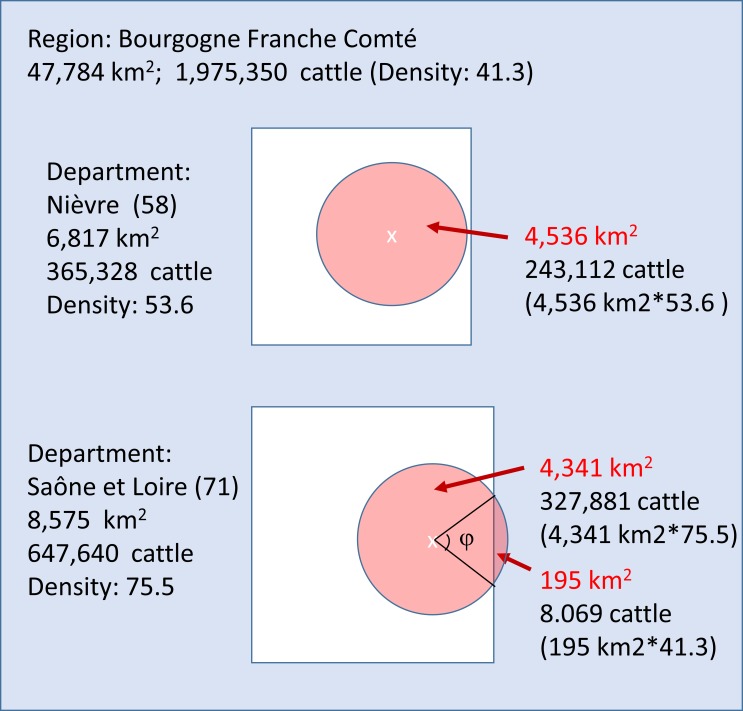
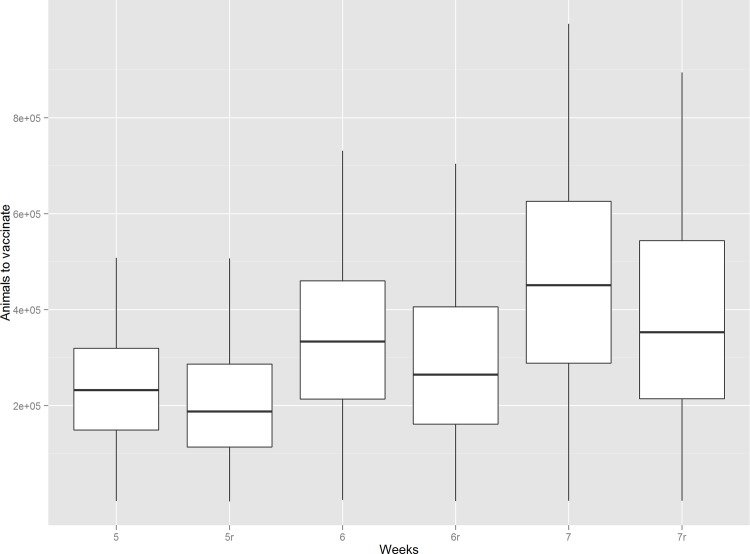
A simple method to estimate the size of the vaccine bank needed to control an epidemic of an exotic infectious disease in case of introduction into a country is presented. The method was applied to the case of a Lumpy Skin disease (LSD) epidemic in France. The size of the stock of vaccines needed was calculated based on a series of simple equations that use some trigonometric functions and take into account the spread of the disease, the time required to obtain good vaccination coverage and the cattle density in the affected region. Assuming a 7-weeks period to vaccinate all the animals and a spread of the disease of 7.3 km/week, the vaccination of 740 716 cattle would be enough to control an epidemic of LSD in France in 90% of the simulations (608 196 cattle would cover 75% of the simulations). The results of this simple method were then validated using a dynamic simulation model, which served as reference for the calculation of the vaccine stock required. The differences between both models in different scenarios, related with the time needed to vaccinate the animals, ranged from 7% to 10.5% more vaccines using the simple method to cover 90% of the simulations, and from 9.0% to 13.8% for 75% of the simulations. The model is easy to use and may be adapted for the control of different diseases in different countries, just by using some simple formulas and few input data.
本文提出了一种简单的方法,用于估计在外国传染病传入时控制疫情所需的疫苗库规模。该方法应用于法国的一种块状皮肤病(LSD)疫情。根据一系列简单的方程来计算所需疫苗库存的大小,这些方程使用了一些三角函数,并考虑了疾病的传播、获得良好疫苗接种覆盖率所需的时间以及受影响地区的牛密度。假设需要 7 周时间为所有动物接种疫苗,且疾病传播速度为每周 7.3 公里,则为了控制 LSD 在法国的疫情,接种 740 716 头牛就足以覆盖 90%的模拟(接种 608 196 头牛将覆盖 75%的模拟)。然后,使用动态模拟模型验证了这种简单方法的结果,该模型为计算所需疫苗库存提供了参考。在不同的情况下,两种模型之间的差异与为动物接种疫苗所需的时间有关,使用简单方法覆盖 90%的模拟,差异在 7%至 10.5%之间,而覆盖 75%的模拟,差异在 9.0%至 13.8%之间。该模型易于使用,可以通过使用一些简单的公式和少量输入数据,适用于不同国家控制不同疾病。