Institute of Cognitive Neuroscience, University College London, London, United Kingdom; Department of Psychiatry, University of Cambridge, Cambridge, United Kingdom.
Institute of Cognitive Neuroscience, University College London, London, United Kingdom.
Biol Psychiatry Cogn Neurosci Neuroimaging. 2022 Feb;7(2):201-209. doi: 10.1016/j.bpsc.2020.02.010. Epub 2020 Mar 4.
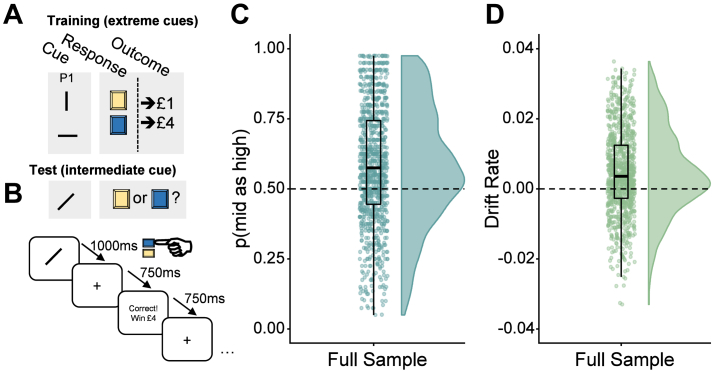
Negative interpretation biases are thought to be core symptoms of mood and anxiety disorders. However, prior work using cognitive tasks to measure such biases is largely restricted to case-control group studies, which cannot be used for inference about individuals without considerable additional validation. Moreover, very few measures are fully translational (i.e., can be used across animals and humans in treatment-development pipelines). This investigation aimed to produce the first measure of negative cognitive biases that is both translational and sensitive to individual differences, and then to determine which specific self-reported psychiatric symptoms are related to bias.
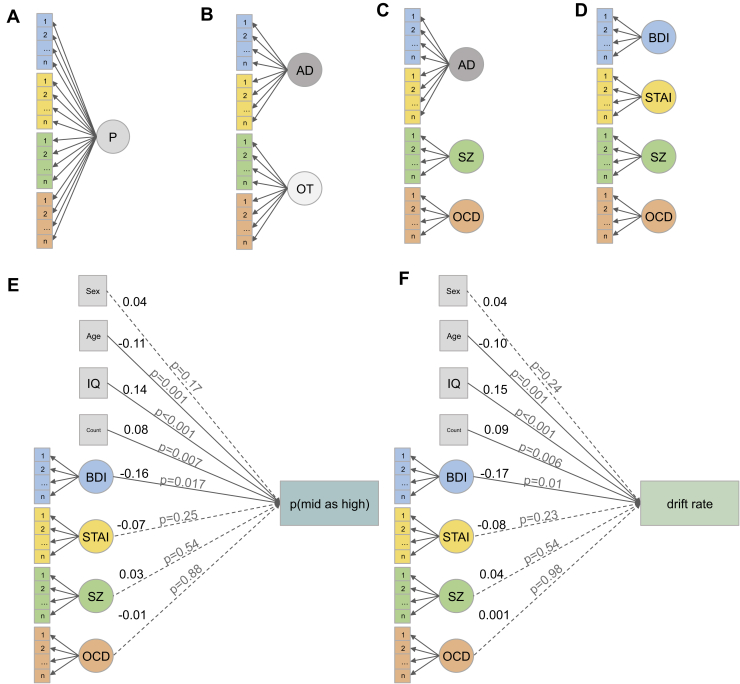
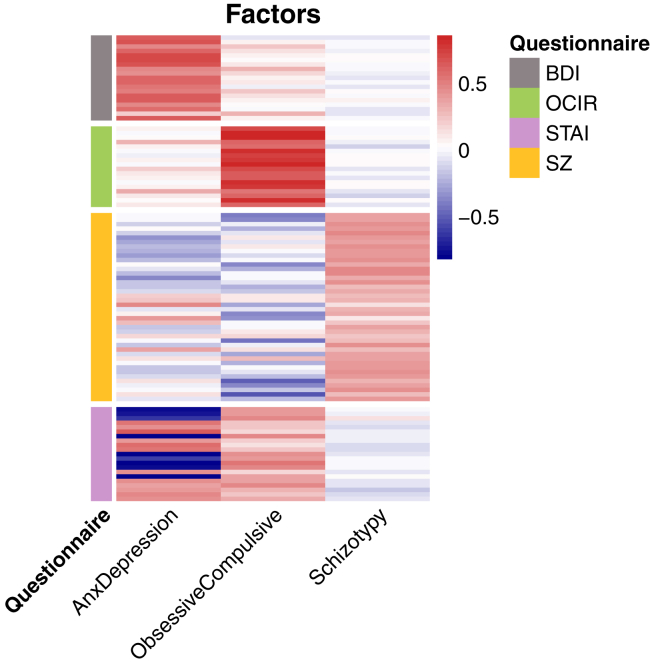
A total of 1060 (n = 990 complete) participants performed a cognitive task of negative bias along with psychiatric symptom questionnaires. We tested the hypothesis that individual levels of mood and anxiety disorder symptomatology would covary positively with negative bias on the cognitive task using a combination of computational modeling of behavior, confirmatory factor analysis, exploratory factor analysis, and structural equation modeling.
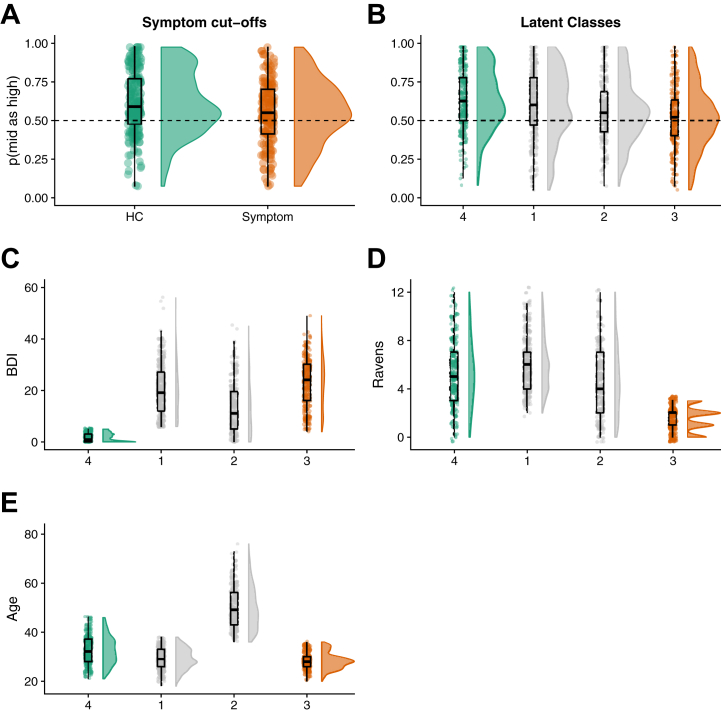
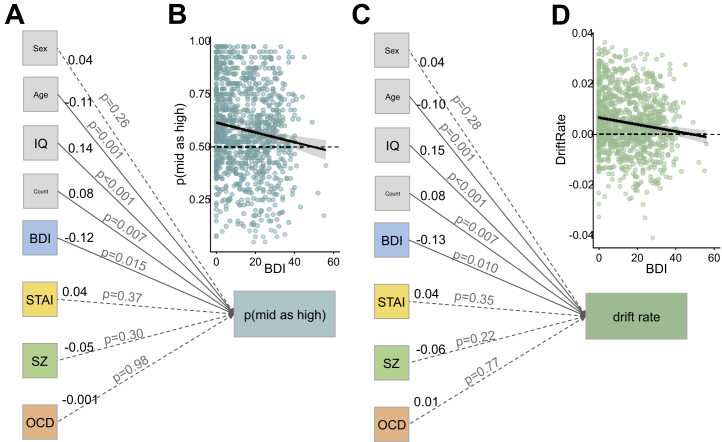
Participants with higher depression symptoms (β = -0.16, p = .017) who were older (β = -0.11, p = .001) and had lower IQ (β = 0.14, p < .001) showed greater negative bias. Confirmatory factor analysis and structural equation modeling suggested that no other psychiatric symptom (or transdiagnostic latent factor) covaried with task performance over and above the effect of depression, while exploratory factor analysis suggested combining depression/anxiety symptoms in a single latent factor. Generating groups using symptom cutoffs or latent mixture modeling recapitulated our prior case-control findings.
This measure, which uniquely spans both the clinical group-to-individual and preclinical animal-to-human generalizability gaps, can be used to measure individual differences in depression vulnerability for translational treatment-development pipelines.
负性解释偏差被认为是心境和焦虑障碍的核心症状。然而,使用认知任务来测量这种偏差的先前工作主要局限于病例对照研究组,对于没有相当多额外验证的个体,不能使用该研究组进行推断。此外,很少有措施是完全可转换的(即,可以在治疗开发管道中的动物和人类中使用)。本研究旨在制作第一个既具有可转换性又能敏感反映个体差异的负性认知偏差测量方法,然后确定哪些特定的自我报告的精神症状与偏差相关。
共有 1060 名(n=990 名完成)参与者进行了认知任务的负性偏差和精神症状问卷测试。我们通过行为计算模型、验证性因子分析、探索性因子分析和结构方程模型的组合,检验了以下假设:个体的心境和焦虑障碍症状水平与认知任务中的负性偏差呈正相关。
抑郁症状较高的参与者(β=-0.16,p=0.017)年龄较大(β=-0.11,p=0.001),智商较低(β=0.14,p<0.001),表现出更大的负性偏差。验证性因子分析和结构方程模型表明,除了抑郁的影响之外,没有其他精神症状(或跨诊断潜在因素)与任务表现相关,而探索性因子分析表明将抑郁/焦虑症状合并为一个单一的潜在因素。使用症状截止值或潜在混合模型生成组,重现了我们之前的病例对照发现。
这种方法独特地跨越了临床组到个体以及临床前动物到人类的可推广性差距,可用于测量翻译治疗开发管道中抑郁易感性的个体差异。