Liu Xi-Hua, Bi Hong-Yan, Cao Jie, Ren Shuo, Yue Shou-Wei
Department of Physical Medicine & Rehabilitation, Affiliated Hospital of Shandong Traditional Chinese Medicine University, Jinan, Shandong Province, China.
Maternal and Child Health Development Research Center, Shandong Maternal and Child Health Hospital, Jinan, Shandong Province, China.
Neural Regen Res. 2019 May;14(5):775-782. doi: 10.4103/1673-5374.249225.
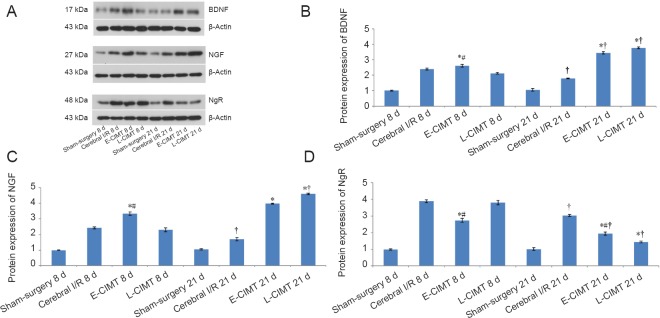
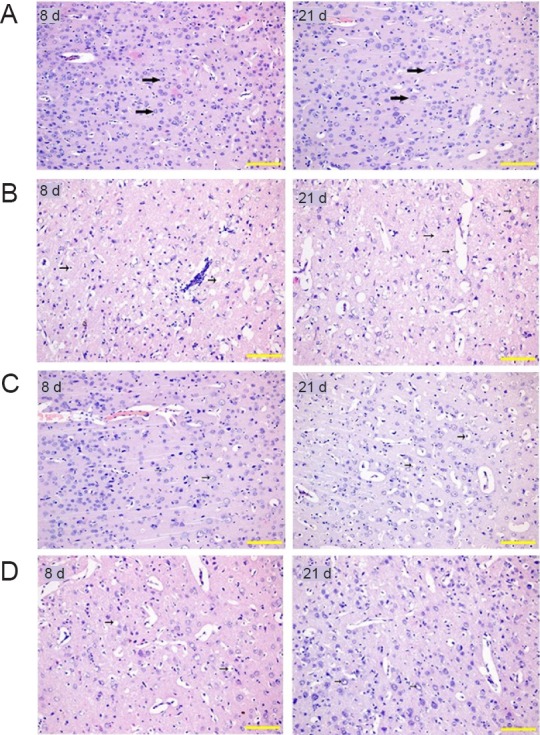
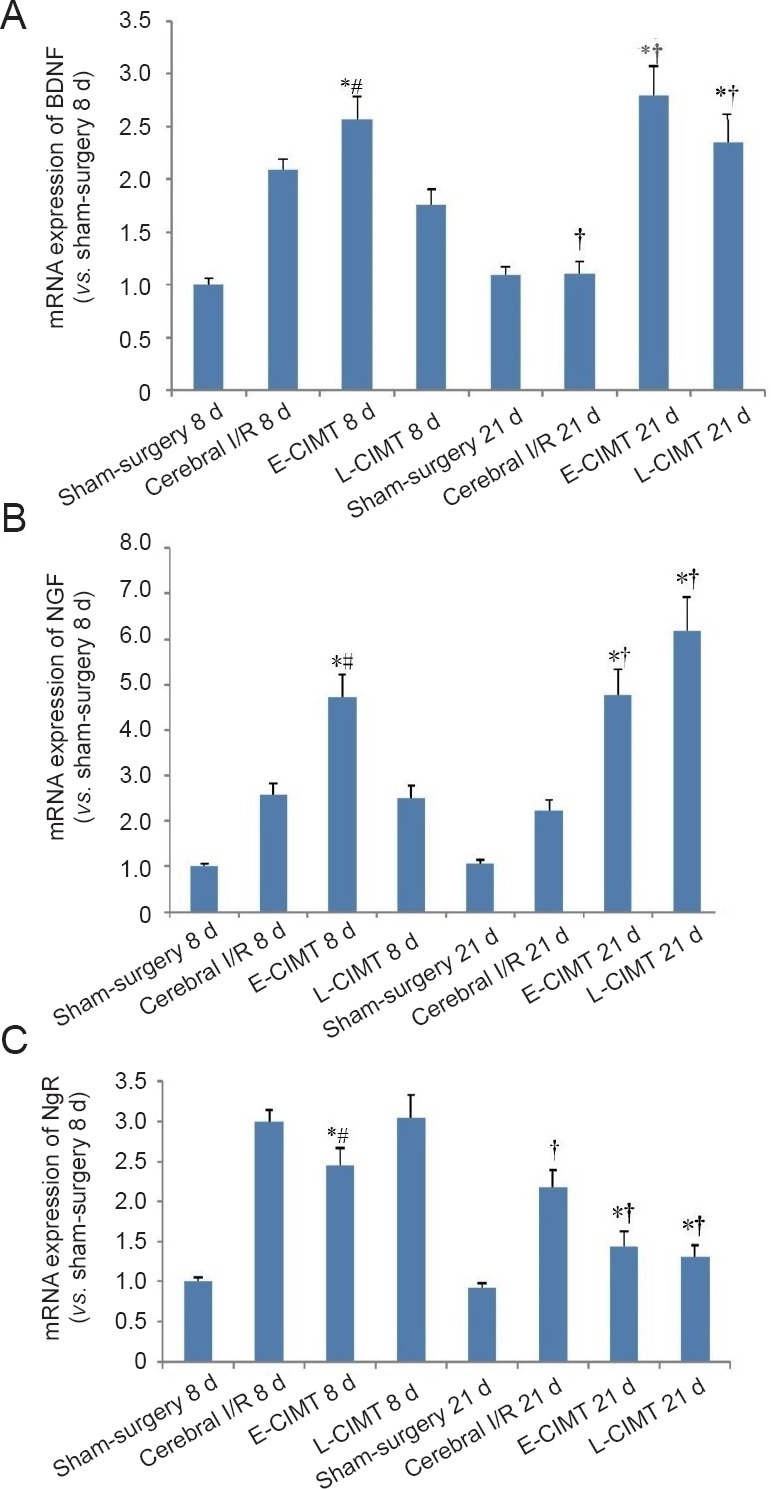
Constraint-induced movement therapy is an effective rehabilitative training technique used to improve the restoration of impaired upper extremity movement after stroke. However, whether constraint-induced movement therapy is more effective than conventional rehabilitation in acute or sub-acute stroke remains controversial. The aim of the present study was to identify the optimal time to start constraint-induced movement therapy after ischemic stroke and to explore the mechanisms by which constraint-induced movement therapy leads to post-stroke recovery. Sixty-four adult male Sprague-Dawley rats were randomly divided into four groups: sham-surgery group, cerebral ischemia/reperfusion group, early constraint-induced movement therapy group, and late constraint-induced movement therapy group. Rat models of left middle cerebral artery occlusion were established according to the Zea Longa line embolism method. Constraint-induced movement therapy was conducted starting on day 1 or day 14 in the early constraint-induced movement therapy and late constraint-induced movement therapy groups, respectively. To explore the effect of each intervention time on neuromotor function, behavioral function was assessed using a balance beam walking test before surgery and at 8 and 21 days after surgery. The expression levels of brain-derived neurotrophic factor, nerve growth factor and Nogo receptor were evaluated using real time-polymerase chain reaction and western blot assay to assess the effect of each intervention time. The results showed that the behavioral score was significantly lower in the early constraint-induced movement therapy group than in the cerebral ischemia/reperfusion and late constraint-induced movement therapy groups at 8 days. At 21 days, the scores had significantly decreased in the early constraint-induced movement therapy and late constraint-induced movement therapy groups. At 8 days, only mild pyknosis appeared in neurons of the ischemic penumbra in the early constraint-induced movement therapy group, which was distinctly better than in the cerebral ischemia/reperfusion group. At 21 days, only a few vacuolated cells were observed and no obvious inflammatory cells were visible in late constraint-induced movement therapy group, which was much better than at 8 days. The mRNA and protein expression levels of brain-derived neurotrophic factor and nerve growth factor were significantly higher, but expression levels of Nogo receptor were significantly lower in the early constraint-induced movement therapy group compared with the cerebral ischemia/reperfusion and late constraint-induced movement therapy groups at 8 days. The changes in expression levels at 21 days were larger but similar in both the early constraint-induced movement therapy and late constraint-induced movement therapy groups. Besides, the protein nerve growth factor level was higher in the late constraint-induced movement therapy group than in the early constraint-induced movement therapy group at 21 days. These results suggest that both early (1 day) and late (14 days) constraint-induced movement therapy induces molecular plasticity and facilitates functional recovery after ischemic stroke, as illustrated by the histology. The mechanism may be associated with downregulation of Nogo receptor expression and upregulation of brain-derived neurotrophic factor and nerve growth factor expression.
强制性运动疗法是一种有效的康复训练技术,用于改善中风后上肢运动功能受损的恢复情况。然而,在急性或亚急性中风中,强制性运动疗法是否比传统康复更有效仍存在争议。本研究的目的是确定缺血性中风后开始强制性运动疗法的最佳时间,并探讨强制性运动疗法导致中风后恢复的机制。64只成年雄性Sprague-Dawley大鼠被随机分为四组:假手术组、脑缺血/再灌注组、早期强制性运动疗法组和晚期强制性运动疗法组。根据Zea Longa线栓塞法建立大鼠左大脑中动脉闭塞模型。早期强制性运动疗法组和晚期强制性运动疗法组分别在第1天或第14天开始进行强制性运动疗法。为了探讨每个干预时间对神经运动功能的影响,在手术前以及手术后第8天和第21天使用平衡木行走试验评估行为功能。使用实时聚合酶链反应和蛋白质印迹分析评估脑源性神经营养因子、神经生长因子和Nogo受体的表达水平,以评估每个干预时间的效果。结果显示,在第8天,早期强制性运动疗法组的行为评分显著低于脑缺血/再灌注组和晚期强制性运动疗法组。在第21天,早期强制性运动疗法组和晚期强制性运动疗法组的评分均显著下降。在第8天,早期强制性运动疗法组缺血半暗带神经元仅出现轻度核固缩,明显优于脑缺血/再灌注组。在第21天,晚期强制性运动疗法组仅观察到少数空泡化细胞,未见明显炎性细胞,比第8天情况要好得多。与脑缺血/再灌注组和晚期强制性运动疗法组相比,在第8天,早期强制性运动疗法组脑源性神经营养因子和神经生长因子的mRNA和蛋白质表达水平显著更高,但Nogo受体的表达水平显著更低。在第21天,早期强制性运动疗法组和晚期强制性运动疗法组表达水平的变化更大但相似。此外,在第21天,晚期强制性运动疗法组的蛋白质神经生长因子水平高于早期强制性运动疗法组。这些结果表明,早期(第1天)和晚期(第14天)强制性运动疗法均可诱导分子可塑性并促进缺血性中风后的功能恢复,组织学结果证明了这一点。其机制可能与Nogo受体表达下调以及脑源性神经营养因子和神经生长因子表达上调有关。