Iwabuchi Yu, Nakahara Tadaki, Kameyama Masashi, Yamada Yoshitake, Hashimoto Masahiro, Matsusaka Yohji, Osada Takashi, Ito Daisuke, Tabuchi Hajime, Jinzaki Masahiro
Department of Radiology, Keio University School of Medicine, 35 Shinanomachi, Shinjyuku-ku, Tokyo, 160-8582, Japan.
Department of Diagnostic Radiology, Tokyo Metropolitan Geriatric Hospital and Institute of Gerontology, 35-2 Sakaecho, Itabashi-ku, Tokyo, 173-0015, Japan.
EJNMMI Res. 2019 Jan 28;9(1):7. doi: 10.1186/s13550-019-0477-x.
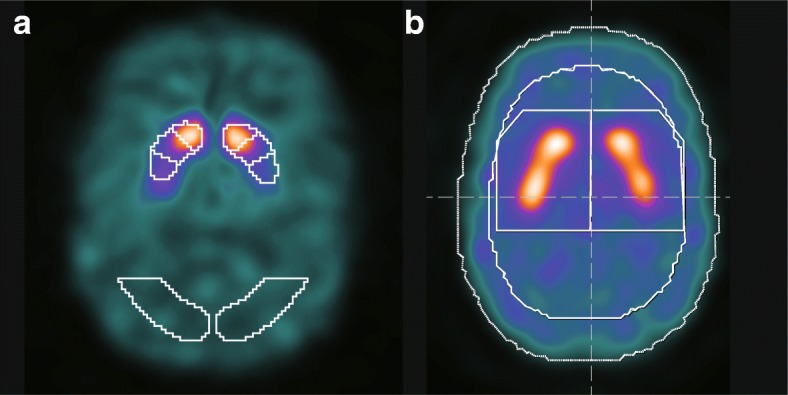
We sought to assess the machine learning-based combined diagnostic accuracy of three types of quantitative indices obtained using dopamine transporter single-photon emission computed tomography (DAT SPECT)-specific binding ratio (SBR), putamen-to-caudate ratio (PCR)/fractal dimension (FD), and asymmetry index (AI)-for parkinsonian syndrome (PS). We also aimed to compare the effect of two different types of volume of interest (VOI) settings from commercially available software packages DaTQUANT (Q) and DaTView (V) on diagnostic accuracy.
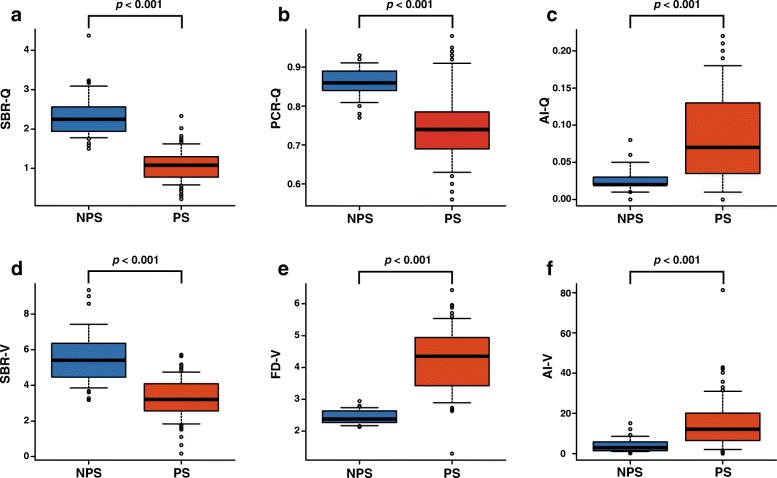
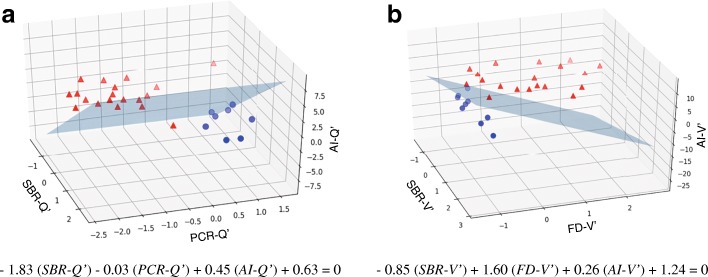
Seventy-one patients with PS and 40 without PS (NPS) were enrolled. Using SPECT images obtained from these patients, three quantitative indices were calculated at two different VOI settings each. SBR-Q, PCR-Q, and AI-Q were derived using the VOI settings from DaTQUANT, whereas SBR-V, FD-V, and AI-V were derived using those from DaTView. We compared the diagnostic value of these six indices for PS. We incorporated a support vector machine (SVM) classifier for assessing the combined accuracy of the three indices (SVM-Q: combination of SBR-Q, PCR-Q, and AI-Q; SVM-V: combination of SBR-V, FD-V, and AI-V). A Mann-Whitney U test and receiver-operating characteristics (ROC) analysis were used for statistical analyses.
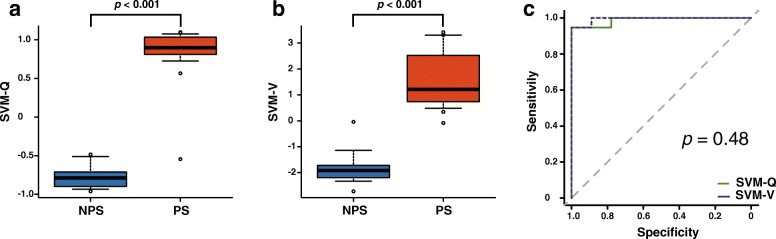
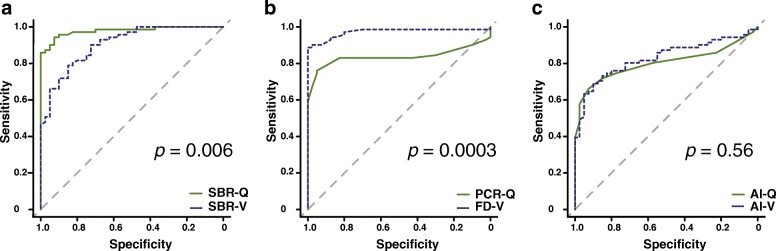
ROC analyses demonstrated that the areas under the curve (AUC) for SBR-Q, PCR-Q, AI-Q, SBR-V, FD-V, and AI-V were 0.978, 0.837, 0.802, 0.906, 0.972, and 0.829, respectively. On comparing the corresponding quantitative indices between the two types of VOI settings, SBR-Q performed better than SBR-V (p = 0.006), whereas FD-V performed better than PCR-Q (p = 0.0003). No significant difference was observed between AI-Q and AI-V (p = 0.56). The AUCs for SVM-Q and SVM-V were 0.988 and 0.994, respectively; the two different VOI settings displayed no significant differences in terms of diagnostic accuracy (p = 0.48).
The combination of the three indices obtained using the SVM classifier improved the diagnostic performance for PS; this performance did not differ based on the VOI settings and software used.
我们试图评估使用多巴胺转运体单光子发射计算机断层扫描(DAT SPECT)获得的三种定量指标——特异性结合率(SBR)、壳核与尾状核比率(PCR)/分形维数(FD)和不对称指数(AI)——基于机器学习的帕金森综合征(PS)联合诊断准确性。我们还旨在比较商业软件包DaTQUANT(Q)和DaTView(V)中两种不同类型的感兴趣区(VOI)设置对诊断准确性的影响。
纳入71例PS患者和40例非PS(NPS)患者。使用从这些患者获得的SPECT图像,在两种不同的VOI设置下分别计算三个定量指标。SBR-Q、PCR-Q和AI-Q使用DaTQUANT的VOI设置得出,而SBR-V、FD-V和AI-V使用DaTView的VOI设置得出。我们比较了这六个指标对PS的诊断价值。我们纳入了支持向量机(SVM)分类器来评估这三个指标的联合准确性(SVM-Q:SBR-Q、PCR-Q和AI-Q的组合;SVM-V:SBR-V、FD-V和AI-V的组合)。采用Mann-Whitney U检验和受试者工作特征(ROC)分析进行统计分析。
ROC分析表明,SBR-Q、PCR-Q、AI-Q、SBR-V、FD-V和AI-V的曲线下面积(AUC)分别为0.978、0.837、0.802、0.906、0.972和0.829。比较两种VOI设置下的相应定量指标,SBR-Q比SBR-V表现更好(p = 0.006),而FD-V比PCR-Q表现更好(p = 0.0003)。AI-Q和AI-V之间未观察到显著差异(p = 0.56)。SVM-Q和SVM-V的AUC分别为0.988和0.994;两种不同的VOI设置在诊断准确性方面无显著差异(p = 0.48)。
使用SVM分类器获得的三个指标的组合提高了PS的诊断性能;这种性能不因VOI设置和使用的软件而有所不同。