Chi Po-Jui, Lin Yu-Li, Tasi Jen-Pi, Wang Chih-Hsien, Hou Jia-Sian, Lee Chung-Jen, Hsu Bang-Gee
Division of Nephrology, Department of Medicine, Dalin Tzu Chi Hospital, Buddhist Tzu Chi Medical Foundation, Chiayi, Taiwan.
Department of Nephrology, Buddhist Tzu Chi General Hospital, Hualien, Taiwan.
Tzu Chi Med J. 2019 Jan-Mar;31(1):23-28. doi: 10.4103/tcmj.tcmj_12_18.
Vascular calcification is a cardiovascular risk factor in dialysis patients. Vascular calcification involves a complex process of biomineralization resembling osteogenesis, which leads to arterial stiffness. Osteocalcin is the most abundant noncollagenous protein in the bone matrix. It is synthesized in the bone by osteoblasts and reflects the rate of bone formation. The aim of this study was to evaluate the relationship between serum osteocalcin levels and the carotid-femoral pulse wave velocity (cfPWV) in peritoneal dialysis (PD) patients.
Serum intact osteocalcin and cfPWV were measured in 62 PD patients. Those with CfPWV values >10 m/s were defined as the high central arterial stiffness group, while those with values ≤10 m/s were regarded as the low central arterial stiffness group, according to the European Society of Hypertension and of the European Society of Cardiology guidelines.
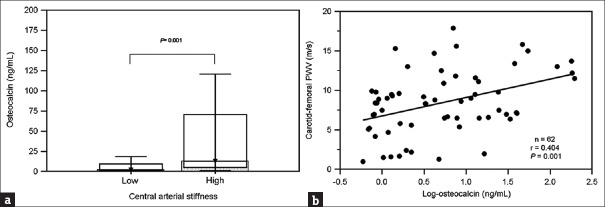
Seventeen of the 62 PD patients (27.4%) were in the high central arterial stiffness group. The high central arterial stiffness group were older ( = 0.002), had a longer PD vintage ( = 0.018), and had higher serum osteocalcin levels ( = 0.001) than those in the low group. Multivariate logistic regression analysis showed that the osteocalcin level (odds ratio: 1.069, 95% confidence interval (CI): 1.005-1.137, = 0.035), PD vintage (odds ratio: 1.028, 95% CI: 1.010-1.048, = 0.003), and age (odds ratio: 1.081, 95% CI: 1.005-1.162, = 0.035) were independently associated with central arterial stiffness in PD patients. Among these patients, cfPWV (: 0.216, = 0.001) values and log-transformed intact parathyroid hormone (: -'0.447, < 0.001) levels were independently associated with the osteocalcin level in PD patients after multivariate forward stepwise linear regression analysis.
Older PD patients with a longer PD vintage and higher serum osteocalcin levels had higher central arterial stiffness as measured by cfPWV. The serum osteocalcin level is an independent marker of central arterial stiffness in PD patients.
血管钙化是透析患者的心血管危险因素。血管钙化涉及一个类似于骨生成的复杂生物矿化过程,会导致动脉僵硬。骨钙素是骨基质中最丰富的非胶原蛋白。它由成骨细胞在骨中合成,反映骨形成速率。本研究的目的是评估腹膜透析(PD)患者血清骨钙素水平与颈股脉搏波速度(cfPWV)之间的关系。
对62例PD患者测量血清完整骨钙素和cfPWV。根据欧洲高血压学会和欧洲心脏病学会的指南,cfPWV值>10 m/s的患者被定义为高中心动脉僵硬度组,而值≤10 m/s的患者被视为低中心动脉僵硬度组。
62例PD患者中有17例(27.4%)属于高中心动脉僵硬度组。高中心动脉僵硬度组患者比低中心动脉僵硬度组患者年龄更大(P = 0.002)、腹膜透析病程更长(P = 0.018)且血清骨钙素水平更高(P = 0.001)。多因素逻辑回归分析显示,骨钙素水平(比值比:1.069,95%置信区间(CI):1.005 - 1.137,P = 0.035)、腹膜透析病程(比值比:1.028,95% CI:1.010 - 1.048,P = 0.003)和年龄(比值比:1.081,95% CI:1.005 - 1.162,P = 0.035)与PD患者的中心动脉僵硬度独立相关。在这些患者中,多因素向前逐步线性回归分析后,cfPWV值(P = 0.216,P = 0.001)和对数转换后的完整甲状旁腺激素水平(P = - 0.447,P < 0.001)与PD患者的骨钙素水平独立相关。
年龄较大、腹膜透析病程较长且血清骨钙素水平较高的PD患者,通过cfPWV测量的中心动脉僵硬度更高。血清骨钙素水平是PD患者中心动脉僵硬度的独立标志物。