Malta Elvis de Souza, de Lira Fabio Santos, Machado Fabiana Andrade, Zago Anderson Saranz, do Amaral Sandra Lia, Zagatto Alessandro Moura
Laboratory of Physiology and Sport Performance, Department of Physical Education, School of Sciences, São Paulo State University, Bauru, Brazil.
Department of Physical Education, School of Technology and Sciences, São Paulo State University, Presidente Prudente, Brazil.
Front Physiol. 2019 Jan 14;9:1948. doi: 10.3389/fphys.2018.01948. eCollection 2018.
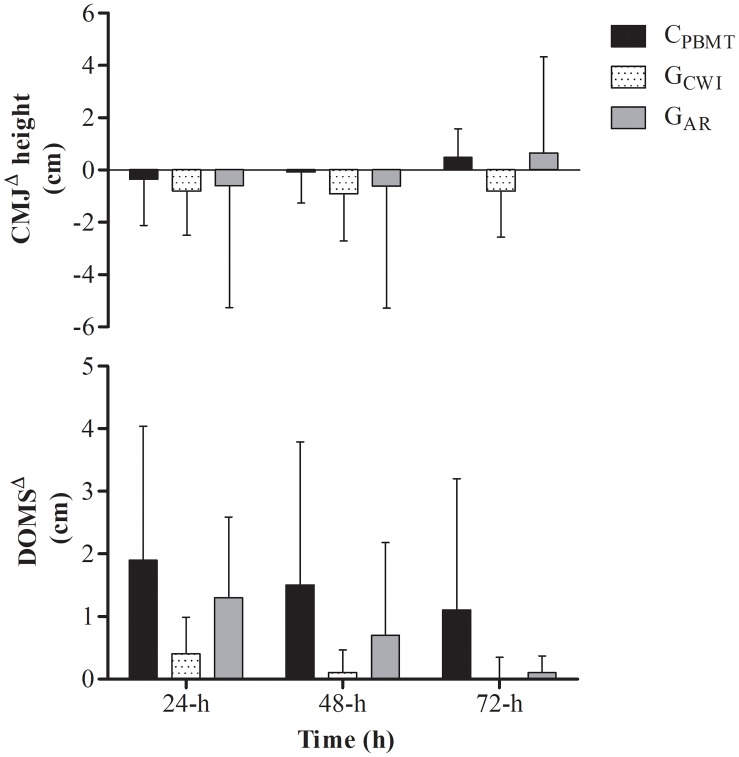
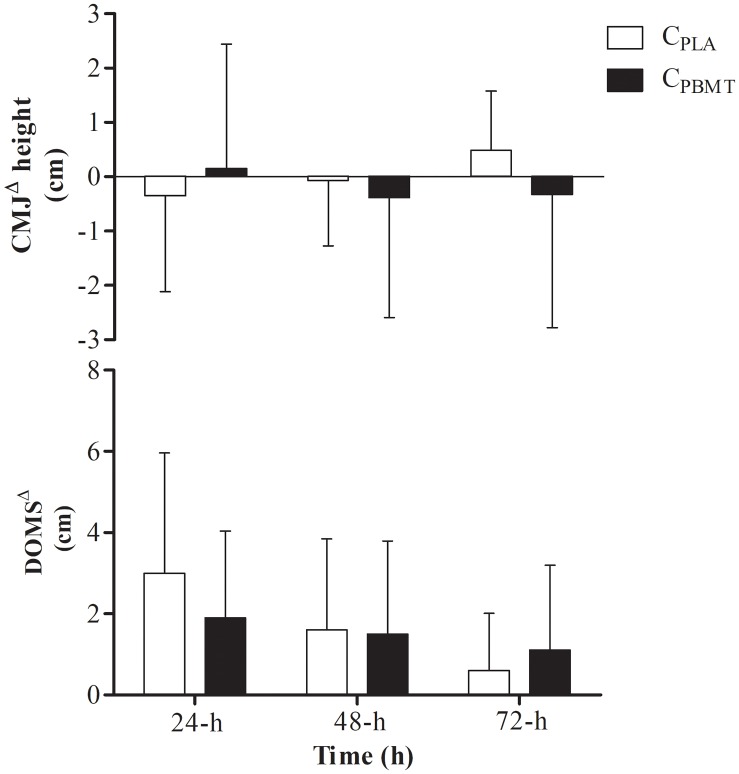
The aim of the present study was to investigate the effectiveness of photobiomodulation therapy (PBMT) on muscle recovery based on inflammation (interleukin-10 [IL-10]; tumor necrosis factor-α [TNFα]), muscle damage markers (creatine kinase [CK]; lactate dehydrogenase [LDH]), delay onset muscle soreness (DOMS), and countermovement jump performance (CMJ) after two sprint interval training (SIT) sessions compared with a placebo condition (part-I), as well as to compare the effectiveness of PBMT with active recovery (AR) and cold-water immersion (CWI) (part-II). Part-I was conducted as a double-blind, randomized and placebo-controlled study and part-II as a parallel-group study. Thirty-six men participated in the studies (12 participants in part-I and 36 participants in part-II). Volunteers performed two SITs interspaced by 24-h (SIT and SIT) to mimic the effect of accumulating 2 consecutive days of SIT. In part-I, only after SIT, PBMT [Total energy: 600J (300J per leg in 5 spots); wavelength: 660-850 nm] or placebo interventions were performed, while in part-II PBMT (part-I data), AR (15-min; 50% of the maximal aerobic power), or CWI (10-min; 10°C) were carried out, also after SIT. Blood samples were collected before (i.e., baseline), and 0.5, 1, 24, 48, and 72-h after SIT, while CMJ and DOMS were measured before, 24, 48, and 72-h after SIT. In part-I, there were no interactions between PBMT and placebo conditions for any blood markers ( ≥ 0.313), DOMS ( = 0.052), and CMJ ( = 0.295). However, an effect of time was found with increases in LDH, CK, and IL-10 ( ≤ 0.043) as well as a decrease in DOMS at 72-h compared with 24-h ( = 0.012). In part-II, there were no interactions between the PBMT, AR, and CWI groups for any markers at the same moments ( ≥ 0.189) and for the peak and integral values ( ≥ 0.193), for DOMS ( = 0.314) and CMJ ( = 0.264). However, an effect of time was found with an increase in CK and IL-10 ( = 0.003), while DOMS decreased at 48 and 72-h compared with 24-h ( = 0.001). In summary, PBMT had no effect on inflammation, muscle damage, CMJ performance, or DOMS after two consecutive sprint interval training sessions compared to placebo, CWI, and AR strategies.
本研究的目的是调查光生物调节疗法(PBMT)对基于炎症(白细胞介素-10 [IL-10];肿瘤坏死因子-α [TNFα])、肌肉损伤标志物(肌酸激酶 [CK];乳酸脱氢酶 [LDH])、延迟性肌肉酸痛(DOMS)以及与安慰剂对照条件相比,两次冲刺间歇训练(SIT)后反向运动跳跃表现(CMJ)的肌肉恢复的有效性(第一部分),并比较PBMT与主动恢复(AR)和冷水浸泡(CWI)的有效性(第二部分)。第一部分作为双盲、随机和安慰剂对照研究进行,第二部分作为平行组研究进行。三十六名男性参与了研究(第一部分12名参与者,第二部分36名参与者)。志愿者进行了两次间隔24小时的SIT(SIT和SIT),以模拟连续两天进行SIT的累积效果。在第一部分中,仅在SIT后进行PBMT [总能量:600焦耳(每条腿在5个部位各300焦耳);波长:660 - 850纳米] 或安慰剂干预,而在第二部分中,同样在SIT后进行PBMT(第一部分数据)、AR(15分钟;最大有氧功率的50%)或CWI(10分钟;10°C)。在SIT前(即基线)以及SIT后0.5、1、24、48和72小时采集血样,同时在SIT前、SIT后24、48和72小时测量CMJ和DOMS。在第一部分中,对于任何血液标志物(≥0.313)、DOMS(=0.052)和CMJ(=0.295),PBMT与安慰剂对照条件之间均无相互作用。然而,发现了时间效应,与24小时相比,LDH、CK和IL-10升高(≤0.001),且72小时时DOMS降低(=0.012)。在第二部分中,在相同时间点(≥0.189)以及峰值和积分值(≥0.193)、DOMS(=0.314)和CMJ(=0.264)方面,PBMT、AR和CWI组之间对于任何标志物均无相互作用。然而,发现了时间效应,CK和IL-10升高(=0.003),而与24小时相比,48和72小时时DOMS降低(=0.001)。总之,与安慰剂、CWI和AR策略相比,连续两次冲刺间歇训练后,PBMT对炎症、肌肉损伤、CMJ表现或DOMS没有影响。