School of Public Health, Capital Medical University, Beijing, China.
Beijing Municipal Key Laboratory of Clinical Epidemiology, Beijing, China.
J Diabetes Res. 2018 Dec 30;2018:6905720. doi: 10.1155/2018/6905720. eCollection 2018.
Hyperuricemia is known to be a risk factor for diabetes. However, information is limited regarding the association between changes in hyperuricemia and the risk of diabetes.
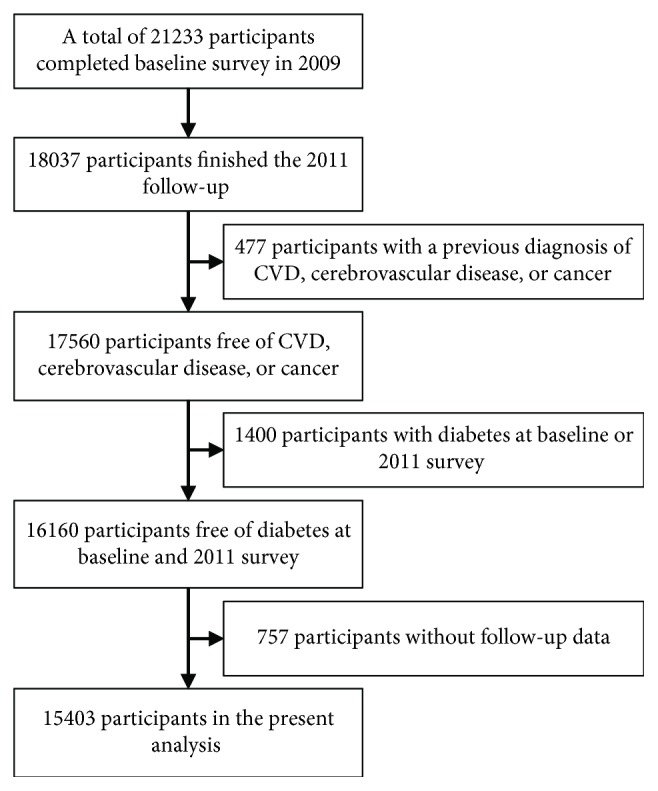
A total of 15,403 participants who were free of diabetes at the time of 2009 and 2011 surveys in the Beijing Health Management Cohort (BHMC) study were recruited and followed up until 2016. Participants were classified into four groups according to 2-year changes in hyperuricemia: no hyperuricemia, remittent hyperuricemia, incident hyperuricemia, and persistent hyperuricemia. Modified Poisson regression models were used to evaluate the effect of 2-year changes in hyperuricemia on the risk of diabetes.
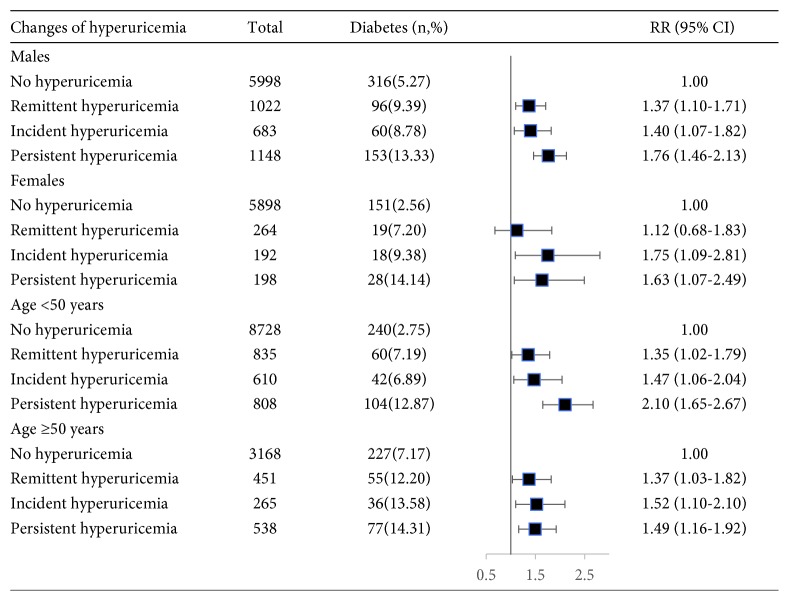
During the 5-year follow-up, we identified 841 new cases of diabetes (216 women). Remittent hyperuricemia and incident hyperuricemia had a 35% and 48% higher risk for developing diabetes compared with no hyperuricemia. Especially, persistent hyperuricemia was associated with a 75% higher risk of diabetes (RR = 1.75, 95% CI = 1.47-2.08). Compared with minor serum uric acid (SUA) change, over 10% decline and over 30% increase in SUA levels were subsequently associated with lower (RR = 0.84, 95% CI = 0.72-0.99) and higher (RR = 1.71, 95% CI = 1.27-2.30) diabetes risk, respectively.
Changes in hyperuricemia, especially persistent hyperuricemia, are more appropriate to reflect the risk of diabetes than a single measurement of hyperuricemia at baseline. Strategies aiming at preventing hyperuricemia are urgently needed to reduce the increasing burden of diabetes.
高尿酸血症是糖尿病的一个已知危险因素。然而,关于高尿酸血症变化与糖尿病风险之间的关系的信息有限。
共纳入 15403 名参与者,他们在 2009 年和 2011 年北京健康管理队列(BHMC)研究中无糖尿病,随访至 2016 年。根据高尿酸血症的 2 年变化,将参与者分为四组:无高尿酸血症、间歇性高尿酸血症、新发高尿酸血症和持续性高尿酸血症。采用改良泊松回归模型评估高尿酸血症 2 年变化对糖尿病风险的影响。
在 5 年的随访期间,我们发现了 841 例新发糖尿病病例(216 例女性)。与无高尿酸血症相比,间歇性高尿酸血症和新发高尿酸血症发生糖尿病的风险分别增加了 35%和 48%。特别是持续性高尿酸血症与糖尿病的风险增加了 75%(RR=1.75,95%CI=1.47-2.08)。与血清尿酸(SUA)小幅度变化相比,SUA 水平下降超过 10%和增加超过 30%与较低(RR=0.84,95%CI=0.72-0.99)和较高(RR=1.71,95%CI=1.27-2.30)的糖尿病风险相关。
与基线时单次测量高尿酸血症相比,高尿酸血症的变化,特别是持续性高尿酸血症,更能反映糖尿病的风险。迫切需要预防高尿酸血症的策略来降低糖尿病日益增长的负担。