Department of Physiotherapy, College of Medicine and Health Sciences, University of Gondar, Gondar, Ethiopia.
Department of Physiotherapy, School of Medicine, College of Health Sciences and Ayder comprehensive specialized Hospital, Mekelle University, Mekelle, North Ethiopia.
PLoS One. 2019 Jan 29;14(1):e0211354. doi: 10.1371/journal.pone.0211354. eCollection 2019.
Antiretroviral therapy has surely increased the life expectancy of people living with HIV. However, long term complications like HIV associated sensory neuropathy has a negative impact on quality of life among people living with HIV (PLHIV). In Ethiopia, lack of data on magnitude of the burden and predictors of HIV associated sensory neuropathy in many resource limited setting has led to under diagnosis and eventually under management of HIV-SN. Hence, this study was set out to establish the burden of HIV-associated sensory neuropathy and, its association with demographic, health and clinical characteristics among people living with HIV in Ethiopia.
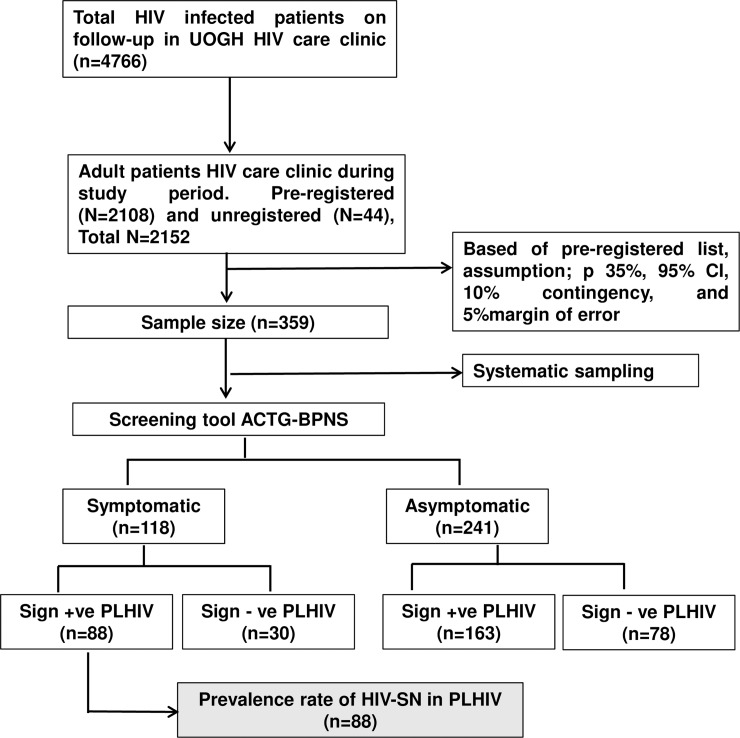
Cross-sectional study was conducted to assess the prevalence of HIV-associated sensory neuropathy and the associated factors among adult HIV patients at University of Gondar Teaching Hospital, Gondar, Ethiopia. Brief Peripheral Neuropathy Screening tool validated by AIDs Clinical trial group was used for screening HIV-associated sensory neuropathy. Data were analyzed descriptively and through uni- and multivariate logistic regression.
In total 359 adult PLHIV with a mean age of 36.5± 9.07 years participated, their median duration of HIV infection was 60 months (IQR 36-84) and their median CD4 count 143cells/μL (IQR 69.5-201.5). Age above 40 years, anti-tuberculosis regimen, tallness, and exposure to didanosine contained antiretroviral therapy were found to be associated with HIV-associated sensory neuropathy (AOR 1.82, 1.84, 1.98 and 4.33 respectively).
More than half of the HIV patients who attended HIV care clinic at University of Gondar hospital during the study period were found to present with peripheral sensory neuropathy. Higher age, tallness, TB medication, and didanosine in ART were significantly associated with HIV-SN as screened by effective diagnostic (BPNS) tool.
抗逆转录病毒疗法肯定提高了艾滋病毒感染者的预期寿命。然而,长期并发症如艾滋病毒相关感觉神经病变对艾滋病毒感染者(PLHIV)的生活质量有负面影响。在埃塞俄比亚,由于缺乏有关许多资源有限环境中艾滋病毒相关感觉神经病变的严重程度和预测因素的数据,导致诊断不足,最终导致艾滋病毒感觉神经病变管理不善。因此,本研究旨在确定艾滋病毒相关感觉神经病变的负担,并评估其与埃塞俄比亚艾滋病毒感染者的人口统计学、健康和临床特征的关联。
在埃塞俄比亚贡德尔大学教学医院进行了一项横断面研究,以评估成人艾滋病毒患者中艾滋病毒相关感觉神经病变的患病率及其相关因素。采用经艾滋病临床试验组验证的简短周围神经病变筛查工具筛查艾滋病毒相关感觉神经病变。数据进行描述性和单变量及多变量逻辑回归分析。
共有 359 名平均年龄为 36.5±9.07 岁的成年 PLHIV 参与了研究,他们的中位艾滋病毒感染持续时间为 60 个月(IQR 36-84),中位 CD4 计数为 143 个细胞/μL(IQR 69.5-201.5)。年龄大于 40 岁、抗结核方案、身高和接触包含更昔洛韦的抗逆转录病毒治疗与艾滋病毒相关感觉神经病变相关(AOR 分别为 1.82、1.84、1.98 和 4.33)。
在研究期间,在贡德尔大学医院参加艾滋病毒护理诊所的 HIV 患者中,超过一半的人被发现患有周围感觉神经病变。更高的年龄、身高、结核病药物和抗逆转录病毒治疗中的更昔洛韦与有效诊断(BPNS)工具筛查的 HIV-SN 显著相关。