Jiangsu Key Laboratory for Horticultural Crop Genetic Improvement, Institute of Vegetable Crops, Jiangsu Academy of Agricultural Sciences, Nanjing, 210014, People's Republic of China.
Zhenjiang Agricultural Research Institute, Jurong, Jiangsu, 212400, People's Republic of China.
BMC Genomics. 2019 Jan 29;20(1):93. doi: 10.1186/s12864-019-5454-2.
The SWEET proteins are a group of sugar transporters that play a role in sugar efflux during a range of biological processes, including stress responses. However, there has been no comprehensive analysis of the SWEET family genes in Brassica oleracea (BoSWEET), and the evolutionary pattern, phylogenetic relationship, gene characteristics of BoSWEET genes and their expression patterns under biotic and abiotic stresses remain largely unexplored.
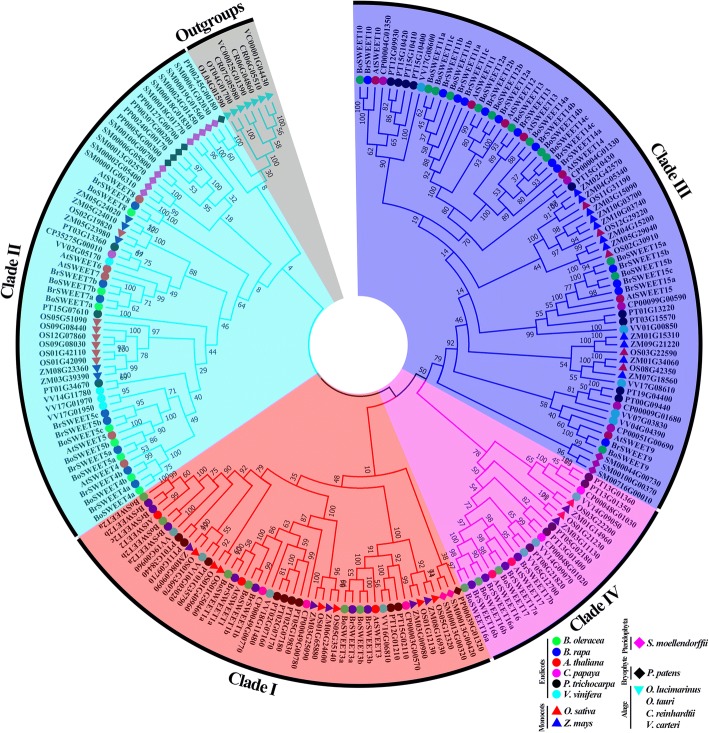
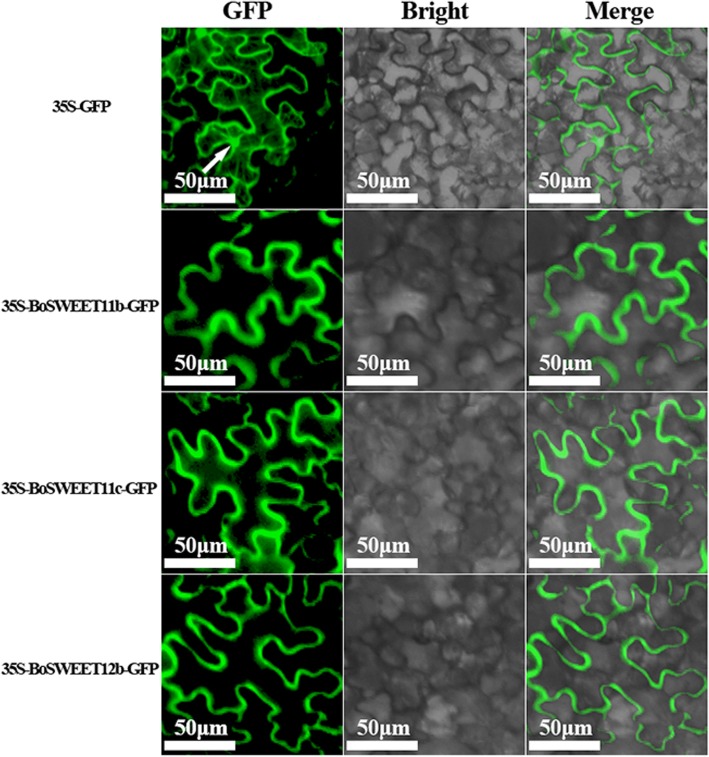
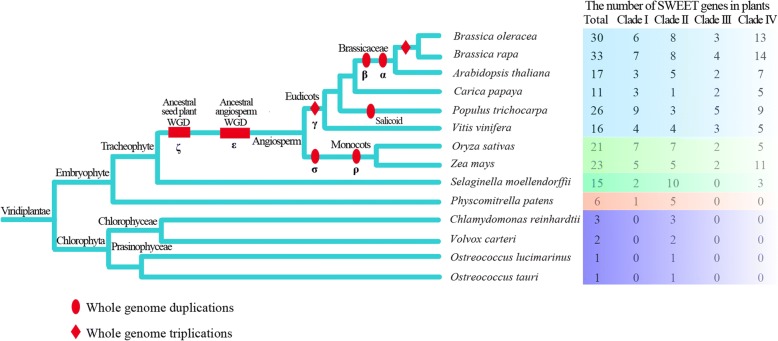
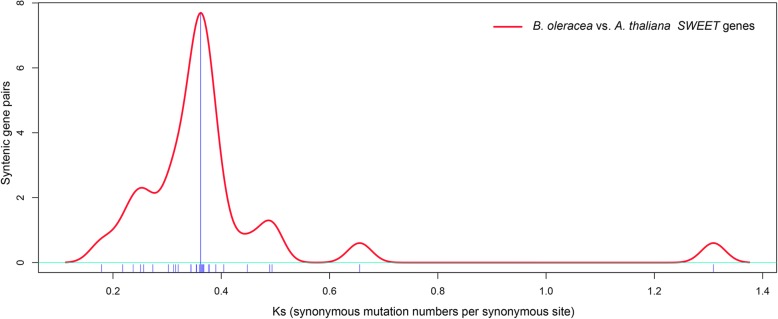
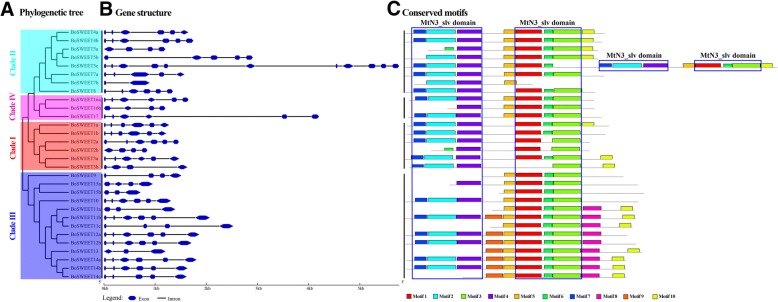
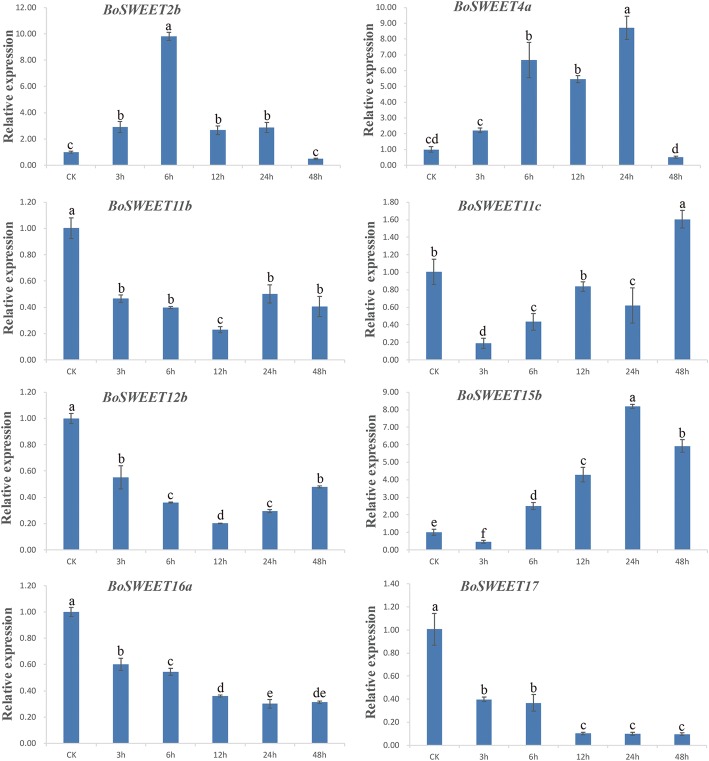
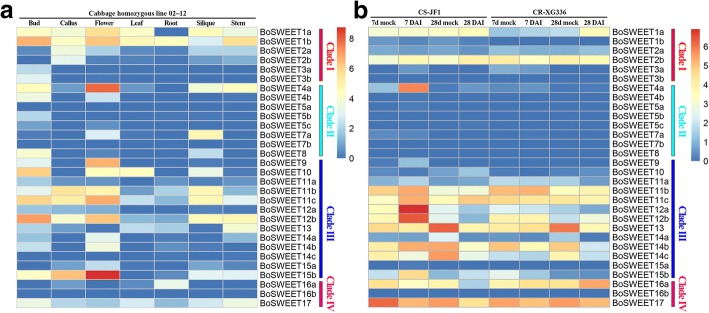
A total of 30 BoSWEET genes were identified and divided into four clades in B. oleracea. Phylogenetic analysis of the BoSWEET proteins indicated that clade II formed first, followed by clade I, clade IV and clade III, successively. Clade III, the newest clade, shows signs of rapid expansion. The Ks values of the orthologous SWEET gene pairs between B. oleracea and Arabidopsis thaliana ranged from 0.30 to 0.45, which estimated that B. oleracea diverged from A. thaliana approximately 10 to 15 million years ago. Prediction of transmembrane regions showed that eight BoSWEET proteins contain one characteristic MtN3_slv domain, twenty-one contain two, and one has four. Quantitative reverse transcription-PCR (qRT-PCR) analysis revealed that five BoSWEET genes from clades III and IV exhibited reduced expression levels under chilling stress. Additionally, the expression levels of six BoSWEET genes were up-regulated in roots of a clubroot-susceptible cabbage cultivar (CS-JF1) at 7 days after inoculation with Plasmodiophora brassicae compared with uninoculated plants, indicating that these genes may play important roles in transporting sugars into sink roots associated with P. brassicae colonization in CS-JF1. Subcellular localization analysis of a subset of BoSWEET proteins indicated that they are localized in the plasma membrane.
This study provides important insights into the evolution of the SWEET gene family in B. oleracea and other species, and represents the first study to characterize phylogenetic relationship, gene structures and expression patterns of the BoSWEET genes. These findings provide new insights into the complex transcriptional regulation of BoSWEET genes, as well as potential candidate BoSWEET genes that promote sugar transport to enhance chilling tolerance and clubroot disease resistance in cabbage.
SWEET 蛋白是一组糖转运蛋白,在一系列生物学过程(包括应激反应)中发挥糖外排作用。然而,目前还没有对甘蓝型油菜(BoSWEET)的 SWEET 家族基因进行全面分析,BoSWEET 基因的进化模式、系统发育关系、基因特征及其在生物和非生物胁迫下的表达模式仍在很大程度上未被探索。
在甘蓝型油菜中鉴定出 30 个 BoSWEET 基因,并分为四个分支。BoSWEET 蛋白的系统发育分析表明,分支 II 首先形成,其次是分支 I、分支 IV 和分支 III,依次形成。分支 III 是最新的分支,显示出快速扩张的迹象。甘蓝型油菜和拟南芥的同源 SWEET 基因对的 Ks 值范围为 0.30 至 0.45,这表明甘蓝型油菜大约在 10 到 1500 万年前与拟南芥分化。跨膜区预测表明,8 个 BoSWEET 蛋白含有一个特征性的 MtN3_slv 结构域,21 个含有两个,一个含有四个。定量反转录-PCR(qRT-PCR)分析显示,在冷胁迫下,来自分支 III 和 IV 的 5 个 BoSWEET 基因的表达水平降低。此外,在接种根肿菌(Plasmodiophora brassicae)的感病白菜品种(CS-JF1)的根中,6 个 BoSWEET 基因的表达水平在接种后 7 天被上调,与未接种的植物相比,表明这些基因可能在将糖运输到与 P. brassicae 定殖相关的汇根中发挥重要作用。对部分 BoSWEET 蛋白的亚细胞定位分析表明,它们定位于质膜上。
本研究为甘蓝型油菜和其他物种的 SWEET 基因家族进化提供了重要的见解,也是首次对 BoSWEET 基因的系统发育关系、基因结构和表达模式进行特征描述。这些发现为 BoSWEET 基因的复杂转录调控提供了新的见解,并为促进糖运输以提高白菜耐冷性和抗根肿病的潜在候选 BoSWEET 基因提供了新的见解。