Department of Psychology, Stockholm University, Stockholm, Sweden.
J Occup Health. 2019 Jan;61(1):91-100. doi: 10.1002/1348-9585.12020.
This longitudinal study aimed to investigate the causal relationships between social support at work and mental health in terms of mental distress. Despite assuming social support at work to be associated with less mental distress, reversed and reciprocal relationships were investigated as well.
Self-reports in questionnaires of social support and mental distress were collected longitudinally, with annual measurements over three consecutive years, among 301 office workers (57% women) in Sweden. Cross-lagged structural equation modeling was used to test the hypotheses.
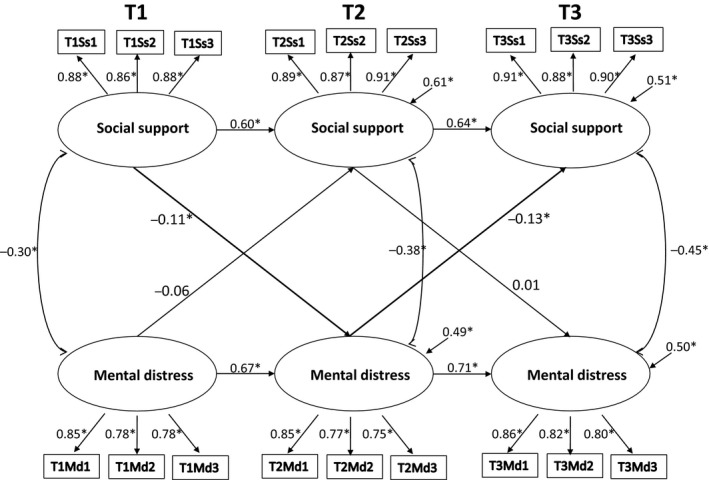
The reciprocal causation model was considered the best-fitting model. The results suggest that social support and mental distress influenced each other negatively, but with a delayed effect. Specifically, this involves Time 1 levels of social support being negatively associated with Time 2 levels of mental distress, while Time 2 levels of mental distress were negatively associated with Time 3 levels of support.
The findings partly align with the hypothesis that social support is related to lower levels of mental distress but also suggest that mental distress can reduce levels of social support. While the findings also suggest a mutual interrelation between social support and mental distress, this is not a consistent reciprocal causation. Rather, and due to the variation in reciprocity between time points, it appears to be a cyclical process, which needs further investigation.
本纵向研究旨在探讨工作中的社会支持与心理健康(以精神困扰为指标)之间的因果关系。尽管我们假设工作中的社会支持与较少的精神困扰有关,但也研究了相反的和相互的关系。
在瑞典,301 名上班族(57%为女性)连续三年每年接受一次问卷调查,收集社会支持和精神困扰的自我报告数据。采用交叉滞后结构方程模型来检验假设。
被认为最佳拟合模型的是互为因果关系模型。结果表明,社会支持和精神困扰相互之间存在负向影响,但存在滞后效应。具体来说,这涉及到第一时间的社会支持水平与第二时间的精神困扰水平呈负相关,而第二时间的精神困扰水平与第三时间的支持水平呈负相关。
研究结果部分符合社会支持与较低水平的精神困扰相关的假设,但也表明精神困扰会降低社会支持的水平。尽管研究结果还表明社会支持和精神困扰之间存在相互关系,但这并不是一种持续的相互因果关系。相反,由于各时间点之间的相互关系存在差异,这似乎是一个循环过程,需要进一步研究。