Hjelmager Ditte Meulengracht, Vinther Line Dausel, Poulsen Søren Herold, Petersen Lone Stub, Jensen Martin Bach, Riis Allan
a Department of Development and Planning , Aalborg University , Aalborg , Denmark.
b Center for General Pracitce at Aalborg University , Aalborg , Denmark.
Scand J Prim Health Care. 2019 Mar;37(1):60-68. doi: 10.1080/02813432.2019.1569413. Epub 2019 Jan 31.
To identify general practitioners' (GPs) barriers and facilitators regarding the use of health information technology (HIT) in the treatment of patients with low back pain (LBP).
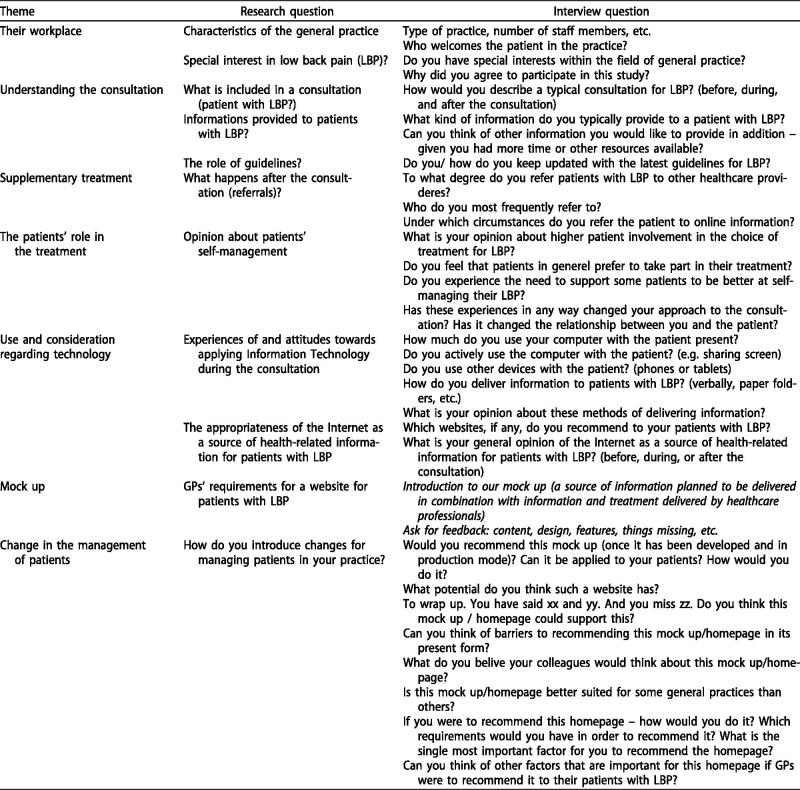
A qualitative study employing a participatory design approach, with an inductive analytical thematic approach utilising semi-structured interviews. Empirical data was analysed using the qualitative data analysis software (QDAS) Nvivo.
General practices in Denmark.
Eight interviews were conducted with an average duration of 60 min. The interviewees were GPs from different geographical settings and different organisational structures, varying in age and professional interests.
Barriers and facilitators for future use of the HIT application for patients with LBP.
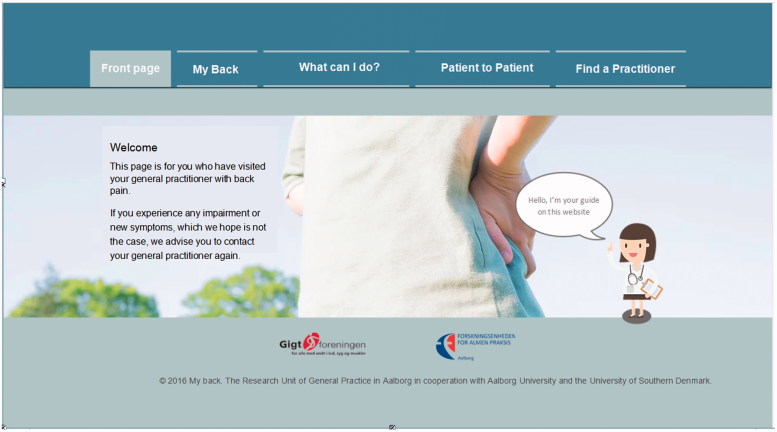
Through the inclusion of healthcare professionals in the design process, this study found that in order for GPs to recommend a HIT application it is essential to target the application towards their patients. Furthermore, GPs required that the HIT application should support patient self-management. Additionally, the content of the HIT application should support the initiated treatment and it should be easy for GPs to recommend the HIT application. Finally, healthcare professionals need to be involved in the design process.
When designing health IT applications for patients with LBP in general practice it is important to include both patients and GPs in the design process. GPs would be more willing to recommend a HIT application that: applies content in line with frequently used recommendations; targets patients; supports patients' self-management; and supports the patients' needs. KEY POINTS Online information is currently applied in general practice to some patients with low back pain Online information cannot replace the GP, but can rather be a bonding tool between the patient and the GP It is important to address both GP and patient barriers to applying new technology and to consider the literacy level Participatory methods could play a central role in the future development of online information material.
确定全科医生(GP)在使用健康信息技术(HIT)治疗腰痛(LBP)患者方面的障碍和促进因素。
一项采用参与式设计方法的定性研究,采用归纳分析主题方法并运用半结构化访谈。使用定性数据分析软件(QDAS)Nvivo对实证数据进行分析。
丹麦的全科诊所。
进行了8次访谈,平均时长60分钟。受访者为来自不同地理区域和不同组织结构、年龄和专业兴趣各异的全科医生。
未来将HIT应用于LBP患者的障碍和促进因素。
通过让医疗保健专业人员参与设计过程,本研究发现,为使全科医生推荐HIT应用,必须使其针对患者。此外,全科医生要求HIT应用应支持患者自我管理。此外,HIT应用的内容应支持初始治疗,且全科医生应易于推荐该HIT应用。最后,医疗保健专业人员需要参与设计过程。
在为全科医疗中的LBP患者设计健康信息技术应用时,让患者和全科医生都参与设计过程很重要。全科医生更愿意推荐符合以下条件的HIT应用:应用符合常用建议的内容;针对患者;支持患者自我管理;满足患者需求。要点:目前在线信息在全科医疗中已应用于一些腰痛患者 在线信息不能取代全科医生,但可成为患者与全科医生之间的联系工具 解决全科医生和患者在应用新技术方面的障碍并考虑文化水平很重要 参与式方法可能在未来在线信息材料的开发中发挥核心作用