Peschmann Anna-Lydia, Beer Meinrad, Ammann Bettina, Dreyhaupt Jens, Kneer Katharina, Beer Ambros J, Beltinger Christian, Steinbach Daniel, Cario Holger, Neubauer Henning
Department of Diagnostic and Interventional Radiology, University Hospital Ulm, Albert-Schweitzer-Allee 23, 89081, Ulm, Germany.
Department of Biometrics, University Hospital Ulm, 89081, Ulm, Germany.
Eur Radiol Exp. 2019 Jan 30;3(1):6. doi: 10.1186/s41747-019-0087-4.
Quantitative diffusion-weighted imaging (DWI) probes into tissue microstructure in solid tumours. In this retrospective ethically approved study, we investigated DWI as a potential non-invasive predictor of tumour dignity and prognosis in paediatric patients with neuroblastic tumours.
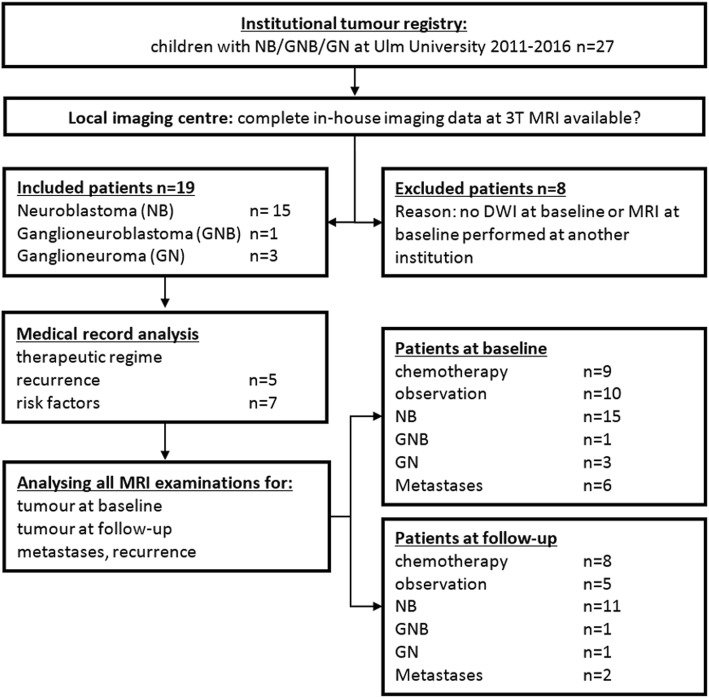
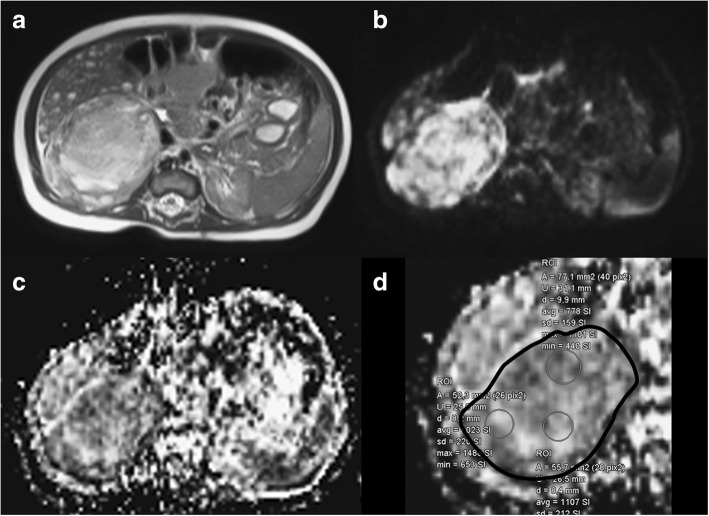
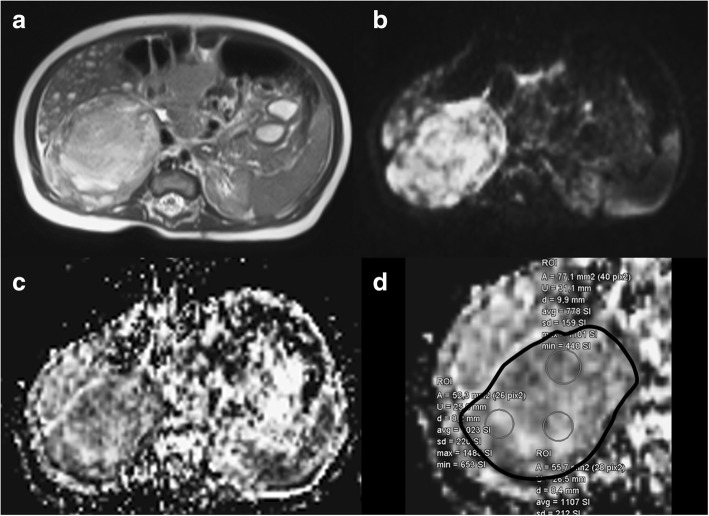
Nineteen consecutive patients with neuroblastoma (NB, n = 15), ganglioneuroblastoma (GNB, n = 1) and ganglioneuroma (GN, n = 3) underwent 3-T magnetic resonance imaging at first diagnosis and after 3-month follow-up, following a protocol including DWI (b = 50 and 800 s/mm) in addition to standard sequences. All DWI scans were analysed for tumour volume assessment and apparent diffusion coefficient (ADC) calculation. Correlation with tumour pathology and risk factors (bone-marrow metastases, MYCN-amplification and 1p-deletion), therapeutic regime (observation versus chemotherapy) and clinical follow-up was evaluated.
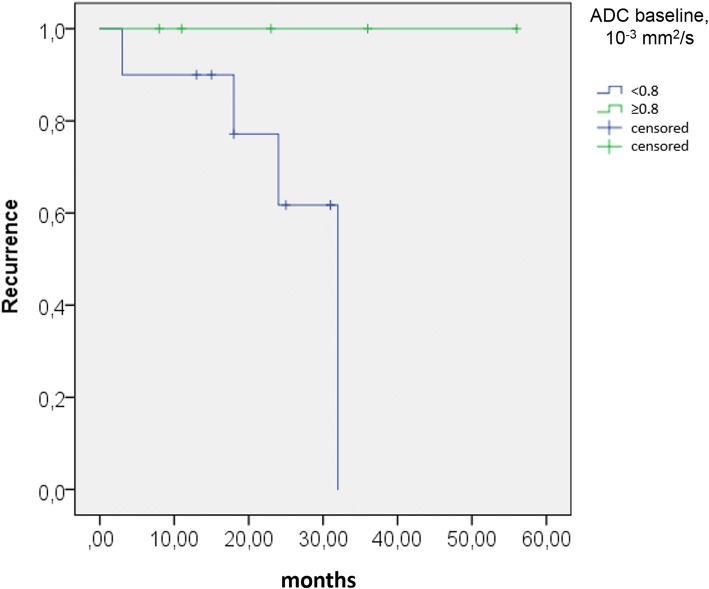
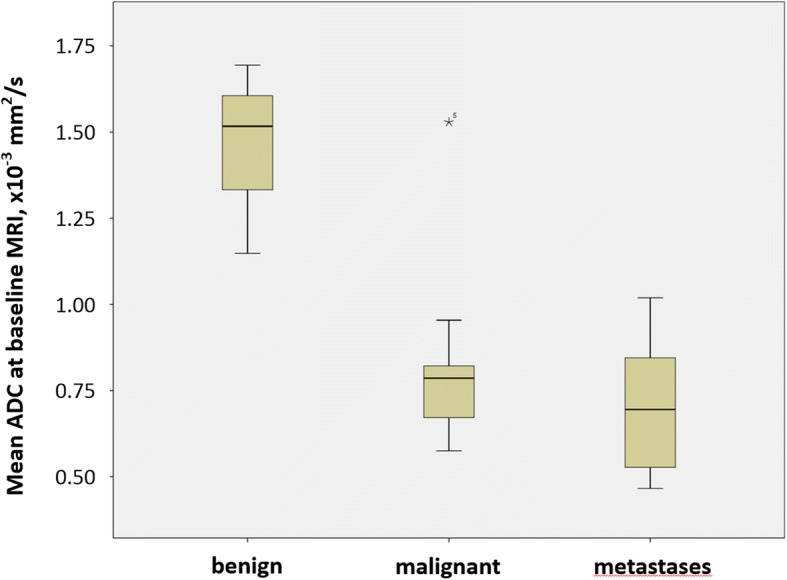
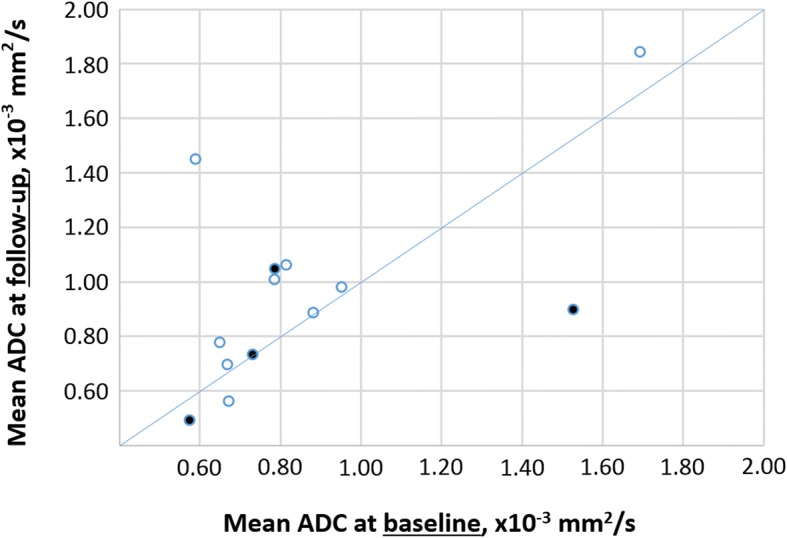
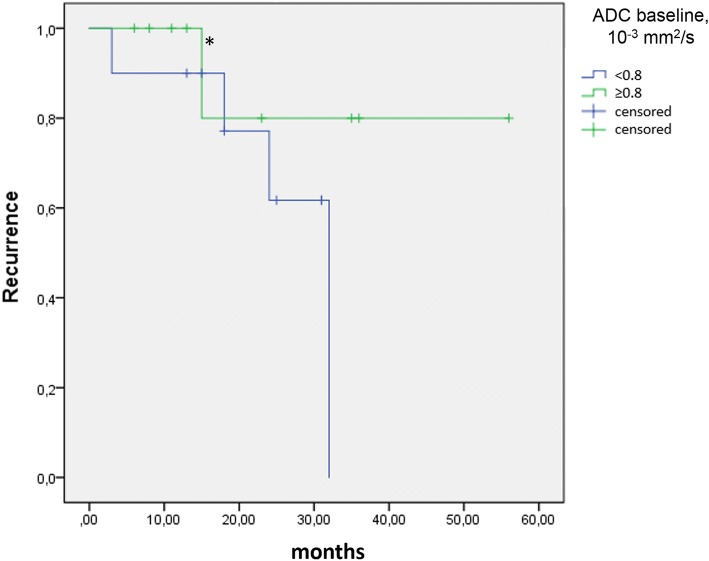
At baseline, mean ADC in NB was lower than in GNB/GN (0.76 vs. 1.47 × 10 mm/s, p = 0.003). An ADC cutoff ≤ 1.05 identified malignant disease with 100.0% sensitivity (95% confidence interval [CI] 29.2-100.0%) and 93.8% specificity (95% CI 69.8-99.8%). Initial ADC was < 0.80 in all NB patients with eventual tumour relapse. During follow-up, tumour ADC values increased in the observation group (NB/GN) without relapse (p = 0.043). In eventually relapsing tumours, ADC values at follow-up tended to decrease further despite reduction in tumour volume.
ADC values at first presentation differed significantly between malignant and benign neuroblastic tumours. Low baseline ADC was predictive of tumour progression and relapse in NB patients. With therapy, increasing ADC values appeared to predict relapse-free survival, while a decreasing ADC during therapy was an indicator of poor prognosis.
定量扩散加权成像(DWI)可探究实体瘤的组织微观结构。在这项经伦理批准的回顾性研究中,我们调查了DWI作为小儿神经母细胞瘤患者肿瘤特性和预后的潜在非侵入性预测指标。
19例连续的神经母细胞瘤(NB,n = 15)、神经节神经母细胞瘤(GNB,n = 1)和神经节瘤(GN,n = 3)患者在初次诊断时及3个月随访后接受了3-T磁共振成像检查,检查方案除标准序列外还包括DWI(b = 50和800 s/mm²)。对所有DWI扫描进行分析以评估肿瘤体积并计算表观扩散系数(ADC)。评估其与肿瘤病理及危险因素(骨髓转移、MYCN扩增和1p缺失)、治疗方案(观察与化疗)及临床随访的相关性。
基线时,NB的平均ADC低于GNB/GN(0.76对1.47×10⁻³mm²/s,p = 0.003)。ADC截止值≤1.05可识别恶性疾病,敏感性为100.0%(95%置信区间[CI] 29.2 - 100.0%),特异性为93.8%(95% CI 69.8 - 99.8%)。所有最终肿瘤复发的NB患者初始ADC均<0.80。随访期间,未复发的观察组(NB/GN)肿瘤ADC值升高(p = 0.043)。在最终复发的肿瘤中,尽管肿瘤体积减小,但随访时的ADC值仍倾向于进一步降低。
初次就诊时恶性和良性神经母细胞瘤的ADC值存在显著差异。低基线ADC可预测NB患者的肿瘤进展和复发。随着治疗,ADC值升高似乎可预测无复发生存,而治疗期间ADC值降低则提示预后不良。