Department of Diagnostic and Interventional Radiology, University Hospital Tuebingen, Hoppe-Seyler-Straße 3, 72076, Tuebingen, Germany.
Department of Pediatric Surgery and Pediatric Urology, University Children's Hospital Tuebingen, Tuebingen, Germany.
Cancer Imaging. 2020 Dec 17;20(1):89. doi: 10.1186/s40644-020-00366-3.
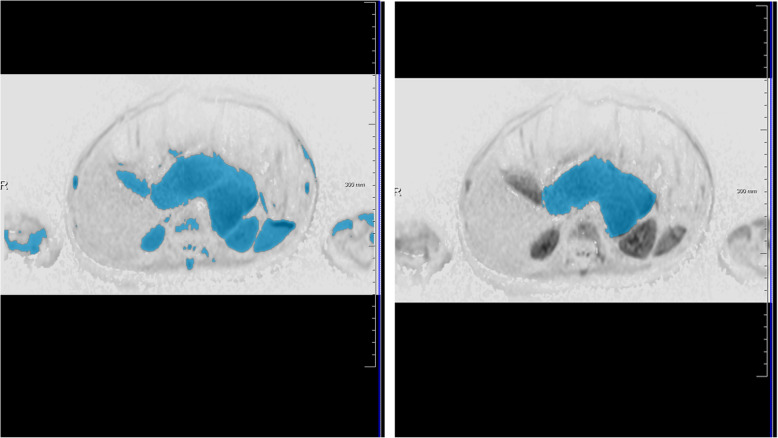
To assess the feasibility and possible value of semi-automated diffusion weighted imaging (DWI) volumetry of whole neuroblastic tumors with apparent diffusion coefficient (ADC) map evaluation after neoadjuvant chemotherapy.
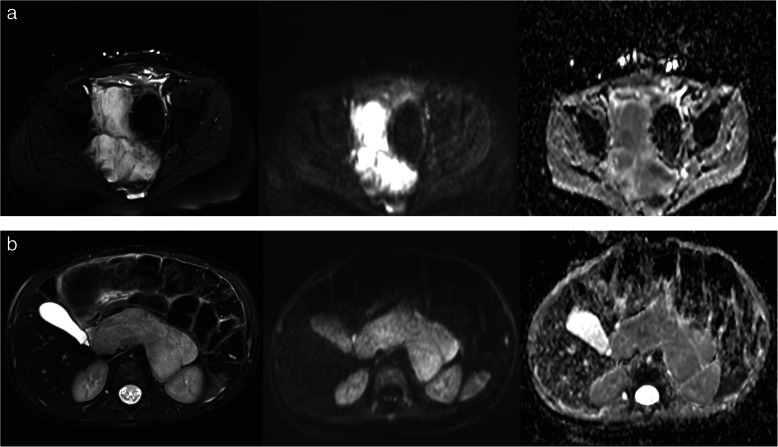
Pediatric patients who underwent surgical resection of neuroblastic tumors at our institution from 2013 to 2019 and who received a preoperative MRI scan with DWI after chemotherapy were included. Tumor volume was assessed with a semi-automated approach in DWI using a dedicated software prototype. Quantitative ADC values were calculated automatically of the total tumor volume after manual exclusion of necrosis. Manual segmentation in T1 weighted and T2 weighted sequences was used as reference standard for tumor volume comparison. The Student's t test was used for parametric data while the Wilcoxon rank sum test and the Kruskal-Wallis test were applied for non-parametric data.
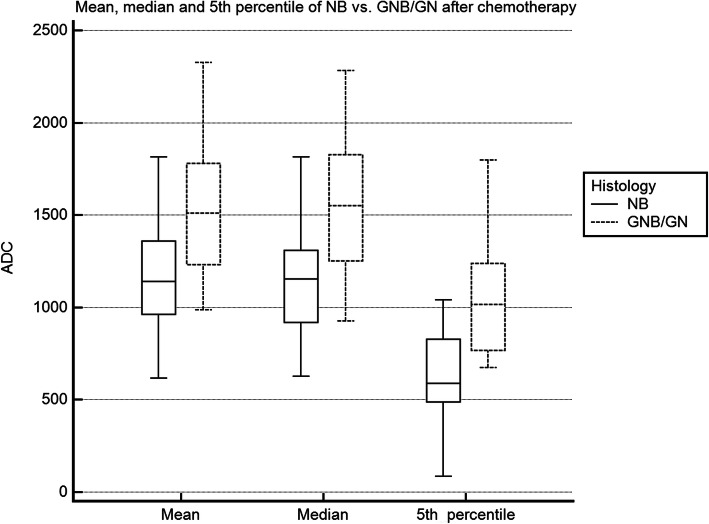
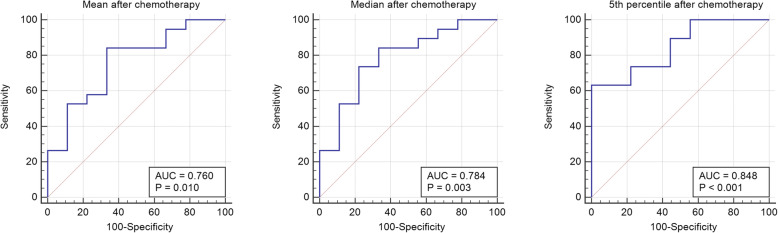
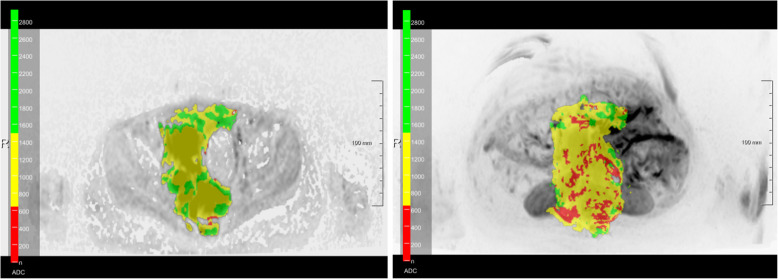
Twenty seven patients with 28 lesions (neuroblastoma (NB): n = 19, ganglioneuroblastoma (GNB): n = 7, ganglioneuroma (GN): n = 2) could be evaluated. Mean patient age was 4.5 ± 3.2 years. Median volume of standard volumetry (T1w or T2w) was 50.2 ml (interquartile range (IQR): 91.9 ml) vs. 45.1 ml (IQR: 98.4 ml) of DWI (p = 0.145). Mean ADC values (× 10 mm/s) of the total tumor volume (without necrosis) were 1187 ± 301 in NB vs. 1552 ± 114 in GNB/GN (p = 0.037). The 5th percentile of ADC values of NB (614 ± 275) and GNB/GN (1053 ± 362) provided the most significant difference (p = 0.007) with an area under the curve of 0.848 (p < 0.001).
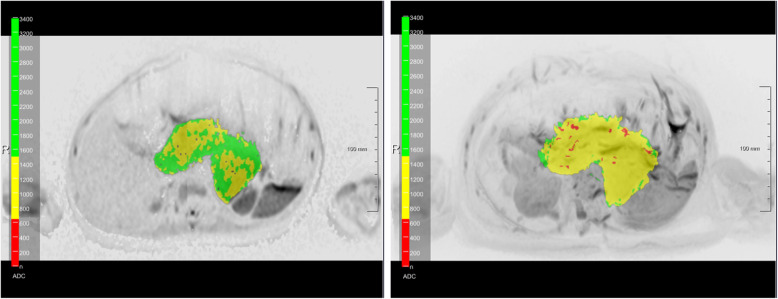
Quantitative semi-automated DWI volumetry is feasible in neuroblastic tumors with integrated analysis of tissue characteristics by providing automatically calculated ADC values of the whole tumor as well as an ADC heatmap. The 5th percentile of the ADC values of the whole tumor volume proved to be the most significant parameter for differentiation of the histopathological subtypes in our patient cohort and further investigation seems to be worthwhile.
评估新辅助化疗后表观扩散系数(ADC)图评估的半自动化扩散加权成像(DWI)全神经母细胞瘤容积测量的可行性和可能价值。
本研究纳入了 2013 年至 2019 年在我院行手术切除神经母细胞瘤的儿科患者,并在化疗前行 MRI 扫描,包括 DWI。使用专用软件原型在 DWI 中采用半自动方法评估肿瘤体积。在手动排除坏死后,自动计算总肿瘤体积的定量 ADC 值。T1 加权和 T2 加权序列的手动分割被用作肿瘤体积比较的参考标准。参数数据采用学生 t 检验,非参数数据采用 Wilcoxon 秩和检验和 Kruskal-Wallis 检验。
共 27 例 28 处病变(神经母细胞瘤(NB):n=19,神经节母细胞瘤(GNB):n=7,神经节细胞瘤(GN):n=2)可进行评估。患者平均年龄为 4.5±3.2 岁。标准容积测量(T1w 或 T2w)的中位数体积为 50.2ml(四分位距(IQR):91.9ml),而 DWI 为 45.1ml(IQR:98.4ml)(p=0.145)。总肿瘤体积(无坏死)的平均 ADC 值(×10mm/s)在 NB 中为 1187±301,在 GNB/GN 中为 1552±114(p=0.037)。NB(614±275)和 GNB/GN(1053±362)的 ADC 值的第 5 百分位数差异最大(p=0.007),曲线下面积为 0.848(p<0.001)。
半自动化 DWI 容积测量在神经母细胞瘤中是可行的,通过对整个肿瘤进行组织特征的综合分析,可以提供自动计算的 ADC 值以及 ADC 热图。在我们的患者队列中,整个肿瘤体积 ADC 值的第 5 百分位数被证明是区分组织学亚型的最显著参数,进一步的研究似乎是值得的。