Hospital Federal dos Servidores do Estado, Ministry of Health, Av. Atlantica 434 - 1101, Rio de Janeiro - CEP, 22010-000, Brazil.
Institute of Psychiatry, Federal University of Rio de Janeiro, Rio de Janeiro, Brazil.
Transl Psychiatry. 2019 Jan 31;9(1):51. doi: 10.1038/s41398-019-0370-4.
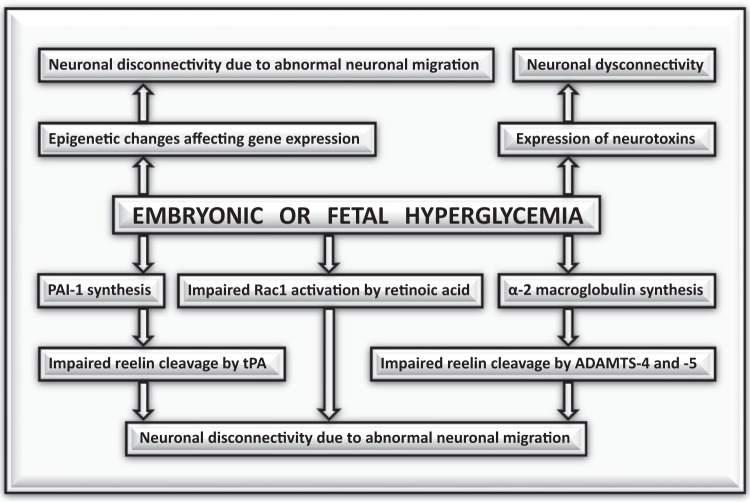
Autism spectrum disorders (ASD) are characterized by disconnectivity due to disordered neuronal migration, and by neuronal mitochondrial dysfunction. Different pathways involved in neuronal migration are affected by intrauterine hyperglycemia and hyperinsulinemia, while prolonged neonatal hypoglycemia may cause mitochondrial dysfunction. Our hypothesis was that conditions leading to intrauterine hyperglycemia or neonatal hypoglycemia would influence ASD pathogenesis. In this study, we identified risk factors for ASD by searching PubMed with the MeSH terms "autism spectrum disorder" and "risk factors". We then analyzed the relationship between the risk factors and glucose abnormalities in the mother and the offspring. The relationship between glucose abnormalities and risk factors such as obesity, excessive maternal weight gain, or diabetes mellitus is evident. For risk factors such as malformations or exposure to selective serotonin reuptake inhibitors, the relationship is speculative. In rodents, for example, intrauterine hyperglycemia is associated with malformations, independent of maternal diabetes. In their turn, selective serotonin reuptake inhibitors reduce the signs of neonatal hypoglycemia. Going undetected, prolonged hypoglycemia may harm the neonatal brain. Importantly, our group demonstrated that either high-carbohydrate diets or physical inactivity the day before delivery may influence neonatal glycemia. In that study, of 158 neonates selected to be screened according to maternal lifestyle risk factors, 48 had hypoglycemia. Of note, five of them had not been identified with current screening programs. Controlled studies are needed to clarify whether maternal interventions aiming at maintaining glycemic control, together with screening programs for neonatal hypoglycemia based on maternal lifestyle risk factors and on exposure to specific prenatal medications can reduce the prevalence of ASD.
自闭症谱系障碍(ASD)的特征是由于神经元迁移紊乱和神经元线粒体功能障碍导致的连接断开。参与神经元迁移的不同途径受宫内高血糖和高胰岛素血症的影响,而新生儿期长时间低血糖可能导致线粒体功能障碍。我们的假设是,导致宫内高血糖或新生儿低血糖的情况会影响 ASD 的发病机制。在这项研究中,我们通过使用 MeSH 术语“自闭症谱系障碍”和“风险因素”在 PubMed 中搜索,确定了 ASD 的风险因素。然后,我们分析了母亲和后代的风险因素与葡萄糖异常之间的关系。肥胖、母亲体重过度增加或糖尿病等葡萄糖异常与风险因素之间的关系是明显的。对于畸形或暴露于选择性 5-羟色胺再摄取抑制剂等风险因素,其关系是推测性的。例如,在啮齿动物中,宫内高血糖与畸形有关,与母体糖尿病无关。反过来,选择性 5-羟色胺再摄取抑制剂可减轻新生儿低血糖的迹象。未被发现的长时间低血糖可能会损害新生儿的大脑。重要的是,我们的研究小组表明,分娩前一天的高碳水化合物饮食或不运动可能会影响新生儿的血糖水平。在那项研究中,在根据母亲生活方式风险因素选择的 158 名新生儿中,有 48 名出现低血糖。值得注意的是,其中有 5 名没有被现行的筛查方案发现。需要进行对照研究,以明确旨在维持血糖控制的母亲干预措施,以及基于母亲生活方式风险因素和特定产前药物暴露的新生儿低血糖筛查计划是否可以降低 ASD 的患病率。